



 Chat with AI
Exam 4: Upper Limb

Exam 1: Preliminary Steps in Radiography33 Questions
Exam 2: Compensating Filters14 Questions
Exam 3: General Anatomy and Radiographic Positioning Terminology101 Questions
Exam 4: Upper Limb125 Questions
Exam 5: Shoulder Girdle92 Questions
Exam 6: Lower Limb143 Questions
Exam 7: Pelvis and Upper Femora53 Questions
Exam 8: Vertebral Column175 Questions
Exam 9: Bony Thorax58 Questions
Exam 10: Thoracic Viscera74 Questions
Exam 11: Long Bone Measurement10 Questions
Exam 12: Contrast Arthrography5 Questions
Exam 13: Trauma Radiography10 Questions
Exam 14: Mouth and Salivary Glands10 Questions
Exam 15: Anterior Part of Neck9 Questions
Exam 16: Abdomen30 Questions
Exam 17: Digestive System: Alimentary Canal130 Questions
Exam 18: Urinary System and Venipuncture96 Questions
Exam 19: Reproductive System11 Questions
Exam 20: Skull, Facial Bones, and Paranasal Sinuses196 Questions
Exam 21: Mammography35 Questions
Exam 22: Central Nervous System15 Questions
Exam 23: Vascular, Cardiac, and Interventional Radiography40 Questions
Exam 24: Pediatric Imaging20 Questions
Exam 25: Geriatric Radiography18 Questions
Exam 26: Mobile Radiography20 Questions
Exam 27: Surgical Radiography10 Questions
Exam 28: Sectional Anatomy for Radiographers30 Questions
Exam 29: Computed Tomography16 Questions
Exam 30: Magnetic Resonance Imaging21 Questions
Exam 31: Diagnostic Ultrasound14 Questions
Exam 32: Nuclear Medicine18 Questions
Exam 33: Bone Densitometry18 Questions
Exam 34: Radiation Oncology20 Questions
Select questions type


The first bone located on the proximal row and lateral side of the wrist is called the:
(Multiple Choice)
4.9/5  (91)
(91) Which of the following breathing techniques should be used for an AP projection of the humerus?
(Multiple Choice)
4.9/5 (84)
(84) The central-ray angle for a PA oblique projection of the wrist is _____ degrees.
(Multiple Choice)
4.9/5 (96)
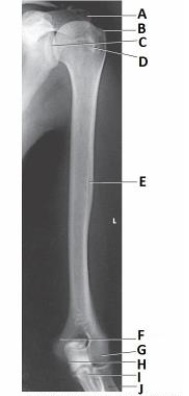
(96) 
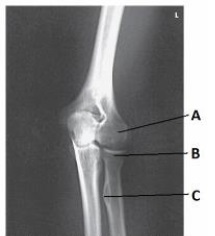
Which of the following is the primary projection used to demonstrate anterior or posterior displacement of fractures of the hand or wrist?
(Multiple Choice)
4.9/5 (104)
(104) The position recommended to increase patient comfort when performing an AP projection of the humerus is:
(Multiple Choice)
4.8/5 (93)
(93) The shallow depression, located on the anterior side of the distal humerus, receives which of the following when the elbow is flexed?
(Multiple Choice)
4.8/5 (82)
(82) 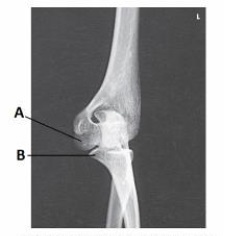
The PA oblique projection of the wrist in lateral rotation requires a wrist angulation of _____ degrees.
(Multiple Choice)
5.0/5 (63)
(63) Which of the following projections would be used to better demonstrate the carpal interspaces?
(Multiple Choice)
5.0/5 (97)
(97) How many degrees is the central ray angled for the AP forearm?
(Multiple Choice)
4.8/5 (83)
(83) The IR must be elevated how many degrees for the PA axial projection of the wrist (Stecher method)?
(Multiple Choice)
4.8/5 (79)
(79) The central-ray angulation for the PA projection of the hand is _____ degrees.
(Multiple Choice)
4.9/5 (77)
(77) The PA axial projection of the wrist (Stecher method) clearly demonstrates the:
(Multiple Choice)
4.8/5 (66)
(66) For the AP projection of the thumb, Lewis suggests angling the central ray toward the wrist to demonstrate the first metacarpal free of the sesamoids and of the soft tissue of the palm. What is the suggested central-ray angle?
(Multiple Choice)
5.0/5 (81)
(81) To demonstrate the radial head in the axiolateral projection of the elbow (Coyle method), the elbow is flexed _____ degrees.
(Multiple Choice)
4.8/5 (89)
(89) What projection and anatomy is demonstrated in the image below?
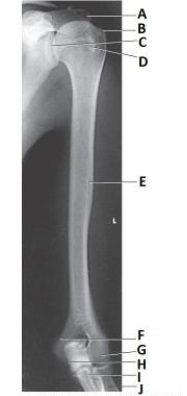
(Multiple Choice)
4.8/5 (63)
(63) 
Filters
- Essay(0)
- Multiple Choice(0)
- Short Answer(0)
- True False(0)
- Matching(0)