



 Chat with AI
Exam 6: Lower Limb

Exam 1: Preliminary Steps in Radiography33 Questions
Exam 2: Compensating Filters14 Questions
Exam 3: General Anatomy and Radiographic Positioning Terminology101 Questions
Exam 4: Upper Limb125 Questions
Exam 5: Shoulder Girdle92 Questions
Exam 6: Lower Limb143 Questions
Exam 7: Pelvis and Upper Femora53 Questions
Exam 8: Vertebral Column175 Questions
Exam 9: Bony Thorax58 Questions
Exam 10: Thoracic Viscera74 Questions
Exam 11: Long Bone Measurement10 Questions
Exam 12: Contrast Arthrography5 Questions
Exam 13: Trauma Radiography10 Questions
Exam 14: Mouth and Salivary Glands10 Questions
Exam 15: Anterior Part of Neck9 Questions
Exam 16: Abdomen30 Questions
Exam 17: Digestive System: Alimentary Canal130 Questions
Exam 18: Urinary System and Venipuncture96 Questions
Exam 19: Reproductive System11 Questions
Exam 20: Skull, Facial Bones, and Paranasal Sinuses196 Questions
Exam 21: Mammography35 Questions
Exam 22: Central Nervous System15 Questions
Exam 23: Vascular, Cardiac, and Interventional Radiography40 Questions
Exam 24: Pediatric Imaging20 Questions
Exam 25: Geriatric Radiography18 Questions
Exam 26: Mobile Radiography20 Questions
Exam 27: Surgical Radiography10 Questions
Exam 28: Sectional Anatomy for Radiographers30 Questions
Exam 29: Computed Tomography16 Questions
Exam 30: Magnetic Resonance Imaging21 Questions
Exam 31: Diagnostic Ultrasound14 Questions
Exam 32: Nuclear Medicine18 Questions
Exam 33: Bone Densitometry18 Questions
Exam 34: Radiation Oncology20 Questions
Select questions type


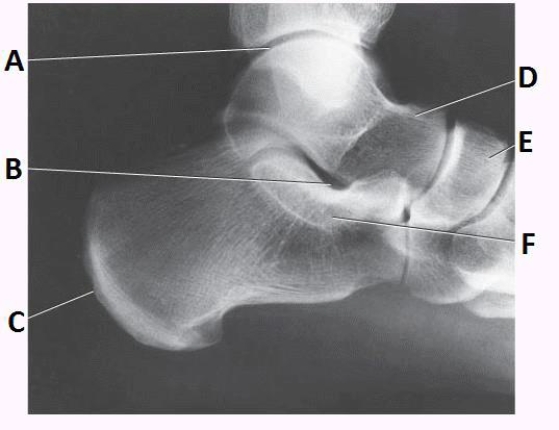
The anatomy labeled with letter F in the image below is the:
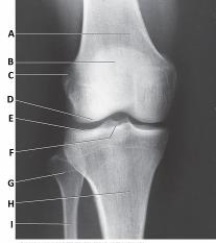
(Multiple Choice)
4.9/5  (80)
(80) The incomplete separation or avulsion of the tibial tuberosity is known as:
(Multiple Choice)
4.9/5 (86)
(86) Posteriorly, the femoral condyles are separated by a deep depression called the:
(Multiple Choice)
4.8/5 (75)
(75) Which of the following is the essential method of demonstrating the patella in the tangential projection?
(Multiple Choice)
4.8/5 (85)
(85) Which of the following objects should be available in the radiography room for performing radiographs of the lower limb?
1)Angle sponges
2)Sandbags
3)Pull straps
(Multiple Choice)
4.9/5 (82)
(82) What is the projection and anatomy of interest in the image below?
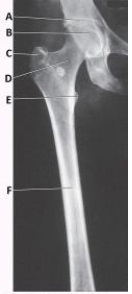
(Multiple Choice)
4.9/5 (87)
(87) If the knee is flexed 40 degrees for the PA axial intercondylar fossa (Camp-Coventry) projection, the central ray will be angled _____ degrees.
(Multiple Choice)
4.9/5 (90)
(90) Which of the following is clearly demonstrated on an AP oblique projection of the knee in medial rotation?
(Multiple Choice)
4.7/5 (71)
(71) What is the central-ray direction needed to produce the image below?
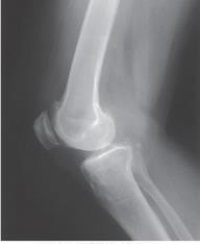
(Multiple Choice)
4.8/5 (77)
(77) Which of the following will ensure that the knee is in proper position for a lateral projection?
1)Epicondyles perpendicular to the IR
2)Patella perpendicular to the IR
3)Leg flexed 20 to 30 degrees
(Multiple Choice)
4.8/5 (82)
(82) The central-ray angulation for an AP oblique projection of the ankle is:
(Multiple Choice)
4.8/5 (77)
(77) The anatomy labeled with letter E in the image below is the:
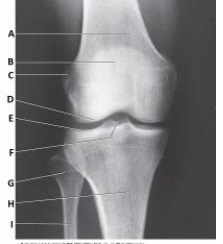
(Multiple Choice)
4.9/5 (80)
(80) Which projection will clearly demonstrate the joint spaces between the talus and both malleoli?
(Multiple Choice)
4.9/5 (91)
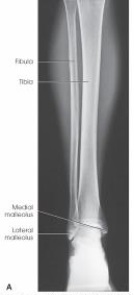
(91) What is needed to complete the projection of the leg in the image below?
(Multiple Choice)
4.9/5 (81)
(81) 
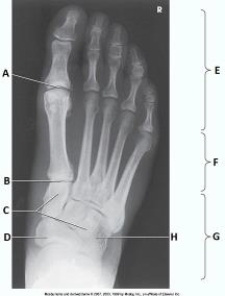
For a lateral projection of the ankle, the central ray must enter the:
(Multiple Choice)
4.9/5 (68)
(68) The most commonly performed oblique projection of the foot is the _____ oblique in _____.
(Multiple Choice)
4.9/5 (67)
(67) How many degrees should the limb be internally rotated for an AP projection of the femur?
(Multiple Choice)
4.9/5 (84)
(84) 
Filters
- Essay(0)
- Multiple Choice(0)
- Short Answer(0)
- True False(0)
- Matching(0)