



 Chat with AI
Exam 20: Skull, Facial Bones, and Paranasal Sinuses

Exam 1: Preliminary Steps in Radiography33 Questions
Exam 2: Compensating Filters14 Questions
Exam 3: General Anatomy and Radiographic Positioning Terminology101 Questions
Exam 4: Upper Limb125 Questions
Exam 5: Shoulder Girdle92 Questions
Exam 6: Lower Limb143 Questions
Exam 7: Pelvis and Upper Femora53 Questions
Exam 8: Vertebral Column175 Questions
Exam 9: Bony Thorax58 Questions
Exam 10: Thoracic Viscera74 Questions
Exam 11: Long Bone Measurement10 Questions
Exam 12: Contrast Arthrography5 Questions
Exam 13: Trauma Radiography10 Questions
Exam 14: Mouth and Salivary Glands10 Questions
Exam 15: Anterior Part of Neck9 Questions
Exam 16: Abdomen30 Questions
Exam 17: Digestive System: Alimentary Canal130 Questions
Exam 18: Urinary System and Venipuncture96 Questions
Exam 19: Reproductive System11 Questions
Exam 20: Skull, Facial Bones, and Paranasal Sinuses196 Questions
Exam 21: Mammography35 Questions
Exam 22: Central Nervous System15 Questions
Exam 23: Vascular, Cardiac, and Interventional Radiography40 Questions
Exam 24: Pediatric Imaging20 Questions
Exam 25: Geriatric Radiography18 Questions
Exam 26: Mobile Radiography20 Questions
Exam 27: Surgical Radiography10 Questions
Exam 28: Sectional Anatomy for Radiographers30 Questions
Exam 29: Computed Tomography16 Questions
Exam 30: Magnetic Resonance Imaging21 Questions
Exam 31: Diagnostic Ultrasound14 Questions
Exam 32: Nuclear Medicine18 Questions
Exam 33: Bone Densitometry18 Questions
Exam 34: Radiation Oncology20 Questions
Select questions type


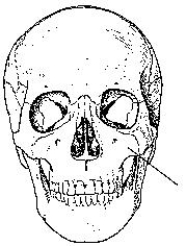
The OML forms an angle of how many degrees from the plane of the image receptor for an open-mouth parietoacanthial (Waters method) projection?
(Multiple Choice)
4.9/5  (76)
(76) 
At which level should the central ray enter the base of the skull for the SMV projection of the sinuses?
(Multiple Choice)
4.8/5 (76)
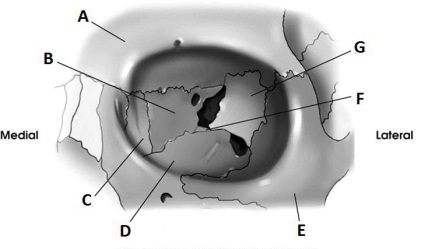
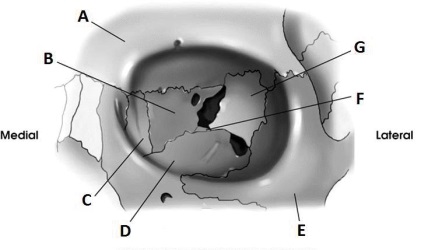
(76) Which facial bone contains a foramen through which the tear duct passes?
(Multiple Choice)
4.9/5 (90)
(90) 
The letter F in the image below of the paranasal sinuses labels the:
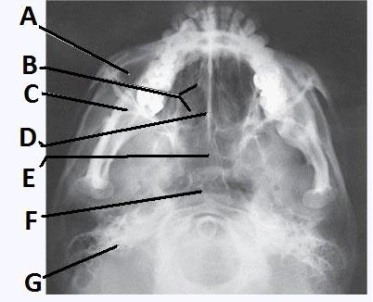
(Multiple Choice)
4.8/5 (71)
(71) The cranial bones are rigidly jointed together by articulations called:
(Multiple Choice)
4.8/5 (66)
(66) 
Which of the following should be clearly demonstrated on a lateral projection of the paranasal sinus?
1)All four sinus groups
2)Superimposed orbital roofs
3)Superimposed mandibular rami
(Multiple Choice)
4.9/5 (84)
(84) Which of the following lines is placed as nearly parallel to the image receptor as possible for the SMV projection of the zygomatic arches?
(Multiple Choice)
5.0/5 (83)
(83) Which of the following lines is placed perpendicular to the image receptor plane for the AP axial (Towne) projection?
(Multiple Choice)
5.0/5 (85)
(85) Often a patient cannot be turned into the prone position for a PA axial projection of the skull (Caldwell method). What central-ray angle would be used if the AP axial projection is used instead?
(Multiple Choice)
5.0/5 (85)
(85) The letter C in the image below of the paranasal sinuses labels the:
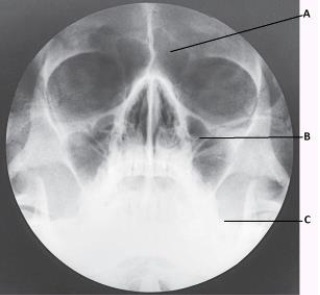
(Multiple Choice)
4.9/5 (75)
(75) What is the central-ray angulation for the PA axial projection of the mandibular rami?
(Multiple Choice)
4.9/5 (85)
(85) 
Filters
- Essay(0)
- Multiple Choice(0)
- Short Answer(0)
- True False(0)
- Matching(0)