



 Chat with AI
Exam 20: Skull, Facial Bones, and Paranasal Sinuses

Exam 1: Preliminary Steps in Radiography33 Questions
Exam 2: Compensating Filters14 Questions
Exam 3: General Anatomy and Radiographic Positioning Terminology101 Questions
Exam 4: Upper Limb125 Questions
Exam 5: Shoulder Girdle92 Questions
Exam 6: Lower Limb143 Questions
Exam 7: Pelvis and Upper Femora53 Questions
Exam 8: Vertebral Column175 Questions
Exam 9: Bony Thorax58 Questions
Exam 10: Thoracic Viscera74 Questions
Exam 11: Long Bone Measurement10 Questions
Exam 12: Contrast Arthrography5 Questions
Exam 13: Trauma Radiography10 Questions
Exam 14: Mouth and Salivary Glands10 Questions
Exam 15: Anterior Part of Neck9 Questions
Exam 16: Abdomen30 Questions
Exam 17: Digestive System: Alimentary Canal130 Questions
Exam 18: Urinary System and Venipuncture96 Questions
Exam 19: Reproductive System11 Questions
Exam 20: Skull, Facial Bones, and Paranasal Sinuses196 Questions
Exam 21: Mammography35 Questions
Exam 22: Central Nervous System15 Questions
Exam 23: Vascular, Cardiac, and Interventional Radiography40 Questions
Exam 24: Pediatric Imaging20 Questions
Exam 25: Geriatric Radiography18 Questions
Exam 26: Mobile Radiography20 Questions
Exam 27: Surgical Radiography10 Questions
Exam 28: Sectional Anatomy for Radiographers30 Questions
Exam 29: Computed Tomography16 Questions
Exam 30: Magnetic Resonance Imaging21 Questions
Exam 31: Diagnostic Ultrasound14 Questions
Exam 32: Nuclear Medicine18 Questions
Exam 33: Bone Densitometry18 Questions
Exam 34: Radiation Oncology20 Questions
Select questions type


Which of the following is (are) clearly demonstrated on an SMV projection of the cranial base?
1)Mastoid process
2)Sphenoid process
3)Carotid canals
(Multiple Choice)
4.9/5  (87)
(87) When using the angled grid technique for the PA axial (Caldwell method) projection of the sinuses, the vertical grid device must be angled _____ degrees.
(Multiple Choice)
4.9/5 (84)
(84) 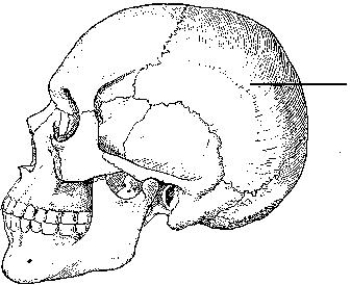
Which part of the patient's face is touching the upright bucky, or table, for a parietoacanthial projection (Waters method)?
(Multiple Choice)
4.7/5 (88)
(88) Which of the following is true regarding the placement of the image receptor for an AP axial (Towne) projection of the skull?
1)Its upper margin is at the level of the top of the cranium.
2)Its upper margin is 2 inches above the top of the cranium.
3)Its upper margin is 2 inches below the top of the cranium.
(Multiple Choice)
4.9/5 (90)
(90) Which of the following should be seen superimposed on a lateral image of the skull?
1)Orbital roofs
2)External acoustic meati
3)Temporomandibular joints
(Multiple Choice)
4.8/5 (78)
(78) The letter A in the image below of the paranasal sinuses labels the _____ sinuses.
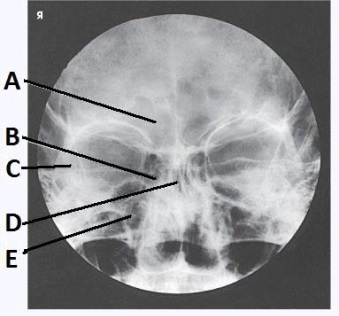
(Multiple Choice)
4.8/5 (61)
(61) Which of the following is centered to the image receptor for a parietoacanthial projection of the facial bones?
(Multiple Choice)
4.9/5 (92)
(92) For the open-mouth modification of the Waters method, the central ray should exit the:
(Multiple Choice)
4.8/5 (75)
(75) What is the average central-ray angulation for the PA axial (Haas) projection of the skull?
(Multiple Choice)
4.8/5 (73)
(73) What is the projection (method) demonstrated in the image below used to evaluate trauma to the orbit?
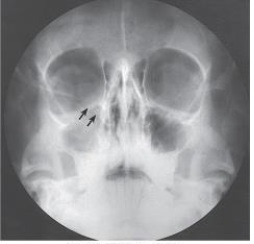
(Multiple Choice)
4.8/5 (71)
(71) Which of the following foramina will be demonstrated in the orbit on a parietoacanthial (Waters method) radiograph?
(Multiple Choice)
4.8/5 (78)
(78) The letter C in the image below of the paranasal sinuses labels the:
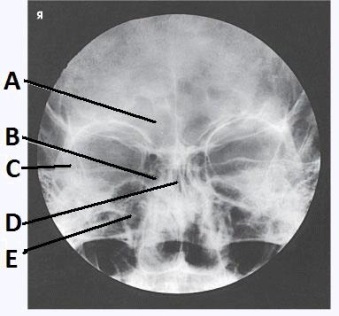
(Multiple Choice)
4.9/5 (79)
(79) What is the central-ray angulation for the AP axial projection of the zygomatic arches?
(Multiple Choice)
5.0/5 (77)
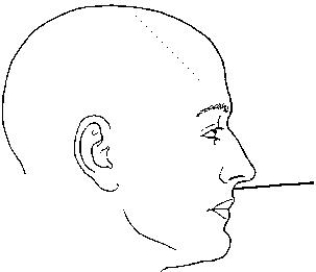
(77) 

Filters
- Essay(0)
- Multiple Choice(0)
- Short Answer(0)
- True False(0)
- Matching(0)