



 Chat with AI
Exam 1: Nutrition Basics

Exam 1: Nutrition Basics80 Questions
Exam 2: Preconception Nutrition80 Questions
Exam 3: Preconception Nutrition Conditions and Interventions80 Questions
Exam 4: Nutrition During Pregnancy80 Questions
Exam 5: Nutrition During Pregnancy Conditions and Interventions80 Questions
Exam 6: Nutrition During Lactation80 Questions
Exam 7: Nutrition During Lactation Conditions and Interventions80 Questions
Exam 8: Infant Nutrition80 Questions
Exam 9: Infant Nutrition Conditions and Interventions80 Questions
Exam 10: Toddler and Preschooler Nutrition88 Questions
Exam 11: Toddler and Preschooler Nutrition Conditions and Interventions80 Questions
Exam 12: Child and Preadolescent Nutrition80 Questions
Exam 13: Child and Preadolescent Nutrition Conditions and Interventions80 Questions
Exam 14: Adolescent Nutrition79 Questions
Exam 15: Adolescent Nutrition Conditions and Interventions80 Questions
Exam 16: Adult Nutrition80 Questions
Exam 17: Adult Nutrition Conditions and Interventions80 Questions
Exam 18: Nutrition and Older Adults80 Questions
Exam 19: Nutrition and Older Adults Conditions and Interventions80 Questions
Select questions type


Which disorder is characterized by high levels of the amino acid phenylalanine in the blood and can lead to intellectual disability,poor growth,and other problems?
(Multiple Choice)
5.0/5  (83)
(83) Nutrient-dense foods have _____ levels of nutrients and _____ calorie values.
(Multiple Choice)
5.0/5 (92)
(92) The balance of fluids,nutrients,gases,temperature,and other conditions needed to ensure proper functioning of cells is known as _____.
(Multiple Choice)
4.8/5 (70)
(70) A 65-year-old woman is buying an iron supplement for her "weak blood." She asks the pharmacist to advise her on the highest amount that she should take daily.What dietary intake standards could the pharmacist use to provide the best recommendation?
(Multiple Choice)
4.8/5 (68)
(68) A dietary supplement can legally claim to treat,cure,or prevent a disease.
(True/False)
4.7/5 (94)
(94) Individuals are 99.9 percent genetically identical,but the 0.1 percent difference in genetic codes makes everyone unique.
(True/False)
5.0/5 (76)
(76) 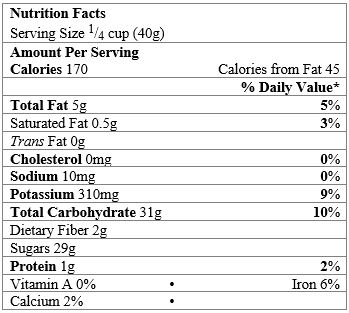 -Which mandatory nutrient is missing from the food label?
What terms refers to the repeated use of questions that hone the accuracy of information provided by interviewees about the food they ate the previous day?
(Multiple Choice)
4.8/5 (83)
(83) 
Filters
- Essay(0)
- Multiple Choice(0)
- Short Answer(0)
- True False(0)
- Matching(0)