



 Chat with AI
Exam 15: Fiscal Policy

Exam 1: Introducing the Economic Way of Thinking254 Questions
Exam 2: Production Possibilities, Opportunity Cost, and Economic Growth209 Questions
Exam 3: Market Demand and Supply361 Questions
Exam 4: Markets in Action259 Questions
Exam 5: Price Elasticity of Demand181 Questions
Exam 6: Production Costs254 Questions
Exam 7: Perfect Competition226 Questions
Exam 8: Monopoly175 Questions
Exam 9: Monopolistic Competition and Oligopoly166 Questions
Exam 10: Labor Markets and Income Distribution185 Questions
Exam 11: Gross Domestic Product207 Questions
Exam 12: Business Cycles and Unemployment199 Questions
Exam 13: Inflation131 Questions
Exam 14: Aggregate Demand and Supply83 Questions
Exam 15: Fiscal Policy205 Questions
Exam 16: The Public Sector131 Questions
Exam 17: Federal Deficits, Surpluses, and the National Debt102 Questions
Exam 18: Money and the Federal Reserve System159 Questions
Exam 19: Money Creation250 Questions
Exam 20: Policy Disputes Using the Self-Correcting Aggregate Demand and Supply Model246 Questions
Exam 21: International Trade and Finance251 Questions
Exam 22: Economies in Transition108 Questions
Exam 23: Growth and the Less-Developed Countries121 Questions
Select questions type


The government wishes to close an inflationary gap by reducing real GDP by $400 billion. Assuming a tax multiplier of 4 and an income multiplier of 5, which of the following policy prescriptions would reduce the inflationary gap by $400 billion?
(Multiple Choice)
5.0/5  (85)
(85) Those who favor government policies to stimulate the economy by creating incentives for individuals and businesses to increase their productive efforts are supporting:
(Multiple Choice)
4.8/5 (83)
(83) An increase in the marginal propensity to consume (MPC) leads to a increase in the spending multiplier.
(True/False)
4.8/5 (85)
(85) Supply-side fiscal policies were advocated by the Reagan administration.
(True/False)
4.9/5 (77)
(77) If an economy were experiencing a high rate of unemployment as the result of insufficient aggregate demand, a Keynesian economist would favor:
(Multiple Choice)
4.8/5 (97)
(97) An advocate of supply-side fiscal policy would advocate which of the following?
(Multiple Choice)
4.8/5 (87)
(87) Exhibit 15-7 Aggregate demand and supply model 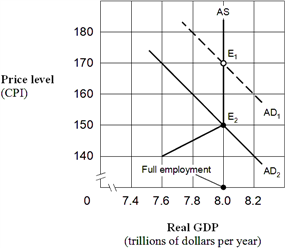 Suppose the economy in Exhibit 15-7 is in equilibrium at point E1 and the marginal propensity to consume ( MPC ) is 0.75. Following Keynesian economics, to lower the price level from 170 to 150 the government should raise taxes by:
 (Multiple Choice)
4.9/5 (68)
(68) A government spending and taxation policy to achieve macroeconomic goals is known as:
(Multiple Choice)
4.8/5 (79)
(79) Assume the economy is in recession and real GDP is below full employment. The marginal propensity to consume (MPC) is 0.75, and the government follows Keynesian economics by using expansionary fiscal policy to increase aggregate demand (total spending). If an increase of $1,000 billion aggregate demand can restore full employment, the government should:
(Multiple Choice)
4.8/5 (88)
(88) Following Keynesian economics, and assuming a marginal propensity to consume (MPC) of 0.80, an increase in federal government spending of $100 billion at below full employment would be expected to shift the aggregate demand curve by $500 billion to the right.
(True/False)
4.8/5 (87)
(87) Exhibit 15-2 Aggregate demand and supply model  Suppose the economy in Exhibit 15-2 is in equilibrium at point E1 and the marginal propensity to consume (MPC) is 0.75. Following Keynesian economics, the federal government can move the economy to full employment at point E2 by:
 (Multiple Choice)
4.9/5 (71)
(71) If your income increases from $40,000 to $48,000 and your consumption increases from $35,000 to $39,000, your marginal propensity to consume (MPC) is:
(Multiple Choice)
4.7/5 (77)
(77) A tax multiplier equal to − 4.30 would imply that a $100 tax increase would lead to a:
(Multiple Choice)
4.9/5 (90)
(90) The change in consumption divided by a change in income is defined as:
(Multiple Choice)
4.9/5 (79)
(79) It is inflationary for government to increase spending if:
(Multiple Choice)
5.0/5 (76)
(76) Appropriate supply-side policy (or policies) during a recession would be to do which of the following?
(Multiple Choice)
4.9/5 (90)
(90) 
Filters
- Essay(0)
- Multiple Choice(0)
- Short Answer(0)
- True False(0)
- Matching(0)