



 Chat with AI
Exam 15: Fiscal Policy

Exam 1: Introducing the Economic Way of Thinking254 Questions
Exam 2: Production Possibilities, Opportunity Cost, and Economic Growth209 Questions
Exam 3: Market Demand and Supply361 Questions
Exam 4: Markets in Action259 Questions
Exam 5: Price Elasticity of Demand181 Questions
Exam 6: Production Costs254 Questions
Exam 7: Perfect Competition226 Questions
Exam 8: Monopoly175 Questions
Exam 9: Monopolistic Competition and Oligopoly166 Questions
Exam 10: Labor Markets and Income Distribution185 Questions
Exam 11: Gross Domestic Product207 Questions
Exam 12: Business Cycles and Unemployment199 Questions
Exam 13: Inflation131 Questions
Exam 14: Aggregate Demand and Supply83 Questions
Exam 15: Fiscal Policy205 Questions
Exam 16: The Public Sector131 Questions
Exam 17: Federal Deficits, Surpluses, and the National Debt102 Questions
Exam 18: Money and the Federal Reserve System159 Questions
Exam 19: Money Creation250 Questions
Exam 20: Policy Disputes Using the Self-Correcting Aggregate Demand and Supply Model246 Questions
Exam 21: International Trade and Finance251 Questions
Exam 22: Economies in Transition108 Questions
Exam 23: Growth and the Less-Developed Countries121 Questions
Select questions type


If no fiscal policy changes are implemented to fight inflation, suppose the aggregate demand curve will exceed the current aggregate demand curve by $900 billion at any level of prices. Assuming the marginal propensity to consume is 0.90, this increase in aggregate demand could be prevented by:
(Multiple Choice)
4.9/5  (85)
(85) In the U.S. economy, the effect on federal tax revenues and spending of an increase in the unemployment rate is to:
(Multiple Choice)
4.8/5 (79)
(79) "Last month unemployment fell to 4 percent, its lowest level in years. The economy is growing rapidly, but consumer prices have risen at an annual rate of 10 percent during the last six months." Which of the following policies would be most appropriate under these circumstances?
(Multiple Choice)
4.8/5 (85)
(85) If MPC = 0.80, how much should government spending change to increase real GDP by $500?
(Multiple Choice)
4.8/5 (69)
(69) The Laffer curve represents the relationship between real GDP and various possible tax rates.
(True/False)
4.8/5 (67)
(67) Automatic stabilizers combine changes in discretionary fiscal policy with changes in government spending and taxes influenced by the business cycle in order to stabilize the economy.
(True/False)
5.0/5 (89)
(89) Exhibit 15-6 Aggregate demand and supply model 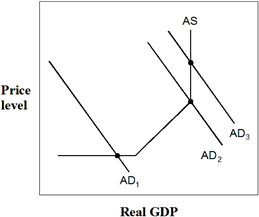 In Exhibit 15-6, if the aggregate demand curve is at AD2 , the government should:
 (Multiple Choice)
4.7/5 (77)
(77) Which of the following is the best example of an automatic stabilizer?
(Multiple Choice)
4.7/5 (82)
(82) Following Keynesian economics, and assuming a marginal propensity to consume (MPC) of 0.75, an increase in federal government spending of $100 billion at below full employment would be expected to shift the aggregate demand curve by $300 billion to the right.
(True/False)
4.8/5 (68)
(68) The presence of the automatic stabilizers means an increase in the budget deficit will be automatically experienced during an economic expansion whereas a budget surplus will be automatically experienced during a recession.
(True/False)
4.9/5 (82)
(82) If the economy is experiencing unemployment, then the most appropriate government policy would be to:
(Multiple Choice)
4.9/5 (80)
(80) The marginal propensity to consume (MPC) is the change in consumption divided by the change in saving.
(True/False)
4.8/5 (78)
(78) If the marginal propensity to consume (MPC) is 0.75, a $50 decrease in government spending, other things being equal, would cause equilibrium real GDP to:
(Multiple Choice)
4.8/5 (81)
(81) The size of the spending multiplier depends on the marginal propensity to consume (MPC).
(True/False)
4.9/5 (80)
(80) If the marginal propensity to consume (MPC) is 0.80, the value of the spending multiplier is:
(Multiple Choice)
5.0/5 (77)
(77) Which economist(s) argued that high tax rates produce less tax revenues and limit the expansion of real GDP and employment?
(Multiple Choice)
4.8/5 (78)
(78) If the marginal propensity to consume (MPC) is 0.80, the value of the spending multiplier is 2.
(True/False)
4.9/5 (76)
(76) 
Filters
- Essay(0)
- Multiple Choice(0)
- Short Answer(0)
- True False(0)
- Matching(0)