



 Chat with AI
Exam 15: Fiscal Policy

Exam 1: Introducing the Economic Way of Thinking254 Questions
Exam 2: Production Possibilities, Opportunity Cost, and Economic Growth209 Questions
Exam 3: Market Demand and Supply361 Questions
Exam 4: Markets in Action259 Questions
Exam 5: Price Elasticity of Demand181 Questions
Exam 6: Production Costs254 Questions
Exam 7: Perfect Competition226 Questions
Exam 8: Monopoly175 Questions
Exam 9: Monopolistic Competition and Oligopoly166 Questions
Exam 10: Labor Markets and Income Distribution185 Questions
Exam 11: Gross Domestic Product207 Questions
Exam 12: Business Cycles and Unemployment199 Questions
Exam 13: Inflation131 Questions
Exam 14: Aggregate Demand and Supply83 Questions
Exam 15: Fiscal Policy205 Questions
Exam 16: The Public Sector131 Questions
Exam 17: Federal Deficits, Surpluses, and the National Debt102 Questions
Exam 18: Money and the Federal Reserve System159 Questions
Exam 19: Money Creation250 Questions
Exam 20: Policy Disputes Using the Self-Correcting Aggregate Demand and Supply Model246 Questions
Exam 21: International Trade and Finance251 Questions
Exam 22: Economies in Transition108 Questions
Exam 23: Growth and the Less-Developed Countries121 Questions
Select questions type


According to Keynesian economics, what impact would a balanced budget amendment to our constitution have on our national economy?
(Essay)
4.8/5  (84)
(84) Suppose the economy is on the classical range of the aggregate supply curve and has a problem with inflation. According to Keynesian theory, which of the following is an appropriate discretionary fiscal policy to use in this situation?
(Multiple Choice)
4.9/5 (81)
(81) The change in consumption divided by a change in income is called the:
(Multiple Choice)
4.8/5 (70)
(70) Automatic stabilizers are government programs that tend to push the federal budget toward surplus as the real GDP rises and toward deficit as the real GDP falls.
(True/False)
4.8/5 (66)
(66) If the marginal propensity to consume (MPC) is 0.50, the value of the spending multiplier is:
(Multiple Choice)
4.8/5 (85)
(85) Exhibit 15-1 Disposable income and consumption data  In Exhibit 15-1, when disposable income is increased from $2,000 to $3,000 to $4,000,
 (Multiple Choice)
4.9/5 (82)
(82) Fiscal policy is the manipulation of government spending and taxes.
(True/False)
4.9/5 (73)
(73) If the spending multiplier is 3 and the desired amount of increase in real GDP is $90 million, then by how much would government spending have to increase?
(Multiple Choice)
4.8/5 (79)
(79) Exhibit 15-7 Aggregate demand and supply model 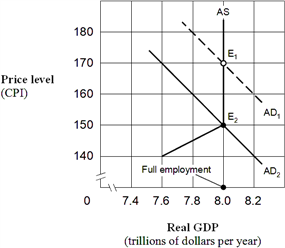 Beginning at equilibrium E1 in Exhibit 15-7, assume the marginal propensity to consume (MPC) is 0.90 and the government increases taxes by $100 billion. The aggregate demand curve will shift to the:
 (Multiple Choice)
5.0/5 (80)
(80) If an inflationary boom exists, the appropriate fiscal policy is to:
(Multiple Choice)
4.7/5 (81)
(81) Which of the following would most likely occur if the federal government increased its spending and enlarged the size of the budget deficit during a period of full employment?
(Multiple Choice)
5.0/5 (71)
(71) Exhibit 15-1 Disposable income and consumption data  In Exhibit 15-1, when disposable income (Y) is increased from $1,000 to $2,000, the marginal propensity to consume is:
 (Multiple Choice)
5.0/5 (59)
(59) Assume the marginal propensity to consume (MPC) is 0.80 and the government cuts taxes by $100 billion. The aggregate demand curve will shift to the:
(Multiple Choice)
4.8/5 (74)
(74) Assume that an economy's real GDP multiplier is 4. If this economy is in equilibrium at $2,000 billion, then which one of the following actions will bring it to a full-employment equilibrium of $1,500 billion?
(Multiple Choice)
4.8/5 (79)
(79) Assume the economy is in recession and real GDP is below full employment. The marginal propensity to consume (MPC) is 0.50, and the government follows Keynesian economics by using expansionary fiscal policy to increase aggregate demand (total spending). If an increase of $1,000 billion aggregate demand can restore full employment, the government should:
(Multiple Choice)
4.9/5 (96)
(96) Exhibit 15-3 Aggregate demand and supply model  Beginning at equilibrium E1 in Exhibit 15-3, when the government increases spending or cuts taxes the economy will experience:
 (Multiple Choice)
4.8/5 (75)
(75) Mathematically, the value of the tax multiplier in terms of the marginal propensity to consume (MPC) is given by the formula:
(Multiple Choice)
4.9/5 (91)
(91) 
Filters
- Essay(0)
- Multiple Choice(0)
- Short Answer(0)
- True False(0)
- Matching(0)