



 Chat with AI
Exam 15: Fiscal Policy

Exam 1: Introducing the Economic Way of Thinking254 Questions
Exam 2: Production Possibilities, Opportunity Cost, and Economic Growth209 Questions
Exam 3: Market Demand and Supply361 Questions
Exam 4: Markets in Action259 Questions
Exam 5: Price Elasticity of Demand181 Questions
Exam 6: Production Costs254 Questions
Exam 7: Perfect Competition226 Questions
Exam 8: Monopoly175 Questions
Exam 9: Monopolistic Competition and Oligopoly166 Questions
Exam 10: Labor Markets and Income Distribution185 Questions
Exam 11: Gross Domestic Product207 Questions
Exam 12: Business Cycles and Unemployment199 Questions
Exam 13: Inflation131 Questions
Exam 14: Aggregate Demand and Supply83 Questions
Exam 15: Fiscal Policy205 Questions
Exam 16: The Public Sector131 Questions
Exam 17: Federal Deficits, Surpluses, and the National Debt102 Questions
Exam 18: Money and the Federal Reserve System159 Questions
Exam 19: Money Creation250 Questions
Exam 20: Policy Disputes Using the Self-Correcting Aggregate Demand and Supply Model246 Questions
Exam 21: International Trade and Finance251 Questions
Exam 22: Economies in Transition108 Questions
Exam 23: Growth and the Less-Developed Countries121 Questions
Select questions type


Assume that we want to drive our economy out of recession by generating a $400 billion change in real GDP. The MPC is 0.80. Which of the following policy prescriptions would generate the targeted $400 billion change in income?
(Multiple Choice)
4.9/5  (83)
(83) To combat a recession, Keynesian fiscal policy recommends:
(Multiple Choice)
4.8/5 (75)
(75) If the marginal propensity to consume (MPC) is 0.75 and if policy makers wish to increase real GDP by $300 million to fight a recession, then by how much would taxes have to change?
(Multiple Choice)
4.9/5 (92)
(92) An advantage of automatic stabilizers is that this type of fiscal policy is not subject to:
(Multiple Choice)
4.9/5 (77)
(77) The Laffer curve is based on the idea that if the tax rate is sufficiently high, then raising it even more will actually reduce total tax revenues. According to Laffer, this happens because the growing tax rates reduce economic activity at an even faster rate.
(True/False)
4.8/5 (68)
(68) If the marginal propensity to consume (MPC) is 0.80, and if policy makers wish to increase real GDP $200 billion, then by how much would they have to change taxes?
(Multiple Choice)
4.7/5 (82)
(82) Supply-side economic policies are designed to shift the aggregate supply curve to the left, whereas Keynesian economic policies focus on shifting the aggregate demand curve to the right during recessions and to the left during economic expansions.
(True/False)
4.9/5 (83)
(83) Assume the marginal propensity to consume (MPC) is 0.75 and the government increases taxes by $250 billion. The aggregate demand curve will shift to the:
(Multiple Choice)
4.8/5 (74)
(74) According to supply-side economists, lowering corporate income taxes:
(Multiple Choice)
4.9/5 (79)
(79) During the Reagan administration, the Laffer curve was used to ague that:
(Multiple Choice)
4.8/5 (87)
(87) If your income increases from $33,000 to $41,000 and your consumption increases from $8,000 to $12,000, your marginal propensity to consume (MPC) is:
(Multiple Choice)
4.9/5 (83)
(83) Assume the marginal propensity to consume (MPC) is 0.75 and the government cuts taxes by $250 billion. The aggregate demand curve will shift to the:
(Multiple Choice)
4.8/5 (83)
(83) Which of the following is an example of expansionary fiscal policy?
(Multiple Choice)
4.8/5 (86)
(86) Exhibit 15-2 Aggregate demand and supply model 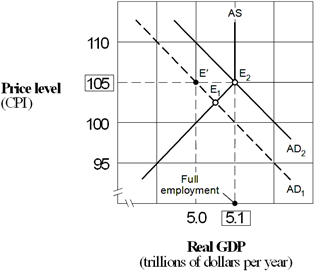 Suppose the economy in Exhibit 15-2 is in equilibrium at point E1 and the marginal propensity to consume (MPC) is 0.75. Following Keynesian economics, the federal government can move the economy to full employment at point E2 by:
 (Multiple Choice)
4.9/5 (85)
(85) Supply-side economic policies are designed to shift the aggregate supply curve to the right, whereas Keynesian economic policies focus on shifting the aggregate demand curve to the right during recessions and to the left during an economic expansion.
(True/False)
4.7/5 (72)
(72) Mathematically, the value of the spending multiplier in terms of the marginal propensity to consume (MPC) is given by the formula:
(Multiple Choice)
4.9/5 (64)
(64) 
Filters
- Essay(0)
- Multiple Choice(0)
- Short Answer(0)
- True False(0)
- Matching(0)