



 Chat with AI
Exam 10: Monopolistic Competition and Oligopoly

Exam 1: Introducing the Economic Way of Thinking85 Questions
Exam 2: Production Possibilities Opportunity Cost and Economic Growth107 Questions
Exam 3: Market Demand and Supply176 Questions
Exam 4: Markets in Action137 Questions
Exam 5: Price Elasticity of Demand and Supply151 Questions
Exam 6: Consumer Choice Theory96 Questions
Exam 7: Production Costs131 Questions
Exam 8: Perfect Competition126 Questions
Exam 9: Monopoly81 Questions
Exam 10: Monopolistic Competition and Oligopoly97 Questions
Exam 11: Labor Markets105 Questions
Exam 12: Income Distribution Poverty and Discrimination57 Questions
Exam 13: Antitrust and Regulation96 Questions
Exam 14: Environmental Economics47 Questions
Exam 15: Gross Domestic Product109 Questions
Exam 16: Business Cycles and Unemployment94 Questions
Exam 17: Inflation56 Questions
Exam 18: The Keynesian Model111 Questions
Exam 19: The Keynesian Model in Action105 Questions
Exam 20: Aggregate Demand and Supply94 Questions
Exam 21: Fiscal Policy108 Questions
Exam 22: The Public Sector55 Questions
Exam 23: Federal Deficits Surpluses and the National Debt42 Questions
Exam 24: Money and the Federal Reserve System75 Questions
Exam 25: Money Creation117 Questions
Exam 26: Monetary Policy106 Questions
Exam 27: The Phillips Curve and Expectations Theory59 Questions
Exam 28: International Trade and Finance127 Questions
Exam 29: Economies in Transition46 Questions
Exam 30: Growth and the Less Developed Countries55 Questions
Exam 31: Understanding Direct and Inverse Relationships between Variables172 Questions
Select questions type


Entry of new firms into a monopolistically competitive market causes a(n)
(Multiple Choice)
4.8/5  (86)
(86) Which of the following is characteristic of a monopolistically competitive firm?
(Multiple Choice)
4.9/5 (75)
(75) Suppose ABC Dairy is one firm competing in the perfectly competitive market for milk. Now suppose ABC Dairy decides to produce only organic milk. Which of the following best describes the effects of this change in the market?
(Multiple Choice)
4.9/5 (68)
(68) Compare and contrast the four market models in terms of the profit-maximizing output level for each, the shut-down rule for each, the probability of long-run economic profits being earned, and their social desirability.
(Essay)
4.8/5 (92)
(92) Which of the following statements best describes the price, output, and profit conditions of monopolistic competition?
(Multiple Choice)
5.0/5 (72)
(72) Which of the following is true about the demand curve for a monopolistically competitive firm?
(Multiple Choice)
4.9/5 (83)
(83) The short-run equilibrium for a monopolistically competitive firm is at P = $28.47, ATC = $22.13, and MC = MR = $17.47. Which of the following is true ?
(Multiple Choice)
4.8/5 (85)
(85) Exhibit 10-1 A monopolistic competitive firm
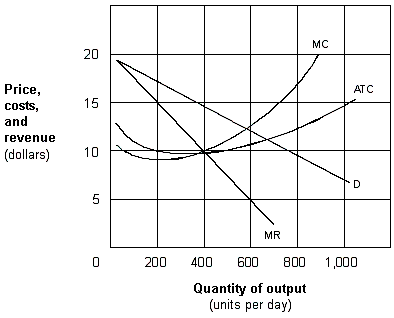 As presented in Exhibit 10-1, the short-run profit-maximizing output for the monopolistic competitive firm is:
 (Multiple Choice)
4.9/5 (76)
(76) Because a monopolistically competitive market is characterized by
(Multiple Choice)
4.8/5 (91)
(91) Exhibit 10-6 Two-Firm Payoff Matrix
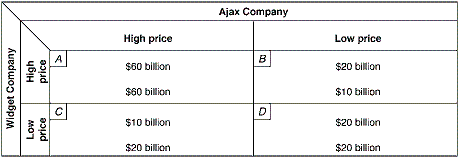 Assume costs are identical for the two firms in Exhibit 10-6. If both firms were allowed to form a cartel and agree on their prices, equilibrium would be established by:
 (Multiple Choice)
4.8/5 (86)
(86) Which of the following is the best example of an oligopoly?
(Multiple Choice)
4.9/5 (81)
(81) Compared to the perfectly competitive outcome, monopolistically competitive markets will result in:
(Multiple Choice)
4.8/5 (66)
(66) Which of the following statements best describes firms under monopolistic competition?
(Multiple Choice)
5.0/5 (77)
(77) How will the price and output of a monopolist compare with perfect competition?
(Multiple Choice)
4.8/5 (75)
(75) Exhibit 10-6 Two-Firm Payoff Matrix
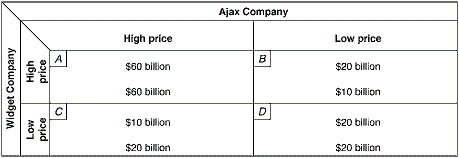 Suppose costs are identical for the two firms in Exhibit 10-6. Each firm assumes without formal agreement that if it sets the high price its rival will not charge a lower price. Under these "tit-for-tat" conditions, equilibrium will be established by:
 (Multiple Choice)
4.7/5 (81)
(81) The marginal revenue curve of a monopolistically competitive firm will always lie:
(Multiple Choice)
4.9/5 (74)
(74) A(n) ____ can be used to demonstrate why a competitive oligopoly tends to result in a low-price strategy that does not maximize mutual profits.
(Multiple Choice)
4.9/5 (96)
(96) Which of the following is true in long-run equilibrium for both perfect competition and monopolistic competition?
(Multiple Choice)
4.8/5 (79)
(79) 
Filters
- Essay(0)
- Multiple Choice(0)
- Short Answer(0)
- True False(0)
- Matching(0)