



 Chat with AI
Exam 10: Monopolistic Competition and Oligopoly

Exam 1: Introducing the Economic Way of Thinking85 Questions
Exam 2: Production Possibilities Opportunity Cost and Economic Growth107 Questions
Exam 3: Market Demand and Supply176 Questions
Exam 4: Markets in Action137 Questions
Exam 5: Price Elasticity of Demand and Supply151 Questions
Exam 6: Consumer Choice Theory96 Questions
Exam 7: Production Costs131 Questions
Exam 8: Perfect Competition126 Questions
Exam 9: Monopoly81 Questions
Exam 10: Monopolistic Competition and Oligopoly97 Questions
Exam 11: Labor Markets105 Questions
Exam 12: Income Distribution Poverty and Discrimination57 Questions
Exam 13: Antitrust and Regulation96 Questions
Exam 14: Environmental Economics47 Questions
Exam 15: Gross Domestic Product109 Questions
Exam 16: Business Cycles and Unemployment94 Questions
Exam 17: Inflation56 Questions
Exam 18: The Keynesian Model111 Questions
Exam 19: The Keynesian Model in Action105 Questions
Exam 20: Aggregate Demand and Supply94 Questions
Exam 21: Fiscal Policy108 Questions
Exam 22: The Public Sector55 Questions
Exam 23: Federal Deficits Surpluses and the National Debt42 Questions
Exam 24: Money and the Federal Reserve System75 Questions
Exam 25: Money Creation117 Questions
Exam 26: Monetary Policy106 Questions
Exam 27: The Phillips Curve and Expectations Theory59 Questions
Exam 28: International Trade and Finance127 Questions
Exam 29: Economies in Transition46 Questions
Exam 30: Growth and the Less Developed Countries55 Questions
Exam 31: Understanding Direct and Inverse Relationships between Variables172 Questions
Select questions type


Assume that an oligopolist has a kinked demand curve. Suppose that the marginal cost curve passes through the gap in the marginal revenue curve. This means price and output will be shown by a point:
(Multiple Choice)
4.9/5  (88)
(88) The monopolistic competition market structure is characterized by:
(Multiple Choice)
4.9/5 (86)
(86) When a perfectly competitive firm or a monopolistically competitive firm is making zero economic profit,
(Multiple Choice)
4.8/5 (84)
(84) In the long run, a monopolistically competitive firm will set price:
(Multiple Choice)
4.8/5 (74)
(74) The demand curve in monopolistic competition slopes downward because of:
(Multiple Choice)
4.8/5 (76)
(76) Suppose that R. J. Reynolds raises the price of cigarettes by 10 percent. Although they have no requirement or agreement to do so, the other cigarette firms decide to raise their prices accordingly. This situation is best described as:
(Multiple Choice)
4.9/5 (75)
(75) While there is no specific number of firms that must dominate an industry before it is an oligopoly, the number of sellers characterizes an oligopoly when
(Multiple Choice)
4.9/5 (90)
(90) Exhibit 10-1 A monopolistic competitive firm
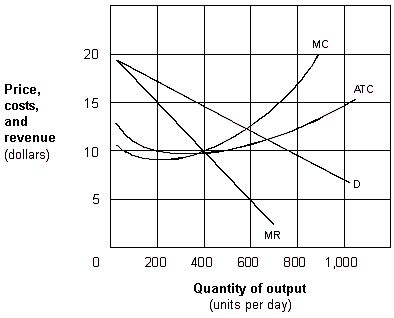 If all firms in the industry are the same as the monopolistic competitive firm shown in this Exhibit 10-1, firms in the long run will:
 (Multiple Choice)
4.7/5 (66)
(66) Under which one of the following market structures are sellers most likely to consider the reaction of rival sellers when they set the price of their product?
(Multiple Choice)
4.9/5 (80)
(80) Exhibit 10-2 A monopolistic competitive firm
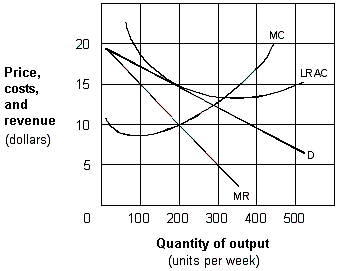 Comparing the firms in a monopolistic competitive industry shown in Exhibit 10-2 to a perfectly competitive firm in long-run equilibrium, we find that both firms
 (Multiple Choice)
4.8/5 (83)
(83) A market situation where a small number of sellers dominate the entire industry is called:
(Multiple Choice)
4.8/5 (79)
(79) The markets for Products X and Y both have many sellers, each earning an economic profit of zero in the long run. One of the markets is perfectly competitive while the other is monopolistically competitive. Which of the following information can help you determine which operates in a monopolistically competitive market structure?
(Multiple Choice)
4.8/5 (89)
(89) In order to make oil profits as large as possible, OPEC meets to set oil production quotas for its members. OPEC is best classified as a:
(Multiple Choice)
4.9/5 (87)
(87) Exhibit 10-2 A monopolistic competitive firm
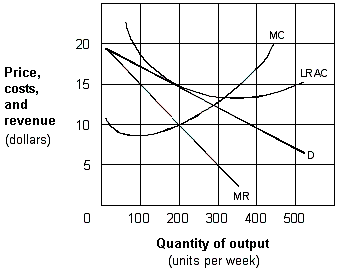 As represented in Exhibit 10-2, the maximum long-run economic profit earned by this monopolistic competitive firm is:
 (Multiple Choice)
4.8/5 (87)
(87) A kink in the demand curve facing an oligopolist is caused by:
(Multiple Choice)
4.8/5 (73)
(73) 
Filters
- Essay(0)
- Multiple Choice(0)
- Short Answer(0)
- True False(0)
- Matching(0)