



 Chat with AI
Exam 3: Market Demand and Supply

Exam 1: Introducing the Economic Way of Thinking85 Questions
Exam 2: Production Possibilities Opportunity Cost and Economic Growth107 Questions
Exam 3: Market Demand and Supply176 Questions
Exam 4: Markets in Action137 Questions
Exam 5: Price Elasticity of Demand and Supply151 Questions
Exam 6: Consumer Choice Theory96 Questions
Exam 7: Production Costs131 Questions
Exam 8: Perfect Competition126 Questions
Exam 9: Monopoly81 Questions
Exam 10: Monopolistic Competition and Oligopoly97 Questions
Exam 11: Labor Markets105 Questions
Exam 12: Income Distribution Poverty and Discrimination57 Questions
Exam 13: Antitrust and Regulation96 Questions
Exam 14: Environmental Economics47 Questions
Exam 15: Gross Domestic Product109 Questions
Exam 16: Business Cycles and Unemployment94 Questions
Exam 17: Inflation56 Questions
Exam 18: The Keynesian Model111 Questions
Exam 19: The Keynesian Model in Action105 Questions
Exam 20: Aggregate Demand and Supply94 Questions
Exam 21: Fiscal Policy108 Questions
Exam 22: The Public Sector55 Questions
Exam 23: Federal Deficits Surpluses and the National Debt42 Questions
Exam 24: Money and the Federal Reserve System75 Questions
Exam 25: Money Creation117 Questions
Exam 26: Monetary Policy106 Questions
Exam 27: The Phillips Curve and Expectations Theory59 Questions
Exam 28: International Trade and Finance127 Questions
Exam 29: Economies in Transition46 Questions
Exam 30: Growth and the Less Developed Countries55 Questions
Exam 31: Understanding Direct and Inverse Relationships between Variables172 Questions
Select questions type


Other things being equal, the effects of an increase in the price of computers would best be represented by which of the following?
(Multiple Choice)
4.8/5  (87)
(87) The law of demand indicates that as the price of a good increases:
(Multiple Choice)
4.8/5 (82)
(82) Other things being equal, the effect of an increase in the price of Coca-Cola would cause a(n):
(Multiple Choice)
4.8/5 (77)
(77) Suppose the prices of petroleum products, including gasoline and fuel oil, fell sharply. Which of the following would most likely occur as the result of the lower prices of petroleum products?
(Multiple Choice)
4.9/5 (72)
(72) The horizontal summation of all individual demands at different given prices results in the:
(Multiple Choice)
4.9/5 (77)
(77) A reduction in production costs will not result in which of the following?
(Multiple Choice)
4.8/5 (79)
(79) If the demand for a good decreases because consumer income increases, the good is a(n):
(Multiple Choice)
4.8/5 (76)
(76) The " ceteris paribus " clause in the law of demand allows which of the following factors to change?
(Multiple Choice)
4.9/5 (75)
(75) Suppose that X and Y are substitute goods. If the price of good X increases, we can expect:
(Multiple Choice)
4.9/5 (93)
(93) 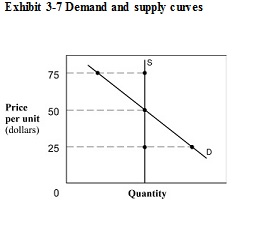
-In Exhibit 3-7, if price happened to currently be $25 in this market, a _______ would result, causing a _______ in price.
-In Exhibit 3-7, if price happened to currently be $25 in this market, a _______ would result, causing a _______ in price. (Multiple Choice)
4.9/5 (80)
(80) The law of demand says that the lower the price charged for a good, ceteris paribus , the:
(Multiple Choice)
4.9/5 (72)
(72) If a decrease in the price of good Y causes the demand for good Z to decrease, this indicates that:
(Multiple Choice)
4.9/5 (82)
(82) 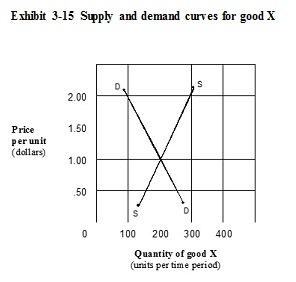
In the market shown in Exhibit 3-15, the equilibrium price and quantity of good X are:
In the market shown in Exhibit 3-15, the equilibrium price and quantity of good X are: (Multiple Choice)
4.8/5 (74)
(74) If the quantity demanded of milk is 55,000 and the quantity supplied of milk is 80,000, then:
(Multiple Choice)
4.9/5 (81)
(81) Assuming that bus travel is an inferior good, an increase in consumer income, other things being equal, will cause a(n):
(Multiple Choice)
4.7/5 (81)
(81) A decrease in the price of coffee, other things being equal, causes a(n):
(Multiple Choice)
5.0/5 (80)
(80) 
Filters
- Essay(0)
- Multiple Choice(0)
- Short Answer(0)
- True False(0)
- Matching(0)