



 Chat with AI
Exam 2: Production Possibilities Opportunity Cost and Economic Growth

Exam 1: Introducing the Economic Way of Thinking85 Questions
Exam 2: Production Possibilities Opportunity Cost and Economic Growth107 Questions
Exam 3: Market Demand and Supply176 Questions
Exam 4: Markets in Action137 Questions
Exam 5: Price Elasticity of Demand and Supply151 Questions
Exam 6: Consumer Choice Theory96 Questions
Exam 7: Production Costs131 Questions
Exam 8: Perfect Competition126 Questions
Exam 9: Monopoly81 Questions
Exam 10: Monopolistic Competition and Oligopoly97 Questions
Exam 11: Labor Markets105 Questions
Exam 12: Income Distribution Poverty and Discrimination57 Questions
Exam 13: Antitrust and Regulation96 Questions
Exam 14: Environmental Economics47 Questions
Exam 15: Gross Domestic Product109 Questions
Exam 16: Business Cycles and Unemployment94 Questions
Exam 17: Inflation56 Questions
Exam 18: The Keynesian Model111 Questions
Exam 19: The Keynesian Model in Action105 Questions
Exam 20: Aggregate Demand and Supply94 Questions
Exam 21: Fiscal Policy108 Questions
Exam 22: The Public Sector55 Questions
Exam 23: Federal Deficits Surpluses and the National Debt42 Questions
Exam 24: Money and the Federal Reserve System75 Questions
Exam 25: Money Creation117 Questions
Exam 26: Monetary Policy106 Questions
Exam 27: The Phillips Curve and Expectations Theory59 Questions
Exam 28: International Trade and Finance127 Questions
Exam 29: Economies in Transition46 Questions
Exam 30: Growth and the Less Developed Countries55 Questions
Exam 31: Understanding Direct and Inverse Relationships between Variables172 Questions
Select questions type


Which fundamental economic question is most closely related to the issues of income distribution and poverty?
(Multiple Choice)
4.8/5  (73)
(73) Exhibit 2-15 Production possibilities curve
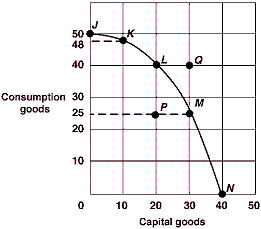 In Exhibit 2-15, the economy will experience the most future economic growth if it chooses what point now?
 (Multiple Choice)
4.9/5 (90)
(90) Which of the following most accurately summarizes the implications of an economy's production possibilities curve?
(Multiple Choice)
4.9/5 (71)
(71) Exhibit 2-1 Production possibilities curve data
Consumption
Goods
Capital
Goods
10
0
9
1
7
2
4
3
0
4
-In Exhibit 2-1, according to the information, the opportunity cost of producing 3 units of capital is:
| Consumption | Capital |
| 10 | 0 |
| 9 | 1 |
| 7 | 2 |
| 4 | 3 |
| 0 | 4 |
(Multiple Choice)
4.8/5 (85)
(85) Three basic decisions must be made by all economies. What are they?
(Multiple Choice)
4.9/5 (81)
(81) Given the possible strategies listed below, design the best plan for increasing the country's future standard of living.
I. build new factories
Ii. print money
Iii. develop new production technology
Iv. sacrifice consumer goods for capital formation
Iv. tighten immigration policy
V. produce only enough capital goods to replenish depreciation.
(Multiple Choice)
4.8/5 (77)
(77) A point outside the production possibilities curve represents a combination of goods that is:
(Multiple Choice)
4.8/5 (95)
(95) Exhibit 2-13 Production possibilities curve
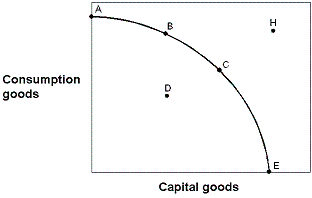 -In Exhibit 2-13, in terms of efficiency:
 (Multiple Choice)
4.9/5 (72)
(72) Which would be least likely to cause the production possibilities curve to shift to the right?
(Multiple Choice)
4.7/5 (93)
(93) In economics, investment refers to the process of accumulating:
(Multiple Choice)
4.9/5 (94)
(94) If an economy is producing at full employment, it means that:
(Multiple Choice)
4.8/5 (69)
(69) Exhibit 2-1 Production possibilities curve data
Consumption
Goods
Capital
Goods
10
0
9
1
7
2
4
3
0
4
-In Exhibit 2-1, why is the opportunity cost of producing the fourth unit of capital 4 units of consumption goods but the opportunity cost of producing 4 units of capital is 10 units of consumption goods?
| Consumption | Capital |
| 10 | 0 |
| 9 | 1 |
| 7 | 2 |
| 4 | 3 |
| 0 | 4 |
(Multiple Choice)
4.8/5 (86)
(86) The process through which an economy's production possibilities curve shifts outward is:
(Multiple Choice)
4.9/5 (96)
(96) Exhibit 2-4 Production possibilities curve data
A
B
C
D
E
Capital goods 0
10
20
30
40
Consumer goods 200
180
140
80
0
In Exhibit 2-4, if the economy chooses production possibility D rather than production possibility B, it can expect
| A | B | C | D | E | |
| Capital goods | 0 | 10 | 20 | 30 | 40 |
| Consumer goods | 200 | 180 | 140 | 80 | 0 |
(Multiple Choice)
4.9/5 (86)
(86) Three of the four following questions are indicative of the three fundamental economic questions. Leaving out the irrelevant question, rearrange the three relevant questions in the order an economy must answer them.
- Should electricity be produced from oil, solar, or nuclear power?
- Should corn be produced in the North or in the South?
- Who drives a Mercedes?
- Should more hybrid cars and fewer SUVs be produced?
(Multiple Choice)
4.8/5 (77)
(77) What can a nation do to increase its economic growth? Why is economic growth among the major national economic goals of all countries?
(Essay)
5.0/5 (79)
(79) With time, which one of the following strategies would most likely result in an outward shift in the production possibilities curve of an economy?
(Multiple Choice)
4.8/5 (65)
(65) Exhibit 2-11 Production possibilities curves
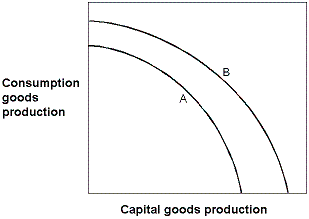 In Exhibit 2-11, which of the following could have caused the production possibilities curve to shift from the one labeled B to the one labeled A?
 (Multiple Choice)
4.9/5 (76)
(76) Which of the following causes the production possibilities curve to shift to the right?
(Multiple Choice)
4.7/5 (74)
(74) 
Filters
- Essay(0)
- Multiple Choice(0)
- Short Answer(0)
- True False(0)
- Matching(0)