



 Chat with AI
Exam 16: Monetary Policy

Exam 1: Introducing the Economic Way of Thinking176 Questions
Exam 2: Production Possibilities, Opportunity Cost, and Economic Growth200 Questions
Exam 3: Market Demand and Supply348 Questions
Exam 4: Markets in Action261 Questions
Exam 5: Gross Domestic Product223 Questions
Exam 6: Business Cycles and Unemployment194 Questions
Exam 7: Inflation126 Questions
Exam 8: The Keynesian Model235 Questions
Exam 9: The Keynesian Model in Action202 Questions
Exam 10: Aggregate Demand and Supply187 Questions
Exam 11: Fiscal Policy223 Questions
Exam 12: The Public Sector127 Questions
Exam 13: Federal Deficits, Surpluses, and the National Debt99 Questions
Exam 14: Money and the Federal Reserve System154 Questions
Exam 15: Money Creation243 Questions
Exam 16: Monetary Policy213 Questions
Exam 17: The Phillips Curve and Expectations Theory120 Questions
Exam 18: International Trade and Finance248 Questions
Exam 19: Economies in Transition104 Questions
Exam 20: Growth and the Less-Developed Countries117 Questions
Exam 21: Applying Graphs to Economics68 Questions
Exam 22: Consumer Surplus, Producer Surplus, and Market Efficiency68 Questions
Exam 23: the Self-Correcting Aggregate Demand and Supply Model83 Questions
Exam 24: Policy Disputes Using the Self-Correcting Aggregate Demand and Supply Model36 Questions
Select questions type


Which of the following correctly gives us the equation of exchange?
(Multiple Choice)
4.8/5  (85)
(85) Assume the demand for money curve is stationary and the Fed increases the money supply. The result is that people:
(Multiple Choice)
4.7/5 (76)
(76) In Keynes's view, an excess quantity of money supplied causes people to:
(Multiple Choice)
4.9/5 (68)
(68) Which of the following characterizes the Monetarist viewpoint?
(Multiple Choice)
4.8/5 (89)
(89) Starting from equilibrium in the money market, suppose the money supply increases. Other things being equal, this will cause an excess demand for money, leading people to sell bonds.
(True/False)
4.8/5 (73)
(73) The quantity of money held in response to interest rates is the:
(Multiple Choice)
5.0/5 (85)
(85) Exhibit 16-5 Money, investment and product markets 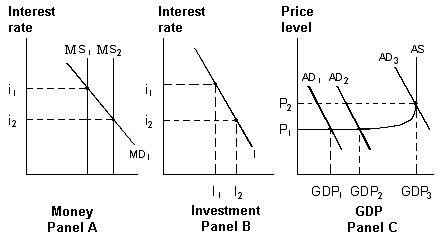 In Exhibit 16-5, a shift in aggregate demand from AD1 to AD2:
 (Multiple Choice)
4.8/5 (72)
(72) If the money supply increases this will cause the interest rate to rise, investment to fall and GDP to fall.
(True/False)
4.9/5 (87)
(87) If the nominal GDP is $500 billion and the money supply is $100 billion, the velocity of money is:
(Multiple Choice)
4.8/5 (78)
(78) Which of the following is an important issue in the Keynesian-Monetarist debate?
(Multiple Choice)
4.8/5 (90)
(90) "Monetary instability has been the major cause of economic instability in this country. Expansion in the money supply has been the source of every major inflation. Every major recession has been either caused or perpetuated by monetary contraction." Who among the following would most likely adhere to this view?
(Multiple Choice)
4.7/5 (83)
(83) When there is an excess demand for money, individuals and businesses will attempt to purchase bonds.
(True/False)
4.8/5 (80)
(80) If M stands for the money supply, V for the velocity of money, P for the average selling price, and Q for the output of goods and services, the equation of exchange is:
(Multiple Choice)
4.9/5 (85)
(85) If the Fed uses its tools to expand the money supply, bond prices will be bid up and interest rates will fall.
(True/False)
4.8/5 (81)
(81) Monetarists argue that the Fed should frequently adjust the money supply in response to ever-changing economic conditions.
(True/False)
4.8/5 (77)
(77) Monetarists reject using discretionary monetary policy as an effective stabilization tool because they believe:
(Multiple Choice)
4.9/5 (86)
(86) 
Filters
- Essay(0)
- Multiple Choice(0)
- Short Answer(0)
- True False(0)
- Matching(0)