



 Chat with AI
Exam 16: Monetary Policy

Exam 1: Introducing the Economic Way of Thinking176 Questions
Exam 2: Production Possibilities, Opportunity Cost, and Economic Growth200 Questions
Exam 3: Market Demand and Supply348 Questions
Exam 4: Markets in Action261 Questions
Exam 5: Gross Domestic Product223 Questions
Exam 6: Business Cycles and Unemployment194 Questions
Exam 7: Inflation126 Questions
Exam 8: The Keynesian Model235 Questions
Exam 9: The Keynesian Model in Action202 Questions
Exam 10: Aggregate Demand and Supply187 Questions
Exam 11: Fiscal Policy223 Questions
Exam 12: The Public Sector127 Questions
Exam 13: Federal Deficits, Surpluses, and the National Debt99 Questions
Exam 14: Money and the Federal Reserve System154 Questions
Exam 15: Money Creation243 Questions
Exam 16: Monetary Policy213 Questions
Exam 17: The Phillips Curve and Expectations Theory120 Questions
Exam 18: International Trade and Finance248 Questions
Exam 19: Economies in Transition104 Questions
Exam 20: Growth and the Less-Developed Countries117 Questions
Exam 21: Applying Graphs to Economics68 Questions
Exam 22: Consumer Surplus, Producer Surplus, and Market Efficiency68 Questions
Exam 23: the Self-Correcting Aggregate Demand and Supply Model83 Questions
Exam 24: Policy Disputes Using the Self-Correcting Aggregate Demand and Supply Model36 Questions
Select questions type


Assume the Fed decreases the money supply and the demand for money curve is fixed. In response, people will:
(Multiple Choice)
4.8/5  (71)
(71) Since classical economists and monetarists believe that the economy operates at full employment, real GDP, that is, along the vertical segment of aggregate supply:
(Multiple Choice)
4.9/5 (77)
(77) Exhibit 16-6 Money, investment and product markets 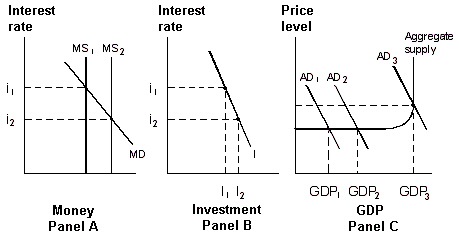 In Exhibit 16-6, if the Fed believes the economy is at AD3, how might it engineer a decline in the price level?
 (Multiple Choice)
4.9/5 (74)
(74) Monetarists argue that the Federal Reserve should allow the money supply to grow:
(Multiple Choice)
4.8/5 (79)
(79) If the investment curve is relatively flat, the Keynesian conclusion is that the transmission mechanism has little effect on the economy.
(True/False)
4.9/5 (73)
(73) Exhibit 16-5 Money, investment and product markets 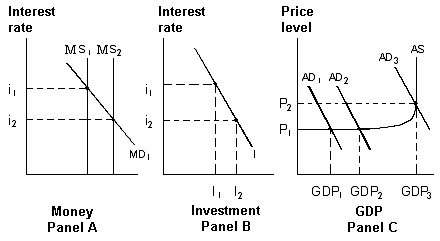 In Exhibit 16-5, if the interest rate falls from i1 to i2, investment spending will:
 (Multiple Choice)
4.8/5 (74)
(74) Exhibit 16-2 Money market demand and supply curves  Beginning from an equilibrium at E1 in Exhibit 16-2, an increase in the money supply from $400 billion to $600 billion causes people to:
 (Multiple Choice)
5.0/5 (77)
(77) An increase in the supply of money will lead to ____ in equilibrium real GDP and ____ in equilibrium price level.
(Multiple Choice)
4.9/5 (78)
(78) Which of the following is the objective of expansionary monetary policy?
(Multiple Choice)
4.8/5 (99)
(99) Exhibit 16-4 Aggregate demand and supply model 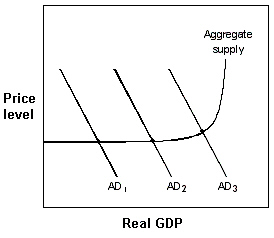 In Exhibit 16-4, which one of the following actions could the Fed use to shift the AD curve from AD1 to AD2?
 (Multiple Choice)
4.9/5 (84)
(84) Suppose nominal GDP equaled $10,988 billion while the M2 money supply was $6,063 billion. What was the velocity of the M2 money stock?
(Multiple Choice)
4.9/5 (76)
(76) Why do people hold money (currency and checking account balances), and thereby forgo earning interest or dividends from a financial investment?
(Multiple Choice)
4.9/5 (91)
(91) 
Filters
- Essay(0)
- Multiple Choice(0)
- Short Answer(0)
- True False(0)
- Matching(0)