



 Chat with AI
Exam 16: Monetary Policy

Exam 1: Introducing the Economic Way of Thinking176 Questions
Exam 2: Production Possibilities, Opportunity Cost, and Economic Growth200 Questions
Exam 3: Market Demand and Supply348 Questions
Exam 4: Markets in Action261 Questions
Exam 5: Gross Domestic Product223 Questions
Exam 6: Business Cycles and Unemployment194 Questions
Exam 7: Inflation126 Questions
Exam 8: The Keynesian Model235 Questions
Exam 9: The Keynesian Model in Action202 Questions
Exam 10: Aggregate Demand and Supply187 Questions
Exam 11: Fiscal Policy223 Questions
Exam 12: The Public Sector127 Questions
Exam 13: Federal Deficits, Surpluses, and the National Debt99 Questions
Exam 14: Money and the Federal Reserve System154 Questions
Exam 15: Money Creation243 Questions
Exam 16: Monetary Policy213 Questions
Exam 17: The Phillips Curve and Expectations Theory120 Questions
Exam 18: International Trade and Finance248 Questions
Exam 19: Economies in Transition104 Questions
Exam 20: Growth and the Less-Developed Countries117 Questions
Exam 21: Applying Graphs to Economics68 Questions
Exam 22: Consumer Surplus, Producer Surplus, and Market Efficiency68 Questions
Exam 23: the Self-Correcting Aggregate Demand and Supply Model83 Questions
Exam 24: Policy Disputes Using the Self-Correcting Aggregate Demand and Supply Model36 Questions
Select questions type


Keynes called money people hold to make routine day-to-day purchases the:
(Multiple Choice)
4.8/5  (75)
(75) If the Fed expands the money supply by $1 trillion, what will happen in the money market?
(Multiple Choice)
4.9/5 (79)
(79) If the Fed uses its tools to expand the money supply, bond prices will be bid down and interest rates will rise.
(True/False)
4.7/5 (80)
(80) According to the Monetarist view, the impact of expansionary monetary policy will be:
(Multiple Choice)
4.8/5 (80)
(80) Exhibit 16-3 Money market demand and supply curves 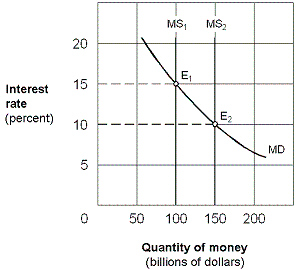 In Exhibit 16-3, assume an equilibrium at E2 with the money supply at $100 billion and the interest rate at 15 percent. The Fed uses its policy tools to move the economy to a new equilibrium at E1 with a money supply of 150 billion and an interest rate of 10 percent. As part of the adjustment to the new equilibrium, we would expect the:
 (Multiple Choice)
4.8/5 (82)
(82) Other things being equal, an increase in the rate of interest causes a(n):
(Multiple Choice)
4.8/5 (80)
(80) The stock of money people hold to take advantage of expected future changes in the price of bonds, stocks, or other nonmoney financial assets is the:
(Multiple Choice)
4.9/5 (88)
(88) A rightward shift in the money supply curve is likely to produce a rightward shift in the aggregate demand curve.
(True/False)
4.8/5 (82)
(82) John Maynard Keynes listed three types of motives for people holding money ¾ transactions, precautionary, and speculative.
(True/False)
4.9/5 (97)
(97) Keynes called the money people hold in order to buy bonds, stocks, or other nonmoney financial assets the:
(Multiple Choice)
5.0/5 (81)
(81) If you hold money in anticipation of household emergency expense, this represents the::
(Multiple Choice)
4.9/5 (72)
(72) Contrast the Keynesian and Monetarist views on how a change in the money supply impacts the economy.
(Essay)
4.8/5 (72)
(72) Which of the following policies would be most likely to reduce the rate of inflation?
(Multiple Choice)
4.7/5 (68)
(68) The Keynesian mechanism through which monetary policy affects the price level, real GDP, and employment depends on the impact of the:
(Multiple Choice)
4.8/5 (88)
(88) According to the equation of exchange, if M = 200, P = 100, and Q = 10, the V is:
(Multiple Choice)
4.9/5 (73)
(73) If M stand for the money supply, V for the velocity of money, P for the average selling price, and Q for the output of goods and services, the equation of exchange is MV = PQ.
(True/False)
4.9/5 (77)
(77) 
Filters
- Essay(0)
- Multiple Choice(0)
- Short Answer(0)
- True False(0)
- Matching(0)