



 Chat with AI
Exam 16: Monetary Policy

Exam 1: Introducing the Economic Way of Thinking176 Questions
Exam 2: Production Possibilities, Opportunity Cost, and Economic Growth200 Questions
Exam 3: Market Demand and Supply348 Questions
Exam 4: Markets in Action261 Questions
Exam 5: Gross Domestic Product223 Questions
Exam 6: Business Cycles and Unemployment194 Questions
Exam 7: Inflation126 Questions
Exam 8: The Keynesian Model235 Questions
Exam 9: The Keynesian Model in Action202 Questions
Exam 10: Aggregate Demand and Supply187 Questions
Exam 11: Fiscal Policy223 Questions
Exam 12: The Public Sector127 Questions
Exam 13: Federal Deficits, Surpluses, and the National Debt99 Questions
Exam 14: Money and the Federal Reserve System154 Questions
Exam 15: Money Creation243 Questions
Exam 16: Monetary Policy213 Questions
Exam 17: The Phillips Curve and Expectations Theory120 Questions
Exam 18: International Trade and Finance248 Questions
Exam 19: Economies in Transition104 Questions
Exam 20: Growth and the Less-Developed Countries117 Questions
Exam 21: Applying Graphs to Economics68 Questions
Exam 22: Consumer Surplus, Producer Surplus, and Market Efficiency68 Questions
Exam 23: the Self-Correcting Aggregate Demand and Supply Model83 Questions
Exam 24: Policy Disputes Using the Self-Correcting Aggregate Demand and Supply Model36 Questions
Select questions type


The speculative demand for money shows the relationship between money demand and:
(Multiple Choice)
4.9/5  (76)
(76) Exhibit 16-3 Money market demand and supply curves  As shown in Exhibit 16-3, assume the money supply curve shifts rightward from MS1 to MS2 and the economy is operating along the intermediate segment of the aggregate supply curve. The result will be a:
 (Multiple Choice)
4.8/5 (73)
(73) When interest rates rise, the quantity demanded of money held for the:
(Multiple Choice)
4.8/5 (84)
(84) Assume a fixed demand for money curve and the Fed decreases the money supply. In response, people will:
(Multiple Choice)
4.9/5 (69)
(69) Keynesians identify three principal motives for demanding money. They are the:
(Multiple Choice)
4.7/5 (83)
(83) Exhibit 16-4 Aggregate demand and supply model 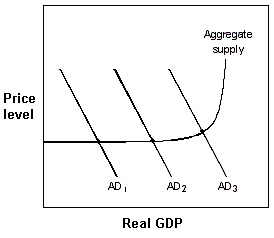 In Exhibit 16-4, which one of the following actions could the Fed use to shift the AD curve from AD3 to AD2?
 (Multiple Choice)
4.8/5 (84)
(84) According to the quantity theory of money, which one of the following economic variables would change in response to an increase in the money supply?
(Multiple Choice)
4.9/5 (81)
(81) The Keynesian cause-and-effect sequence predicts that an increase in the money supply will cause interest rates to:
(Multiple Choice)
4.8/5 (70)
(70) The opportunity cost of holding money is properly measured by the rate of interest on financial assets such as bonds.
(True/False)
5.0/5 (86)
(86) According to the equation of exchange, if V = 5, P = 100, and Q = 10, the M is:
(Multiple Choice)
4.8/5 (71)
(71) If the Fed reduces the discount rate, which of the following are most likely to result?
(Multiple Choice)
4.9/5 (79)
(79) According to Keynesians, an increase in the money supply will have its greatest impact on GDP when the aggregate demand curve intersects:
(Multiple Choice)
4.9/5 (84)
(84) One reason that people hold money is to pay for unexpected car repairs and other unpredictable expenses. This motive for holding money is called:
(Multiple Choice)
4.9/5 (79)
(79) According to the quantity theory of money, a 10 percent increase in the money supply leads to a 10 percent increase in:
(Multiple Choice)
4.7/5 (84)
(84) Exhibit 16-1 Money market demand and supply curves  Starting from an equilibrium at E1 in Exhibit 16-1, a leftward shift of the money supply curve from MS1 to MS2 would cause an excess:
 (Multiple Choice)
4.9/5 (67)
(67) 
Filters
- Essay(0)
- Multiple Choice(0)
- Short Answer(0)
- True False(0)
- Matching(0)