



 Chat with AI
Exam 8: The Keynesian Model

Exam 1: Introducing the Economic Way of Thinking176 Questions
Exam 2: Production Possibilities, Opportunity Cost, and Economic Growth200 Questions
Exam 3: Market Demand and Supply348 Questions
Exam 4: Markets in Action261 Questions
Exam 5: Gross Domestic Product223 Questions
Exam 6: Business Cycles and Unemployment194 Questions
Exam 7: Inflation126 Questions
Exam 8: The Keynesian Model235 Questions
Exam 9: The Keynesian Model in Action202 Questions
Exam 10: Aggregate Demand and Supply187 Questions
Exam 11: Fiscal Policy223 Questions
Exam 12: The Public Sector127 Questions
Exam 13: Federal Deficits, Surpluses, and the National Debt99 Questions
Exam 14: Money and the Federal Reserve System154 Questions
Exam 15: Money Creation243 Questions
Exam 16: Monetary Policy213 Questions
Exam 17: The Phillips Curve and Expectations Theory120 Questions
Exam 18: International Trade and Finance248 Questions
Exam 19: Economies in Transition104 Questions
Exam 20: Growth and the Less-Developed Countries117 Questions
Exam 21: Applying Graphs to Economics68 Questions
Exam 22: Consumer Surplus, Producer Surplus, and Market Efficiency68 Questions
Exam 23: the Self-Correcting Aggregate Demand and Supply Model83 Questions
Exam 24: Policy Disputes Using the Self-Correcting Aggregate Demand and Supply Model36 Questions
Select questions type


The value of consumption at each level of disposable personal income, all other determinants of consumption unchanged, is shown by the:
(Multiple Choice)
4.7/5  (91)
(91) Which of the following events would produce an upward shift in the consumption function, other things being equal?
(Multiple Choice)
4.8/5 (85)
(85) John Maynard Keynes and his followers argued that the Great Depression was primarily the result of:
(Multiple Choice)
5.0/5 (72)
(72) In the basic Keynesian model, the major determinant of consumption expenditures is:
(Multiple Choice)
4.8/5 (84)
(84) Exhibit 8-15 Disposable income and consumption data 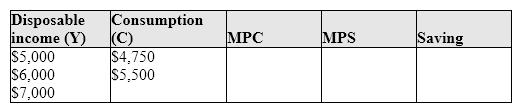 In Exhibit 8-15, when disposable income is $7,000, then saving will equal:
 (Multiple Choice)
4.8/5 (78)
(78) If disposable income is $400 billion, autonomous consumption is $60 billion, and MPC is 0.8, what is the level of saving?
(Multiple Choice)
4.8/5 (76)
(76) Exhibit 8-12 Consumption function 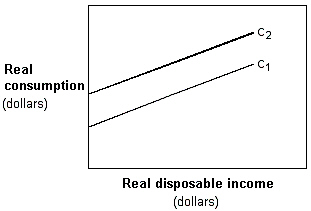 In Exhibit 8-12, which of the following could cause the movement from C1 to C2?
 (Multiple Choice)
4.8/5 (68)
(68) When sketched as a function of disposable income, the investment demand curve is:
(Multiple Choice)
4.9/5 (64)
(64) Consumption spending that is independent of the level of disposable income is known as:
(Multiple Choice)
4.9/5 (70)
(70) Prior to the Great Depression, classical economists believed that a recessionary downturn would be reversed by:
(Multiple Choice)
4.7/5 (84)
(84) Use the table below to answer the following question. 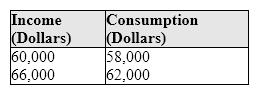 What is the marginal propensity to consume?
 (Multiple Choice)
4.9/5 (88)
(88) Exhibit 8-4 Disposable income and consumption data 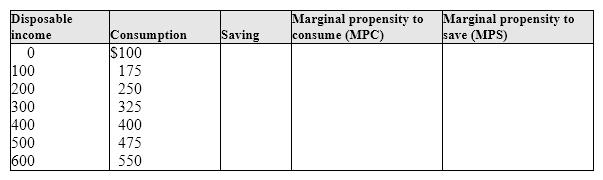 Note: All amounts are in billions of dollars per year. As shown in Exhibit 8-4, if disposable income is $100 billion, saving is:
 (Multiple Choice)
4.7/5 (91)
(91) If the interest rate rises, then firms' investment spending:
(Multiple Choice)
4.8/5 (73)
(73) Classical economic theory predicted that in the long run the economy would experience:
(Multiple Choice)
4.9/5 (87)
(87) 
Filters
- Essay(0)
- Multiple Choice(0)
- Short Answer(0)
- True False(0)
- Matching(0)