



 Chat with AI
Exam 8: The Keynesian Model

Exam 1: Introducing the Economic Way of Thinking176 Questions
Exam 2: Production Possibilities, Opportunity Cost, and Economic Growth200 Questions
Exam 3: Market Demand and Supply348 Questions
Exam 4: Markets in Action261 Questions
Exam 5: Gross Domestic Product223 Questions
Exam 6: Business Cycles and Unemployment194 Questions
Exam 7: Inflation126 Questions
Exam 8: The Keynesian Model235 Questions
Exam 9: The Keynesian Model in Action202 Questions
Exam 10: Aggregate Demand and Supply187 Questions
Exam 11: Fiscal Policy223 Questions
Exam 12: The Public Sector127 Questions
Exam 13: Federal Deficits, Surpluses, and the National Debt99 Questions
Exam 14: Money and the Federal Reserve System154 Questions
Exam 15: Money Creation243 Questions
Exam 16: Monetary Policy213 Questions
Exam 17: The Phillips Curve and Expectations Theory120 Questions
Exam 18: International Trade and Finance248 Questions
Exam 19: Economies in Transition104 Questions
Exam 20: Growth and the Less-Developed Countries117 Questions
Exam 21: Applying Graphs to Economics68 Questions
Exam 22: Consumer Surplus, Producer Surplus, and Market Efficiency68 Questions
Exam 23: the Self-Correcting Aggregate Demand and Supply Model83 Questions
Exam 24: Policy Disputes Using the Self-Correcting Aggregate Demand and Supply Model36 Questions
Select questions type


Exhibit 8-3 Consumption Function 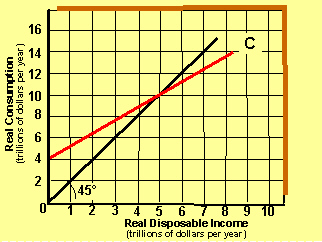 In Exhibit 8-3, what is the households' marginal propensity to consume (MPC)?
 (Multiple Choice)
4.9/5  (76)
(76) Exhibit 8-10 Consumption function 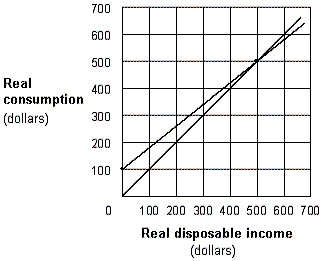 In Exhibit 8-10, consumption and real disposable income are equal at:
 (Multiple Choice)
4.8/5 (84)
(84) Exhibit 8-5 Consumption function 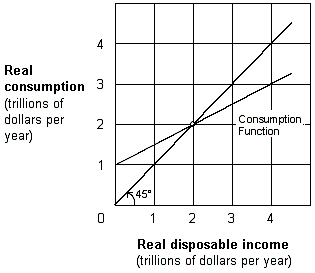 As shown in Exhibit 8-5, autonomous consumption is:
 (Multiple Choice)
4.9/5 (81)
(81) If your disposable personal income increases from $30,000 to $40,000 and your savings increases from $2,000 to $4,000, your marginal propensity to save (MPS)is:
(Multiple Choice)
4.9/5 (75)
(75) Explain how changes in wealth, the price level, interest rates, and expectations alter the consumption curve.
(Essay)
4.8/5 (73)
(73) If disposable income is $400 billion, consumption spending is $380 billion, and MPC is 0.5, what is the level of saving?
(Multiple Choice)
4.8/5 (71)
(71) Michelle Martelle, CEO of Michelle Enterprises, has five projects in hand and is considering which, if any, to undertake. Their expected returns are: project A = 12 percent, project B = 7 percent, project C = 10 percent, project D = 9 percent, and project E = 8 percent. If the interest rate is 8.5 percent, which, if any, investment projects will she accept?
(Multiple Choice)
4.9/5 (79)
(79) The vertical intercept of the consumption function is used to determine the break-even level of real disposable income.
(True/False)
4.8/5 (90)
(90) The most appropriate countercyclical policy, or stabilization policy, in times of unemployment, according to classical economists, is for the government to:
(Multiple Choice)
4.8/5 (82)
(82) Exhibit 8-1 Disposable income and consumption data
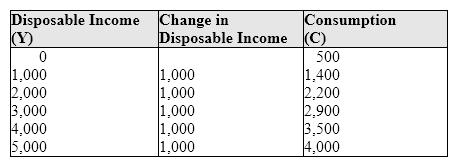 In Exhibit 8-1, when disposable income (Y)is increased from $1,000 to $2,000, the marginal propensity to consume is:
 (Multiple Choice)
4.9/5 (74)
(74) An upward shift in the consumption function, other things being equal, could be caused by households:
(Multiple Choice)
4.9/5 (84)
(84) A movement along the consumption function is caused by a change in:
(Multiple Choice)
4.9/5 (73)
(73) Exhibit 8-14 Consumption function 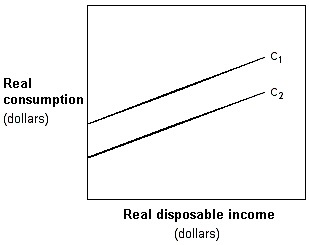 In Exhibit 8-14, which of the following could cause the shift from C1 to C2?
 (Multiple Choice)
4.7/5 (82)
(82) 
Filters
- Essay(0)
- Multiple Choice(0)
- Short Answer(0)
- True False(0)
- Matching(0)