



 Chat with AI
Exam 8: The Keynesian Model

Exam 1: Introducing the Economic Way of Thinking176 Questions
Exam 2: Production Possibilities, Opportunity Cost, and Economic Growth200 Questions
Exam 3: Market Demand and Supply348 Questions
Exam 4: Markets in Action261 Questions
Exam 5: Gross Domestic Product223 Questions
Exam 6: Business Cycles and Unemployment194 Questions
Exam 7: Inflation126 Questions
Exam 8: The Keynesian Model235 Questions
Exam 9: The Keynesian Model in Action202 Questions
Exam 10: Aggregate Demand and Supply187 Questions
Exam 11: Fiscal Policy223 Questions
Exam 12: The Public Sector127 Questions
Exam 13: Federal Deficits, Surpluses, and the National Debt99 Questions
Exam 14: Money and the Federal Reserve System154 Questions
Exam 15: Money Creation243 Questions
Exam 16: Monetary Policy213 Questions
Exam 17: The Phillips Curve and Expectations Theory120 Questions
Exam 18: International Trade and Finance248 Questions
Exam 19: Economies in Transition104 Questions
Exam 20: Growth and the Less-Developed Countries117 Questions
Exam 21: Applying Graphs to Economics68 Questions
Exam 22: Consumer Surplus, Producer Surplus, and Market Efficiency68 Questions
Exam 23: the Self-Correcting Aggregate Demand and Supply Model83 Questions
Exam 24: Policy Disputes Using the Self-Correcting Aggregate Demand and Supply Model36 Questions
Select questions type


If firms increase investment, the aggregate expenditures function will shift upward, other things being equal.
(True/False)
4.8/5  (85)
(85) Exhibit 8-14 Consumption function 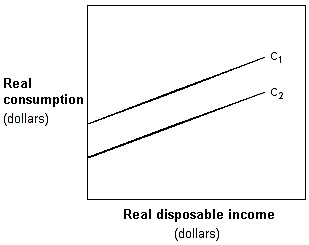 In Exhibit 8-14, which of the following could cause the shift from C1 to C2?
 (Multiple Choice)
4.8/5 (87)
(87) Which one of the following will shift the investment demand curve leftward?
(Multiple Choice)
4.8/5 (81)
(81) In the simple Keynesian aggregate expenditure model, the equilibrium level of disposable income is achieved when:
(Multiple Choice)
4.8/5 (77)
(77) Exhibit 8-10 Consumption function 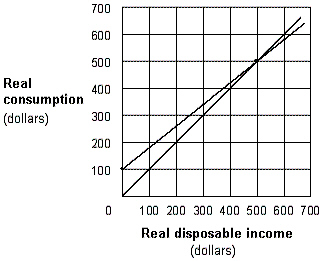 In Exhibit 8-10, the value of the marginal propensity to save is:
 (Multiple Choice)
4.9/5 (65)
(65) That part of disposable income not spent on consumption is:
(Multiple Choice)
4.7/5 (81)
(81) Exhibit 8-2 Consumption function 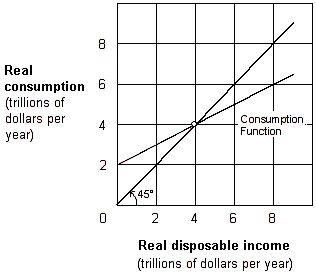 As shown in Exhibit 8-2, saving occurs:
 (Multiple Choice)
4.8/5 (72)
(72) Which of the following events would produce an upward shift in the consumption function, other things being equal?
(Multiple Choice)
4.9/5 (71)
(71) A movement along in the consumption function is caused by a change in:
(Multiple Choice)
4.8/5 (82)
(82) Explain why the marginal propensity to save and the marginal propensity to consume sum to 1.
(Essay)
4.9/5 (70)
(70) The marginal propensity to consume measures the ratio of the:
(Multiple Choice)
4.8/5 (76)
(76) Real investment spending is ____ real personal consumption.
(Multiple Choice)
5.0/5 (88)
(88) When one observes consumption and investment patterns over time, one finds that:
(Multiple Choice)
4.8/5 (67)
(67) In the consumption function, consumption is caused by changes in the:
(Multiple Choice)
4.9/5 (83)
(83) The classical economists argued that the production of goods and services (supply)generates an equal amount of total income and, in turn, total spending. This theory is called:
(Multiple Choice)
4.9/5 (83)
(83) Use the table below to answer the following question. 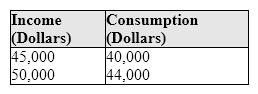 What is the marginal propensity to consume?
 (Multiple Choice)
4.8/5 (80)
(80) 
Filters
- Essay(0)
- Multiple Choice(0)
- Short Answer(0)
- True False(0)
- Matching(0)