



 Chat with AI
Exam 8: The Keynesian Model

Exam 1: Introducing the Economic Way of Thinking176 Questions
Exam 2: Production Possibilities, Opportunity Cost, and Economic Growth200 Questions
Exam 3: Market Demand and Supply348 Questions
Exam 4: Markets in Action261 Questions
Exam 5: Gross Domestic Product223 Questions
Exam 6: Business Cycles and Unemployment194 Questions
Exam 7: Inflation126 Questions
Exam 8: The Keynesian Model235 Questions
Exam 9: The Keynesian Model in Action202 Questions
Exam 10: Aggregate Demand and Supply187 Questions
Exam 11: Fiscal Policy223 Questions
Exam 12: The Public Sector127 Questions
Exam 13: Federal Deficits, Surpluses, and the National Debt99 Questions
Exam 14: Money and the Federal Reserve System154 Questions
Exam 15: Money Creation243 Questions
Exam 16: Monetary Policy213 Questions
Exam 17: The Phillips Curve and Expectations Theory120 Questions
Exam 18: International Trade and Finance248 Questions
Exam 19: Economies in Transition104 Questions
Exam 20: Growth and the Less-Developed Countries117 Questions
Exam 21: Applying Graphs to Economics68 Questions
Exam 22: Consumer Surplus, Producer Surplus, and Market Efficiency68 Questions
Exam 23: the Self-Correcting Aggregate Demand and Supply Model83 Questions
Exam 24: Policy Disputes Using the Self-Correcting Aggregate Demand and Supply Model36 Questions
Select questions type


An increase in the interest rate will stimulate firms' investment spending.
(True/False)
4.9/5  (79)
(79) If your disposable personal income increases from $40,000 to $48,000 and your consumption increases from $35,000 to $39,000, your marginal propensity to consume (MPC)is:
(Multiple Choice)
4.9/5 (89)
(89) In the Keynesian aggregate consumption-income graph, the vertical distance between the consumption function and the 45-degree line shows the:
(Multiple Choice)
4.8/5 (59)
(59) The dominant school of economic thought until midway through the Great Depression of the 1930s was:
(Multiple Choice)
4.8/5 (97)
(97) Exhibit 8-1 Disposable income and consumption data 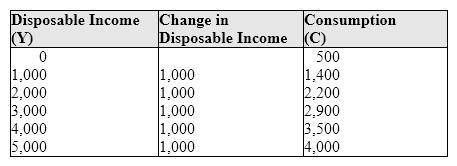 In Exhibit 8-1, when disposable income (Y)is increased from $0 to $1,000 to $2,000, the marginal propensity to consume:
 (Multiple Choice)
4.8/5 (83)
(83) If there are strong expectations of future economic growth, then the:
(Multiple Choice)
4.7/5 (70)
(70) Exhibit 8-5 Consumption function 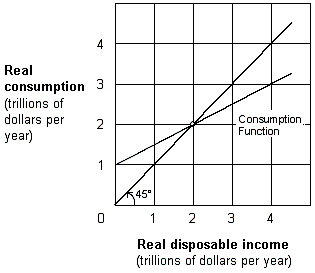 As shown in Exhibit 8-5, the marginal propensity to save (MPS)is:
 (Multiple Choice)
4.8/5 (79)
(79) If autonomous consumption is greater than zero and the marginal propensity to consume is greater than zero, but less than one, the consumption function will first be below and then above the 45 degree line.
(True/False)
4.9/5 (78)
(78) In the Keynesian model, investment spending is an autonomous expenditure.
(True/False)
4.8/5 (83)
(83) Exhibit 8-8 Aggregate expenditures function 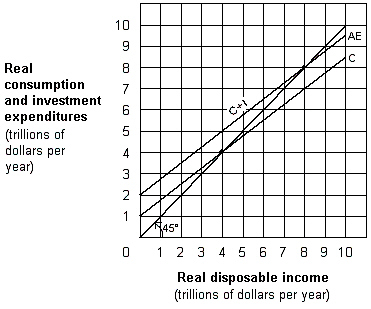 In Exhibit 8-8, what is the households' marginal propensity to consume (MPC)?
 (Multiple Choice)
4.9/5 (79)
(79) An increase in the price level, other things remaining the same, may be expected to result in ____ the consumption function.
(Multiple Choice)
4.7/5 (71)
(71) Economists refer to the simple relationship between consumption and disposable income as:
(Multiple Choice)
4.8/5 (89)
(89) The change in saving divided by the change in disposable income is the:
(Multiple Choice)
4.8/5 (74)
(74) Which one of the following will shift the consumption function downward?
(Multiple Choice)
4.9/5 (79)
(79) According to the classical economists, which of the following would make prolonged unemployment impossible?
(Multiple Choice)
4.9/5 (89)
(89) Which of the following will shift the consumption function upward?
(Multiple Choice)
4.7/5 (83)
(83) 
Filters
- Essay(0)
- Multiple Choice(0)
- Short Answer(0)
- True False(0)
- Matching(0)