



 Chat with AI
Exam 2: Production Possibilities, Opportunity Cost, and Economic Growth

Exam 1: Introducing the Economic Way of Thinking176 Questions
Exam 2: Production Possibilities, Opportunity Cost, and Economic Growth200 Questions
Exam 3: Market Demand and Supply348 Questions
Exam 4: Markets in Action261 Questions
Exam 5: Gross Domestic Product223 Questions
Exam 6: Business Cycles and Unemployment194 Questions
Exam 7: Inflation126 Questions
Exam 8: The Keynesian Model235 Questions
Exam 9: The Keynesian Model in Action202 Questions
Exam 10: Aggregate Demand and Supply187 Questions
Exam 11: Fiscal Policy223 Questions
Exam 12: The Public Sector127 Questions
Exam 13: Federal Deficits, Surpluses, and the National Debt99 Questions
Exam 14: Money and the Federal Reserve System154 Questions
Exam 15: Money Creation243 Questions
Exam 16: Monetary Policy213 Questions
Exam 17: The Phillips Curve and Expectations Theory120 Questions
Exam 18: International Trade and Finance248 Questions
Exam 19: Economies in Transition104 Questions
Exam 20: Growth and the Less-Developed Countries117 Questions
Exam 21: Applying Graphs to Economics68 Questions
Exam 22: Consumer Surplus, Producer Surplus, and Market Efficiency68 Questions
Exam 23: the Self-Correcting Aggregate Demand and Supply Model83 Questions
Exam 24: Policy Disputes Using the Self-Correcting Aggregate Demand and Supply Model36 Questions
Select questions type


Exhibit 2-13 Production possibilities curve 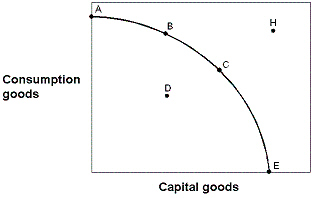 In Exhibit 2-13, point H is:
 (Multiple Choice)
5.0/5  (78)
(78) Other things being equal, a decreased supply of natural resources would be represented on a production possibilities curve by a(n):
(Multiple Choice)
4.9/5 (78)
(78) The amount of a good that is given up to produce another good is:
(Multiple Choice)
5.0/5 (86)
(86) Which fundamental economic question requires society to choose the technological and resource mix used to produce goods?
(Multiple Choice)
4.7/5 (69)
(69) Which of the following does not illustrate opportunity cost?
(Multiple Choice)
4.8/5 (91)
(91) The basic approach in marginal analysis is to compare a policy's total benefits with its total costs.
(True/False)
4.8/5 (67)
(67) Exhibit 2-10 Production possibilities curve data  Suppose an economy is faced with the production possibilities table shown in Exhibit 2-10. As additional units of capital goods are being produced, the number of consumption goods produced must ____, because ____.
 (Multiple Choice)
4.9/5 (73)
(73) Exhibit 2-1 Production possibilities curve data 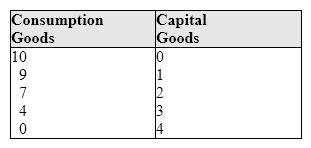 In Exhibit 2-1, according to the information, the opportunity cost of producing 3 units of capital is:
 (Multiple Choice)
4.8/5 (91)
(91) A local restaurant offers an "all you can eat" Sunday brunch for $12. Susan eats four servings, but leaves half of a fifth helping uneaten. Why?
(Multiple Choice)
4.9/5 (67)
(67) Which of the following would be most likely to cause the production possibilities curve for computers and education to shift outward?
(Multiple Choice)
4.8/5 (78)
(78) Which of the following most accurately indicates the implications of an economy's production possibilities curve?
(Multiple Choice)
4.9/5 (76)
(76) If an economy is operating at a point inside the production possibilities curve,
(Multiple Choice)
4.7/5 (81)
(81) Exhibit 2-9 Production possibilities curve 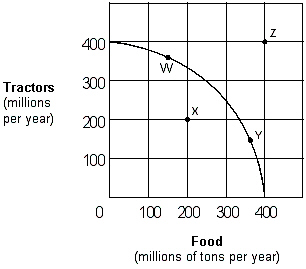 Which of the following moves from one point to another in Exhibit 2-9 would represent an increase in economic efficiency?
 (Multiple Choice)
4.9/5 (80)
(80) Marginal analysis examines the effects of additions to or subtractions from a current situation.
(True/False)
4.8/5 (82)
(82) After the terrorist attacks on September 11, 2001, the United States began devoting substantial resources toward the War on Terrorism, homeland security, and relief efforts. As long as our resources were being used efficiently, the production possibilities curve would suggest that:
(Multiple Choice)
4.9/5 (80)
(80) The law of increasing costs holds that the opportunity cost:
(Multiple Choice)
4.9/5 (75)
(75) 
Filters
- Essay(0)
- Multiple Choice(0)
- Short Answer(0)
- True False(0)
- Matching(0)