



 Chat with AI
Exam 2: Production Possibilities, Opportunity Cost, and Economic Growth

Exam 1: Introducing the Economic Way of Thinking176 Questions
Exam 2: Production Possibilities, Opportunity Cost, and Economic Growth200 Questions
Exam 3: Market Demand and Supply348 Questions
Exam 4: Markets in Action261 Questions
Exam 5: Gross Domestic Product223 Questions
Exam 6: Business Cycles and Unemployment194 Questions
Exam 7: Inflation126 Questions
Exam 8: The Keynesian Model235 Questions
Exam 9: The Keynesian Model in Action202 Questions
Exam 10: Aggregate Demand and Supply187 Questions
Exam 11: Fiscal Policy223 Questions
Exam 12: The Public Sector127 Questions
Exam 13: Federal Deficits, Surpluses, and the National Debt99 Questions
Exam 14: Money and the Federal Reserve System154 Questions
Exam 15: Money Creation243 Questions
Exam 16: Monetary Policy213 Questions
Exam 17: The Phillips Curve and Expectations Theory120 Questions
Exam 18: International Trade and Finance248 Questions
Exam 19: Economies in Transition104 Questions
Exam 20: Growth and the Less-Developed Countries117 Questions
Exam 21: Applying Graphs to Economics68 Questions
Exam 22: Consumer Surplus, Producer Surplus, and Market Efficiency68 Questions
Exam 23: the Self-Correcting Aggregate Demand and Supply Model83 Questions
Exam 24: Policy Disputes Using the Self-Correcting Aggregate Demand and Supply Model36 Questions
Select questions type


Which word best completes the following sentence? A rational decision maker always chooses the option for which marginal benefit is __________ marginal cost.
(Multiple Choice)
4.9/5  (77)
(77) Three basic decisions must be made by all economies. What are they?
(Multiple Choice)
4.9/5 (70)
(70) Exhibit 2-13 Production possibilities curve 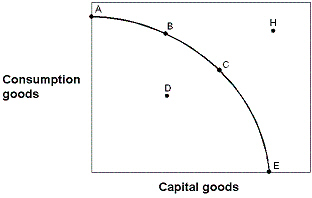 In Exhibit 2-13, which of the following is not true regarding point H? Point H:
 (Multiple Choice)
5.0/5 (91)
(91) The production possibilities curve depicts the various combinations of two goods that can be:
(Multiple Choice)
5.0/5 (74)
(74) The production possibilities curve illustrates all of the following concepts except :
(Multiple Choice)
4.8/5 (80)
(80) An opportunity cost is the highest valued alternative foregone whenever one chooses an alternative.
(True/False)
4.8/5 (70)
(70) Graphically express a production possibilities curve. What do points on, inside and outside the curve represent? What does a rightward shift of the curve represent? How is economic growth expressed in terms of the production possibilities model?
(Essay)
4.8/5 (86)
(86) Exhibit 2-16 Production possibilities curve 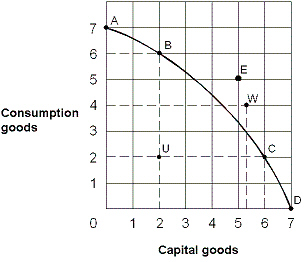 In Exhibit 2-16, to move from U to B, the opportunity cost:
 (Multiple Choice)
4.8/5 (79)
(79) In economics, investment refers to the process of accumulating:
(Multiple Choice)
4.9/5 (77)
(77) The production possibility curve is bowed outward from the origin because of:
(Multiple Choice)
4.9/5 (83)
(83) Exhibit 2-8 Production possibilities curve data  As shown in Exhibit 2-8, a total output of 0 units of capital goods and 10 units of consumer goods is:
 (Multiple Choice)
4.7/5 (84)
(84) Exhibit 2-2 Production possibilities curve 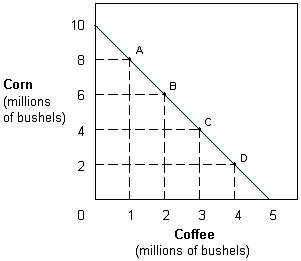 The production possibilities in Exhibit 2-2 indicates that the opportunity cost of corn is:
 (Multiple Choice)
4.9/5 (74)
(74) Exhibit 2-18 Production possibilities curves 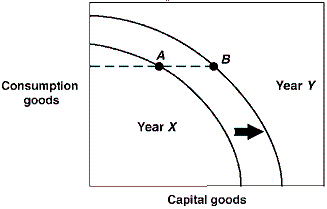 In Exhibit 2-18, the production possibilities curves for a country are shown for the years Year X and Year Y. Suppose this country was located at point A in Year X and point B in Year Y. This country:
 (Multiple Choice)
5.0/5 (81)
(81) When the production possibilities curve is bowed out, resources are:
(Multiple Choice)
4.8/5 (71)
(71) While waiting in line to buy one cheeseburger for $1.50 and a medium drink for $1.00, Sally notices that she could get a value meal that contains both the cheeseburger and medium drink and also a medium order of fries for $2.75. She thinks to herself, "Is it worth the extra 25 cents to get the medium fries?" To an economist, Sally's decision is an example of:
(Multiple Choice)
4.9/5 (74)
(74) If an economy is producing at full employment, it means that:
(Multiple Choice)
4.8/5 (78)
(78) If society leaves some of its resources unemployed, then it will be operating at a point:
(Multiple Choice)
4.9/5 (81)
(81) When an economy's resources are not fully employed, then it must be true that the:
(Multiple Choice)
4.8/5 (79)
(79) Which of the following would be least likely to cause the production possibilities curve to shift outward?
(Multiple Choice)
4.7/5 (68)
(68) 
Filters
- Essay(0)
- Multiple Choice(0)
- Short Answer(0)
- True False(0)
- Matching(0)