



 Chat with AI
Exam 2: Production Possibilities, Opportunity Cost, and Economic Growth

Exam 1: Introducing the Economic Way of Thinking176 Questions
Exam 2: Production Possibilities, Opportunity Cost, and Economic Growth200 Questions
Exam 3: Market Demand and Supply348 Questions
Exam 4: Markets in Action261 Questions
Exam 5: Gross Domestic Product223 Questions
Exam 6: Business Cycles and Unemployment194 Questions
Exam 7: Inflation126 Questions
Exam 8: The Keynesian Model235 Questions
Exam 9: The Keynesian Model in Action202 Questions
Exam 10: Aggregate Demand and Supply187 Questions
Exam 11: Fiscal Policy223 Questions
Exam 12: The Public Sector127 Questions
Exam 13: Federal Deficits, Surpluses, and the National Debt99 Questions
Exam 14: Money and the Federal Reserve System154 Questions
Exam 15: Money Creation243 Questions
Exam 16: Monetary Policy213 Questions
Exam 17: The Phillips Curve and Expectations Theory120 Questions
Exam 18: International Trade and Finance248 Questions
Exam 19: Economies in Transition104 Questions
Exam 20: Growth and the Less-Developed Countries117 Questions
Exam 21: Applying Graphs to Economics68 Questions
Exam 22: Consumer Surplus, Producer Surplus, and Market Efficiency68 Questions
Exam 23: the Self-Correcting Aggregate Demand and Supply Model83 Questions
Exam 24: Policy Disputes Using the Self-Correcting Aggregate Demand and Supply Model36 Questions
Select questions type


The process through which an economy's production possibilities curve shifts outward is:
(Multiple Choice)
4.7/5  (87)
(87) What can a nation do to increase its economic growth? Why is economic growth among the major national economic goals of all countries?
(Essay)
4.7/5 (82)
(82) A production possibilities curve has "good X" on the horizontal axis and "good Y" on the vertical axis. On this diagram, the opportunity cost of good X, in terms of good Y, is represented by the:
(Multiple Choice)
4.7/5 (72)
(72) A point outside the production possibilities curve represents a combination of goods that is:
(Multiple Choice)
4.8/5 (72)
(72) Production possibilities curve analysis includes the idea of:
(Multiple Choice)
4.7/5 (78)
(78) Which of the following does not illustrate opportunity cost?
(Multiple Choice)
4.9/5 (79)
(79) When the opportunity cost of producing carrots increases as more carrots are produced, then:
(Multiple Choice)
4.9/5 (66)
(66) The most efficient point on the production possibilities curve is the midpoint on the curve.
(True/False)
4.8/5 (78)
(78) Exhibit 2-12 Production possibilities curve 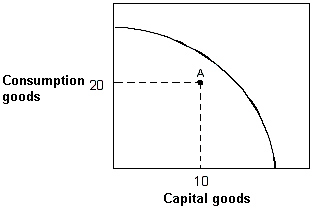 In Exhibit 2-12, suppose an economy with the given production possibilities curve is currently located at point A in the figure. Which of the following statements is false ?
 (Multiple Choice)
4.8/5 (87)
(87) On a production possibilities curve diagram, greater entrepreneurship:
(Multiple Choice)
4.8/5 (86)
(86) Robinson Crusoe's decision to produce more capital goods and fewer consumer goods in a given period causes:
(Multiple Choice)
5.0/5 (82)
(82) Exhibit 2-15 Production possibilities curve 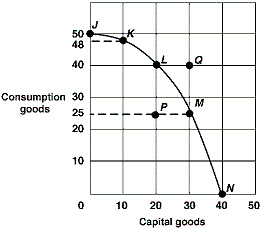 In Exhibit 2-15, if the economy moves from point L to point M, the opportunity cost of producing 10 more capital goods is:
 (Multiple Choice)
4.8/5 (82)
(82) Compare two economies A and B that start out with identical production possibilities curves. Economy A chooses an efficient point with 6 consumption goods and 3 capital goods, while economy B also chooses an efficient point, but with 4 consumption goods and 5 capital goods. In the future we can predict:
(Multiple Choice)
4.8/5 (90)
(90) Exhibit 2-16 Production possibilities curve 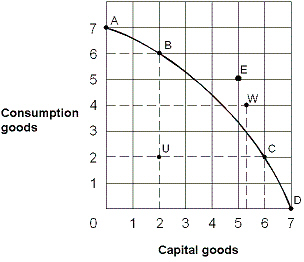 In Exhibit 2-16, which of the following points on the production possibilities curve are efficient production points?
 (Multiple Choice)
4.7/5 (83)
(83) Which of the following causes the production possibilities curve to shift to the right?
(Multiple Choice)
4.9/5 (75)
(75) The law of increasing opportunity costs causes the production possibilities curve to:
(Multiple Choice)
4.9/5 (87)
(87) Investment in capital accumulation, as well as investment in education and other labor productivity enhancing programs, is necessary for economic growth.
(True/False)
4.8/5 (86)
(86) While waiting in line to buy a cheeseburger for $2 and a drink for 75 cents, Aaron notices that the restaurant has a value meal containing a cheeseburger, drink, and French fries for $3. For Aaron, the marginal cost of purchasing the French fries:
(Multiple Choice)
4.9/5 (78)
(78) 
Filters
- Essay(0)
- Multiple Choice(0)
- Short Answer(0)
- True False(0)
- Matching(0)