



 Chat with AI
Exam 13: Fiscal Policy, Deficits, and Debt

Exam 2: The Market System and the Circular Flow274 Questions
Exam 3: Demand, Supply, and Market Equilibrium357 Questions
Exam 4: Market Failures Caused by Externalities Asymmetric Information222 Questions
Exam 5: Public Goods, Public Choice, and Government Failure242 Questions
Exam 6: An Introduction to Macroeconomics243 Questions
Exam 7: Measuring Domestic Output and National Income238 Questions
Exam 8: Economic Growth274 Questions
Exam 9: Business Cycles, Unemployment, and Inflation298 Questions
Exam 10: Basic Macroeconomic Relationships233 Questions
Exam 11: The Aggregate Expenditures Model126 Questions
Exam 12: Aggregate Demand and Aggregate Supply320 Questions
Exam 13: Fiscal Policy, Deficits, and Debt401 Questions
Exam 14: Money, Banking, and Financial Institutions265 Questions
Exam 15: Money Creation285 Questions
Exam 16: Interest Rates and Monetary Policy405 Questions
Exam 17: Financial Economics356 Questions
Exam 18: Extending the Analysis of Aggregate Supply268 Questions
Exam 19: Current Issues in Macro Theory and Policy279 Questions
Exam 20: International Trade339 Questions
Exam 21: The Balance of Payments, Exchange Rates, and Trade Deficits315 Questions
Exam 22: The Economics of Developing Countries269 Questions
Select questions type


Through the start of 2009, Social Security revenues exceeded payouts, and the excess inflow was used to buy
(Multiple Choice)
4.7/5  (85)
(85) Permanent tax reductions are more likely to be expansionary than temporary tax reductions.
(True/False)
4.8/5 (92)
(92) Tax revenues automatically increase during economic expansions and decrease during recessions.
(True/False)
4.9/5 (78)
(78) One important reason why the United States government is not likely to go bankrupt even with a large public debt is that it has
(Multiple Choice)
4.9/5 (76)
(76) If the crowding-out effect is at its maximum strength, it follows that an increase in government spending will
(Multiple Choice)
5.0/5 (79)
(79) Which of the following best describes the idea of a political business cycle?
(Multiple Choice)
4.9/5 (85)
(85) Government Spending Tax Revenues GDP Year 1 \ 450 \ 425 \ 2,000 Year 2 500 450 3,000 Year 3 600 500 4,000 Year 4 640 620 5,000 Year 5 680 580 4,800 Year 6 600 620 5,000 The accompanying table gives budget information for a hypothetical economy. Assume that all budget surpluses are used to pay down the public debt. The public debt declined in year
(Multiple Choice)
4.9/5 (86)
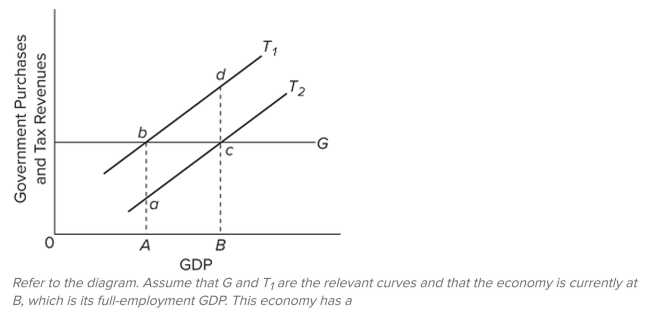
(86) 
The American Recovery and Reinvestment Act of 2009 included mostly
(Multiple Choice)
4.9/5 (76)
(76) The two reasons why bankruptcy is a false concern about the public debt are
(Multiple Choice)
4.8/5 (72)
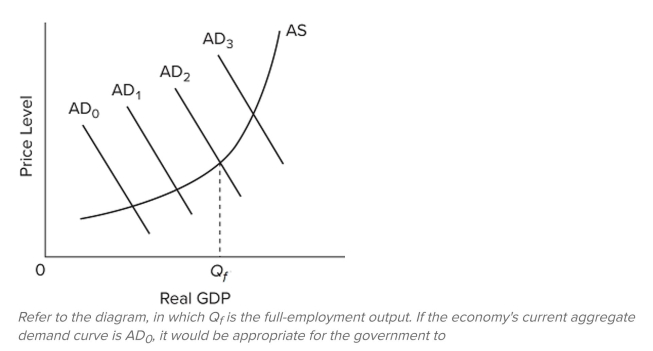
(72) 
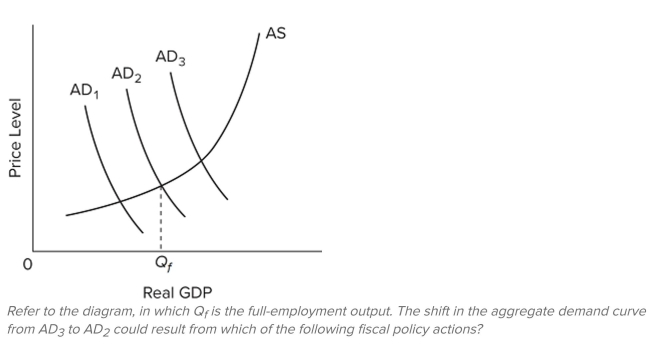
Government Spending Tax Revenues GDP Year 1 \ 450 \ 425 \ 2,000 Year 2 500 450 3,000 Year 3 600 500 4,000 Year 4 640 620 5,000 Year 5 680 580 4,800 Year 6 600 620 5,000 The accompanying table gives budget information for a hypothetical economy. Assume that all budget surpluses are used to pay down the public debt. A budget surplus occurred in year
(Multiple Choice)
4.9/5 (77)
(77) If people expected that a fiscal policy in the form of a tax cut was temporary, then this policy's effect on the economy would tend to be
(Multiple Choice)
4.8/5 (82)
(82) Which of the following historically has not been a significant contributor to the U.S. public debt?
(Multiple Choice)
4.9/5 (77)
(77) 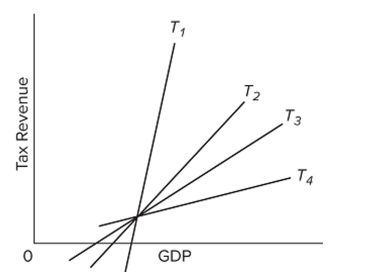 Refer to the diagram. Which tax system has the most built-in stability?
 (Multiple Choice)
4.7/5 (85)
(85) A tax reduction of a specific amount will be more expansionary the
(Multiple Choice)
4.8/5 (85)
(85) Proponents of the notion of a "political business cycle" suggest that
(Multiple Choice)
4.8/5 (89)
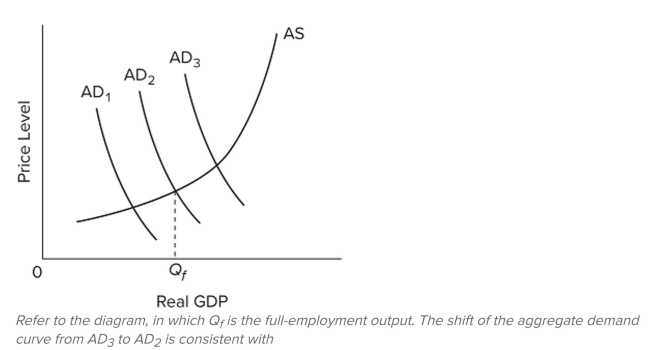
(89) 

Filters
- Essay(0)
- Multiple Choice(0)
- Short Answer(0)
- True False(0)
- Matching(0)