



 Chat with AI
Exam 13: Fiscal Policy, Deficits, and Debt

Exam 2: The Market System and the Circular Flow274 Questions
Exam 3: Demand, Supply, and Market Equilibrium357 Questions
Exam 4: Market Failures Caused by Externalities Asymmetric Information222 Questions
Exam 5: Public Goods, Public Choice, and Government Failure242 Questions
Exam 6: An Introduction to Macroeconomics243 Questions
Exam 7: Measuring Domestic Output and National Income238 Questions
Exam 8: Economic Growth274 Questions
Exam 9: Business Cycles, Unemployment, and Inflation298 Questions
Exam 10: Basic Macroeconomic Relationships233 Questions
Exam 11: The Aggregate Expenditures Model126 Questions
Exam 12: Aggregate Demand and Aggregate Supply320 Questions
Exam 13: Fiscal Policy, Deficits, and Debt401 Questions
Exam 14: Money, Banking, and Financial Institutions265 Questions
Exam 15: Money Creation285 Questions
Exam 16: Interest Rates and Monetary Policy405 Questions
Exam 17: Financial Economics356 Questions
Exam 18: Extending the Analysis of Aggregate Supply268 Questions
Exam 19: Current Issues in Macro Theory and Policy279 Questions
Exam 20: International Trade339 Questions
Exam 21: The Balance of Payments, Exchange Rates, and Trade Deficits315 Questions
Exam 22: The Economics of Developing Countries269 Questions
Select questions type


The so-called crowding-out effect refers to government spending crowding out private investment
spending.
(True/False)
4.8/5  (95)
(95) The amount by which federal tax revenues exceed federal government expenditures during a particular year is the
(Multiple Choice)
4.9/5 (70)
(70) Financing wartime expenditures by increasing internally held public debt permits a nation to defer a part
of the economic cost of war.
(True/False)
4.8/5 (89)
(89) The public debt is held as Treasury bills, Treasury notes, Treasury bonds, and U.S. savings bonds.
(True/False)
4.7/5 (93)
(93) The so-called recognition lag associated with fiscal policy is a result of how slowly the U.S. Congress
moves.
(True/False)
4.9/5 (82)
(82) A decrease in taxes is one way to pursue a contractionary fiscal policy because it will make government
revenues contract.
(True/False)
4.9/5 (88)
(88) A large public debt would not bankrupt the federal government, because it can refinance the debt or
increase taxes to pay the debt.
(True/False)
4.9/5 (74)
(74) 
Discretionary fiscal policy will stabilize the economy most when
(Multiple Choice)
4.7/5 (85)
(85) Demand-pull inflation can be restrained by increasing government spending and reducing taxes.
(True/False)
4.8/5 (70)
(70) Expansionary fiscal policy during a recession means cutting taxes, increasing government spending, or
taking both actions.
(True/False)
4.9/5 (79)
(79) One of the potential consequences of the public debt is that it may
(Multiple Choice)
4.9/5 (92)
(92) The "stimulus package" that the government implemented in response to the Great Recession of 2007-
09 made the cyclically adjusted budget of the U.S. have a very large positive balance in that time
period.
(True/False)
4.9/5 (80)
(80) It is more meaningful economically to measure the public debt relative to the GDP than to measure it in
absolute terms.
(True/False)
4.8/5 (70)
(70) 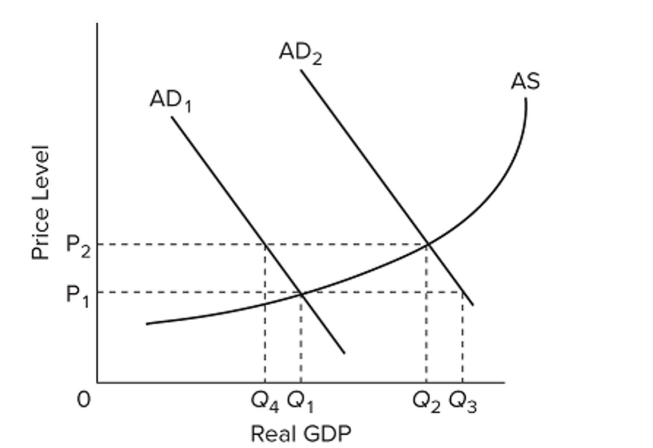 Refer to the graph. Assume that the economy is in a recession with a price level of and output level
. The government then adopts an appropriate discretionary ?scal policy. What will be the most likely
New equilibrium price level and output?
Refer to the graph. Assume that the economy is in a recession with a price level of and output level
. The government then adopts an appropriate discretionary ?scal policy. What will be the most likely
New equilibrium price level and output? (Multiple Choice)
5.0/5 (82)
(82) The crowding-out effect refers to the possibility that deficit spending may motivate people to increase
their saving in anticipation of higher future taxes.
(True/False)
4.9/5 (78)
(78) The economy is in a recession. The government enacts a policy to increase spending by $2 billion. The MPS is 0.2. What would be the full increase in real GDP from the change in government spending,
Assuming that the aggregate supply curve is horizontal across the range of GDP being considered?
(Multiple Choice)
4.8/5 (66)
(66) 
Filters
- Essay(0)
- Multiple Choice(0)
- Short Answer(0)
- True False(0)
- Matching(0)