



 Chat with AI
Exam 13: Fiscal Policy, Deficits, and Debt

Exam 2: The Market System and the Circular Flow274 Questions
Exam 3: Demand, Supply, and Market Equilibrium357 Questions
Exam 4: Market Failures Caused by Externalities Asymmetric Information222 Questions
Exam 5: Public Goods, Public Choice, and Government Failure242 Questions
Exam 6: An Introduction to Macroeconomics243 Questions
Exam 7: Measuring Domestic Output and National Income238 Questions
Exam 8: Economic Growth274 Questions
Exam 9: Business Cycles, Unemployment, and Inflation298 Questions
Exam 10: Basic Macroeconomic Relationships233 Questions
Exam 11: The Aggregate Expenditures Model126 Questions
Exam 12: Aggregate Demand and Aggregate Supply320 Questions
Exam 13: Fiscal Policy, Deficits, and Debt401 Questions
Exam 14: Money, Banking, and Financial Institutions265 Questions
Exam 15: Money Creation285 Questions
Exam 16: Interest Rates and Monetary Policy405 Questions
Exam 17: Financial Economics356 Questions
Exam 18: Extending the Analysis of Aggregate Supply268 Questions
Exam 19: Current Issues in Macro Theory and Policy279 Questions
Exam 20: International Trade339 Questions
Exam 21: The Balance of Payments, Exchange Rates, and Trade Deficits315 Questions
Exam 22: The Economics of Developing Countries269 Questions
Select questions type


Expansionary fiscal policy will tend to reduce the budget deficit.
(True/False)
4.8/5  (79)
(79) A decrease in taxes is one way to pursue a contractionary fiscal policy because it will make government
revenues contract.
(True/False)
4.8/5 (80)
(80) A procyclical fiscal policy, like those of many state and local governments in the United States, tends to
(Multiple Choice)
4.9/5 (74)
(74) 
If the MPS in an economy is 0.1, government could shift the aggregate demand curve rightward by $40 billion by
(Multiple Choice)
4.9/5 (87)
(87) It is more meaningful economically to measure the public debt relative to the GDP than to measure it in
absolute terms.
(True/False)
4.7/5 (76)
(76) If there is a constitutional requirement to maintain a balanced budget, then during a recession when tax revenues are shrinking, the government will have to implement
(Multiple Choice)
4.9/5 (66)
(66) 
You are given the following information about aggregate demand at the existing price level for an economy: (1) consumption = $500 billion, (2) investment = $50 billion, (3) government purchases = $100
Billion, and (4) net export = $20 billion. If the full-employment level of GDP for this economy is $620
Billion, then what combination of actions would be most consistent with closing the GDP gap here?
(Multiple Choice)
4.8/5 (69)
(69) 
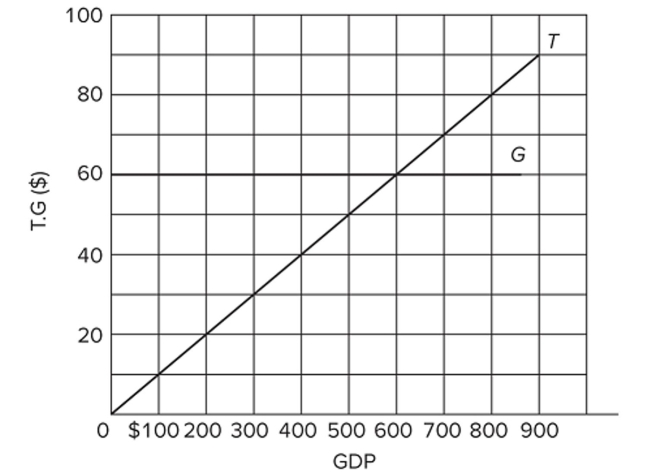 Refer to the diagram, where T is tax revenues and G is government expenditures. All figures are in billions of dollars. If the full-employment GDP is $400 billion, while the actual GDP is $200 billion, the
Actual budget deficit is
Refer to the diagram, where T is tax revenues and G is government expenditures. All figures are in billions of dollars. If the full-employment GDP is $400 billion, while the actual GDP is $200 billion, the
Actual budget deficit is (Multiple Choice)
4.8/5 (68)
(68) The "stimulus package" that the government implemented in response to the Great Recession of 2007-
09 made the cyclically adjusted budget of the U.S. have a very large positive balance in that time
period.
(True/False)
4.8/5 (95)
(95) If the MPC in an economy is 0.75, government could shift the aggregate demand curve leftward by $60 billion by
(Multiple Choice)
4.8/5 (87)
(87) Which of the following represents the most expansionary fiscal policy?
(Multiple Choice)
4.9/5 (82)
(82) To say that "the U.S. public debt is mostly held internally" is to say that
(Multiple Choice)
4.9/5 (77)
(77) 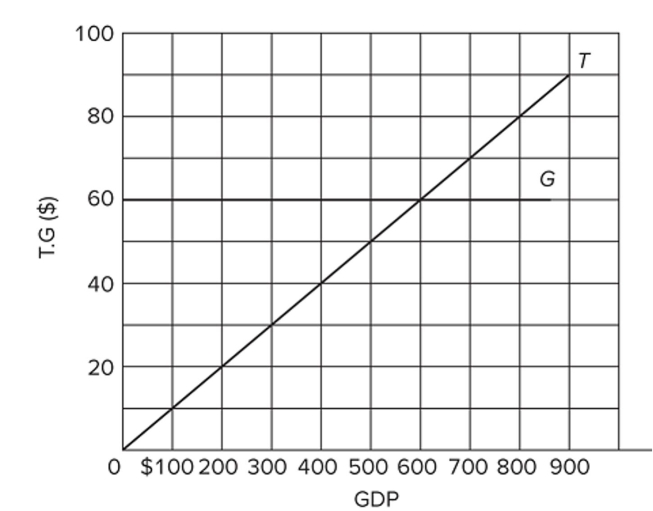 Refer to the diagram, where T is tax revenues and G is government expenditures. All figures are in billions of dollars. If the full-employment GDP is $400 billion, while the actual GDP is $200 billion, the
Cyclically adjusted budget deficit is
Refer to the diagram, where T is tax revenues and G is government expenditures. All figures are in billions of dollars. If the full-employment GDP is $400 billion, while the actual GDP is $200 billion, the
Cyclically adjusted budget deficit is (Multiple Choice)
4.8/5 (65)
(65) The actual and cyclically adjusted budgets will be equal when the economy is at full employment.
(True/False)
4.8/5 (91)
(91) 
Filters
- Essay(0)
- Multiple Choice(0)
- Short Answer(0)
- True False(0)
- Matching(0)