



 Chat with AI
Exam 13: Fiscal Policy, Deficits, and Debt

Exam 2: The Market System and the Circular Flow274 Questions
Exam 3: Demand, Supply, and Market Equilibrium357 Questions
Exam 4: Market Failures Caused by Externalities Asymmetric Information222 Questions
Exam 5: Public Goods, Public Choice, and Government Failure242 Questions
Exam 6: An Introduction to Macroeconomics243 Questions
Exam 7: Measuring Domestic Output and National Income238 Questions
Exam 8: Economic Growth274 Questions
Exam 9: Business Cycles, Unemployment, and Inflation298 Questions
Exam 10: Basic Macroeconomic Relationships233 Questions
Exam 11: The Aggregate Expenditures Model126 Questions
Exam 12: Aggregate Demand and Aggregate Supply320 Questions
Exam 13: Fiscal Policy, Deficits, and Debt401 Questions
Exam 14: Money, Banking, and Financial Institutions265 Questions
Exam 15: Money Creation285 Questions
Exam 16: Interest Rates and Monetary Policy405 Questions
Exam 17: Financial Economics356 Questions
Exam 18: Extending the Analysis of Aggregate Supply268 Questions
Exam 19: Current Issues in Macro Theory and Policy279 Questions
Exam 20: International Trade339 Questions
Exam 21: The Balance of Payments, Exchange Rates, and Trade Deficits315 Questions
Exam 22: The Economics of Developing Countries269 Questions
Select questions type


Which of the following serves as an automatic stabilizer in the economy?
(Multiple Choice)
4.9/5  (94)
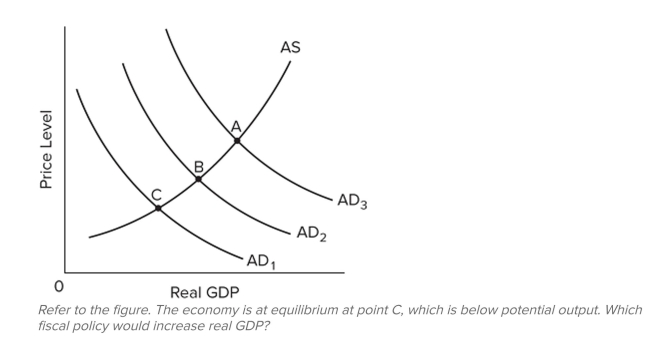
(94) 
Government Spending Tax Revenues GDP Year 1 \ 450 \ 425 \ 2,000 Year 2 500 450 3,000 Year 3 600 500 4,000 Year 4 640 620 5,000 Year 5 680 580 4,800 Year 6 600 620 5,000 The accompanying table gives budget information for a hypothetical economy. Assume that all budget surpluses are used to pay down the public debt. As a percentage of GDP, the
(Multiple Choice)
4.9/5 (80)
(80)  Refer to the diagram, in which T is tax revenues and G is government expenditures. All figures are in billions. In this economy,
 (Multiple Choice)
4.7/5 (75)
(75) The cyclically adjusted deficit as a percentage of GDP is 2 percent in Year 1. This cyclically adjusted deficit becomes 1 percent of GDP in Year 2. It can be concluded that from Year 1 to Year 2,
(Multiple Choice)
4.8/5 (80)
(80) The actual and cyclically adjusted budgets will be equal when the economy is at full employment.
(True/False)
4.9/5 (93)
(93) Year Actual Budget Deficit (-) or Surplus (+) Cyclically Adjusted Deficit (-) or Surplus (+) 1 +1.4\% +0.1\% 2 +2.5 +1.1 3 +1.3 +1.1 4 -1.5 -1.1 5 -3.4 -2.7 6 -3.5 -2.4 7 -2.6 -1.8 8 -1.9 -1.8 9 -1.3 -1.4 Refer to the data in the table. The direction of ?scal policy became more contractionary from
(Multiple Choice)
4.8/5 (81)
(81) A major reason that the public debt cannot bankrupt the federal government is because
(Multiple Choice)
4.9/5 (71)
(71) When Social Security contributions have exceeded payouts in the past, the excess amounts were used
to help finance the federal government's budget deficits.
(True/False)
4.9/5 (72)
(72) 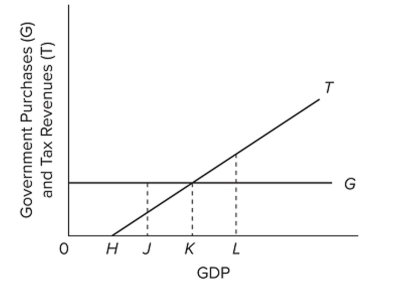 If the full-employment GDP for the economy is at L, then we can say with certainty that the
 (Multiple Choice)
5.0/5 (77)
(77) Built-in stability is synonymous with discretionary fiscal policy.
(True/False)
4.8/5 (85)
(85) Which of the following is an important real consequence of the public debt of the United States?
(Multiple Choice)
4.9/5 (81)
(81) The payment of interest on the public debt in the United States mildly increases income inequality.
(True/False)
4.9/5 (80)
(80) If the MPC in the economy is 0.75, government could shift the aggregate demand curve rightward by
$30 billion by cutting taxes by $10 billion.
(True/False)
4.9/5 (85)
(85) The crowding-out effect will be minimal when the economy is in a severe recession.
(True/False)
4.7/5 (82)
(82)  Refer to the diagram, in which T is tax revenues and G is government expenditures. All figures are in billions. The budget will entail a deficit
 (Multiple Choice)
4.8/5 (80)
(80) Crowding out is a decrease in private investment caused by
(Multiple Choice)
4.8/5 (80)
(80) 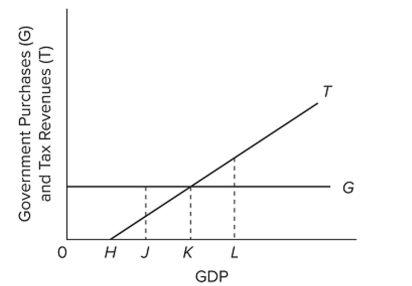 Refer to the diagram. The degree of built-in stability in the economy could be increased by
 (Multiple Choice)
4.9/5 (83)
(83) 
Filters
- Essay(0)
- Multiple Choice(0)
- Short Answer(0)
- True False(0)
- Matching(0)