



 Chat with AI
Exam 13: Fiscal Policy, Deficits, and Debt

Exam 2: The Market System and the Circular Flow274 Questions
Exam 3: Demand, Supply, and Market Equilibrium357 Questions
Exam 4: Market Failures Caused by Externalities Asymmetric Information222 Questions
Exam 5: Public Goods, Public Choice, and Government Failure242 Questions
Exam 6: An Introduction to Macroeconomics243 Questions
Exam 7: Measuring Domestic Output and National Income238 Questions
Exam 8: Economic Growth274 Questions
Exam 9: Business Cycles, Unemployment, and Inflation298 Questions
Exam 10: Basic Macroeconomic Relationships233 Questions
Exam 11: The Aggregate Expenditures Model126 Questions
Exam 12: Aggregate Demand and Aggregate Supply320 Questions
Exam 13: Fiscal Policy, Deficits, and Debt401 Questions
Exam 14: Money, Banking, and Financial Institutions265 Questions
Exam 15: Money Creation285 Questions
Exam 16: Interest Rates and Monetary Policy405 Questions
Exam 17: Financial Economics356 Questions
Exam 18: Extending the Analysis of Aggregate Supply268 Questions
Exam 19: Current Issues in Macro Theory and Policy279 Questions
Exam 20: International Trade339 Questions
Exam 21: The Balance of Payments, Exchange Rates, and Trade Deficits315 Questions
Exam 22: The Economics of Developing Countries269 Questions
Select questions type


Built-in stability is exemplified by the fact that with a progressive tax system, net tax revenues decrease
when GDP decreases.
(True/False)
4.7/5  (81)
(81) One timing problem in using fiscal policy to counter a recession is the "operational lag" that occurs between the
(Multiple Choice)
4.7/5 (70)
(70) A major concern with the Social Security trust fund is that
(Multiple Choice)
5.0/5 (93)
(93) If the MPS in an economy is 0.4, government could shift the aggregate demand curve leftward by $50 billion by
(Multiple Choice)
4.9/5 (67)
(67) If the MPC in the economy is 0.75, government could shift the aggregate demand curve rightward by
$30 billion by cutting taxes by $10 billion.
(True/False)
4.8/5 (83)
(83) Suppose the federal government had budget surpluses of $80 billion in year 1 and $120 billion in year 2 but had budget deficits of $10 billion in year 3 and $40 billion in year 4. Also assume that it used its
Budget surpluses to pay down prior years of the public debt. At the end of these four years, the federal
Government's public debt would have
(Multiple Choice)
4.9/5 (85)
(85) 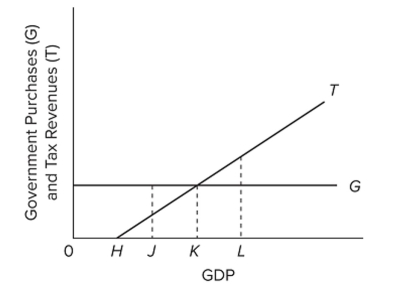 With the expenditures programs and the tax system shown in the diagram,
 (Multiple Choice)
5.0/5 (84)
(84) Which one of the following might offset a crowding-out effect of financing a large public debt?
(Multiple Choice)
4.8/5 (76)
(76) What percentage of the U.S. public debt is held by U.S. government agencies and the Federal Reserve (2018)?
(Multiple Choice)
4.9/5 (76)
(76) The public debt is held as Treasury bills, Treasury notes, Treasury bonds, and U.S. savings bonds.
(True/False)
4.8/5 (77)
(77) (Last Word) In 1960 the ratio of workers to Social Security and Medicare beneficiaries was ______; by 2040 it is projected to be _________.
(Multiple Choice)
4.7/5 (88)
(88) It is possible for an increase in government spending to encourage, instead of crowding out, private
investment.
(True/False)
4.8/5 (71)
(71) In 2018, about ____ percent of the U.S. public debt was held by people and institutions abroad.
(Multiple Choice)
4.9/5 (84)
(84)  Refer to the diagram. If the full-employment level of GDP is A, then it would be appropriate fiscal policy for government to
 (Multiple Choice)
4.8/5 (76)
(76) An increase in the cyclical deficits will automatically increase the cyclically adjusted budget deficit.
(True/False)
4.9/5 (85)
(85) The crowding-out effect tends to be stronger when the economy
(Multiple Choice)
4.8/5 (72)
(72) Describe the characteristics of fiscal policy in the Great Recession. Was it expansionary or
contractionary?
(Essay)
4.8/5 (68)
(68) Transfer payments that increase as GDP falls are a type of automatic stabilizer in the economy.
(True/False)
4.9/5 (80)
(80) If taxation becomes more progressive, the built-in stability in the economy will decrease.
(True/False)
4.9/5 (91)
(91) 
Filters
- Essay(0)
- Multiple Choice(0)
- Short Answer(0)
- True False(0)
- Matching(0)