



 Chat with AI
Exam 13: Fiscal Policy, Deficits, and Debt

Exam 2: The Market System and the Circular Flow274 Questions
Exam 3: Demand, Supply, and Market Equilibrium357 Questions
Exam 4: Market Failures Caused by Externalities Asymmetric Information222 Questions
Exam 5: Public Goods, Public Choice, and Government Failure242 Questions
Exam 6: An Introduction to Macroeconomics243 Questions
Exam 7: Measuring Domestic Output and National Income238 Questions
Exam 8: Economic Growth274 Questions
Exam 9: Business Cycles, Unemployment, and Inflation298 Questions
Exam 10: Basic Macroeconomic Relationships233 Questions
Exam 11: The Aggregate Expenditures Model126 Questions
Exam 12: Aggregate Demand and Aggregate Supply320 Questions
Exam 13: Fiscal Policy, Deficits, and Debt401 Questions
Exam 14: Money, Banking, and Financial Institutions265 Questions
Exam 15: Money Creation285 Questions
Exam 16: Interest Rates and Monetary Policy405 Questions
Exam 17: Financial Economics356 Questions
Exam 18: Extending the Analysis of Aggregate Supply268 Questions
Exam 19: Current Issues in Macro Theory and Policy279 Questions
Exam 20: International Trade339 Questions
Exam 21: The Balance of Payments, Exchange Rates, and Trade Deficits315 Questions
Exam 22: The Economics of Developing Countries269 Questions
Select questions type


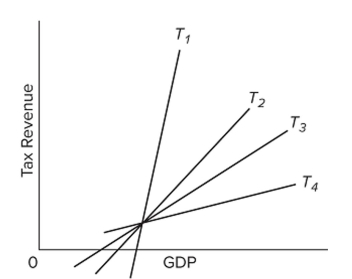 Refer to the diagram. Which tax system will generate the largest cyclical de?cits?
 (Multiple Choice)
4.9/5  (71)
(71) In an economy, the government wants to increase aggregate demand by $50 billion at each price level to increase real GDP and reduce unemployment. If the MPS is 0.4, then it could increase government
Spending by
(Multiple Choice)
4.9/5 (82)
(82) The United States is experiencing a recession and Congress decides to adopt an expansionary fiscal policy to stimulate the economy. In this case, the crowding-out effect suggests that investment spending
Will
(Multiple Choice)
4.7/5 (90)
(90) A large public debt would not bankrupt the federal government, because it can refinance the debt or
increase taxes to pay the debt.
(True/False)
4.8/5 (89)
(89) A decrease in government spending and a cut in taxes would be a pair of fiscal policies that reinforce
each other.
(True/False)
4.9/5 (78)
(78) In 2018, interest payments on the public debt, as a percentage of GDP, were about
(Multiple Choice)
4.8/5 (93)
(93) List the three types of tax systems, and briefly state how each system relates to GDP.
(Essay)
4.9/5 (83)
(83) In Year 1, the actual budget deficit was $150 billion and the cyclically adjusted deficit was $125 billion. In Year 2, the actual budget deficit was $130 billion and the cyclically adjusted deficit was $125 billion. It
Can be concluded that from Year 1 to Year 2,
(Multiple Choice)
4.9/5 (75)
(75) In Year 1, the actual budget deficit was $200 billion and the cyclically adjusted deficit was $150 billion. In Year 2, the actual budget deficit was $225 billion and the cyclically adjusted deficit was $175 billion. It
Can be concluded that fiscal policy from Year 1 to Year 2 became more
(Multiple Choice)
4.9/5 (82)
(82) Tax increases and government spending cuts by state governments during recessions often reduce the
expansionary impact of fiscal policy by the federal government.
(True/False)
4.9/5 (76)
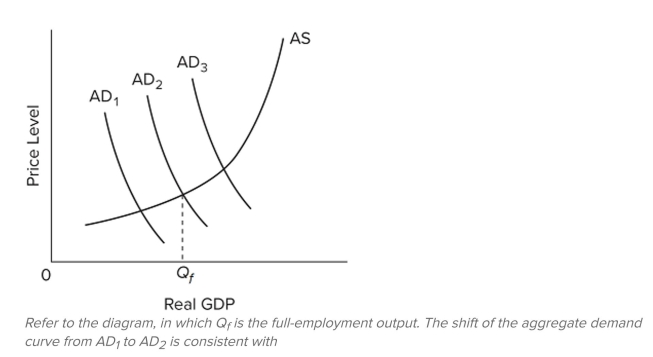
(76) 
Other things equal, the stock of capital inherited by future generations is likely to be smaller when government spending
(Multiple Choice)
4.8/5 (81)
(81) Discretionary fiscal policy is often initiated on the advice of the
(Multiple Choice)
5.0/5 (73)
(73) The payment of interest on the public debt in the United States mildly increases income inequality.
(True/False)
4.8/5 (74)
(74) 
Filters
- Essay(0)
- Multiple Choice(0)
- Short Answer(0)
- True False(0)
- Matching(0)