



 Chat with AI
Exam 13: Fiscal Policy, Deficits, and Debt

Exam 2: The Market System and the Circular Flow274 Questions
Exam 3: Demand, Supply, and Market Equilibrium357 Questions
Exam 4: Market Failures Caused by Externalities Asymmetric Information222 Questions
Exam 5: Public Goods, Public Choice, and Government Failure242 Questions
Exam 6: An Introduction to Macroeconomics243 Questions
Exam 7: Measuring Domestic Output and National Income238 Questions
Exam 8: Economic Growth274 Questions
Exam 9: Business Cycles, Unemployment, and Inflation298 Questions
Exam 10: Basic Macroeconomic Relationships233 Questions
Exam 11: The Aggregate Expenditures Model126 Questions
Exam 12: Aggregate Demand and Aggregate Supply320 Questions
Exam 13: Fiscal Policy, Deficits, and Debt401 Questions
Exam 14: Money, Banking, and Financial Institutions265 Questions
Exam 15: Money Creation285 Questions
Exam 16: Interest Rates and Monetary Policy405 Questions
Exam 17: Financial Economics356 Questions
Exam 18: Extending the Analysis of Aggregate Supply268 Questions
Exam 19: Current Issues in Macro Theory and Policy279 Questions
Exam 20: International Trade339 Questions
Exam 21: The Balance of Payments, Exchange Rates, and Trade Deficits315 Questions
Exam 22: The Economics of Developing Countries269 Questions
Select questions type


Suppose the government cuts taxes to keep the economy's cyclically adjusted budget in balance when the economy is expanding. The government is engaging in a(n)
(Multiple Choice)
4.9/5  (64)
(64) One timing problem in using fiscal policy to counter a recession is the "recognition lag" that occurs between the
(Multiple Choice)
4.7/5 (76)
(76) If the government wants to reduce unemployment using fiscal policy, it may do so by increasing
government spending.
(True/False)
4.7/5 (88)
(88) The political business cycle refers to the possibility that
(Multiple Choice)
5.0/5 (100)
(100) The American Recovery and Reinvestment Act of 2009 is a clear example of
(Multiple Choice)
4.8/5 (67)
(67) 
Suppose the government purposely changes the economy's cyclically adjusted budget from a deficit of 3 percent of real GDP to a surplus of 1 percent of real GDP. The government is engaging in a(n)
(Multiple Choice)
4.9/5 (64)
(64) 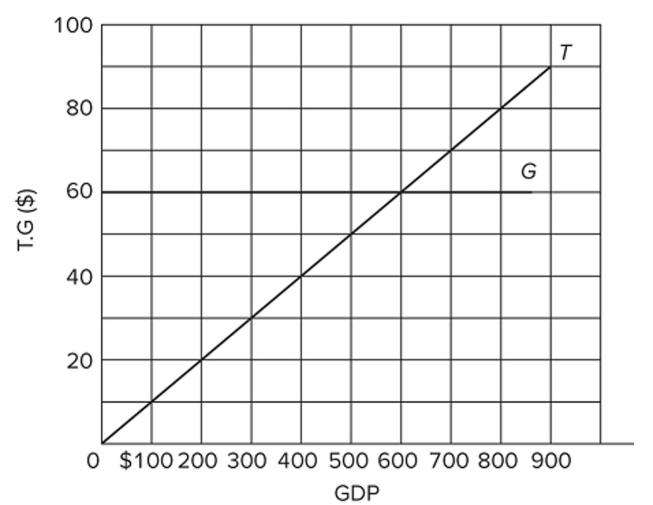 Refer to the diagram, where T is tax revenues and G is government expenditures. All figures are in billions of dollars. If the full-employment GDP is $400 billion, while the actual GDP is $300 billion, the
Cyclical deficit is
Refer to the diagram, where T is tax revenues and G is government expenditures. All figures are in billions of dollars. If the full-employment GDP is $400 billion, while the actual GDP is $300 billion, the
Cyclical deficit is (Multiple Choice)
4.9/5 (74)
(74) Most of the U.S. public debt is owed to the nation's citizens and domestic institutions. This is one reason that the public debt
(Multiple Choice)
4.9/5 (88)
(88) One advantage of automatic fiscal policy over discretionary fiscal policy is that automatic fiscal policy
(Multiple Choice)
4.8/5 (84)
(84) A specific reduction in government spending will dampen demand-pull inflation by a greater amount the
(Multiple Choice)
4.9/5 (77)
(77) Without a change in discretionary fiscal policy, we would expect that if the economy goes into recession, then the
(Multiple Choice)
5.0/5 (79)
(79) Government Spending Tax Revenues GDP Year 1 \ 450 \ 425 \ 2,000 Year 2 500 450 3,000 Year 3 600 500 4,000 Year 4 640 620 5,000 Year 5 680 580 4,800 Year 6 600 620 5,000 The accompanying table gives budget information for a hypothetical economy. Assume that all budget surpluses are used to pay down the public debt. If year 1 is the ?rst year of this nation's existence and
Year 6 is the present year, this nation's public debt is
(Multiple Choice)
4.9/5 (77)
(77) eGovernment Spending Tax Revenues GDP Year 1 \ 800 \ 825 \ 4,000 Year 2 850 850 4,200 Year 3 900 875 4,350 Year 4 950 900 4,500 Year 5 1,000 925 4,600 The table contains budget information for a hypothetical economy. All data are in billions of dollars. Assume that Year 1 is the ?rst year for this economy and Year 5 is the current year. What is the public
Debt in this economy at Year 5?
(Multiple Choice)
4.9/5 (93)
(93) An economy is experiencing a high rate of inflation. The government wants to reduce consumption by $36 billion to reduce inflationary pressure. The MPC is 0.75. By how much should the government raise
Taxes to achieve its objective?
(Multiple Choice)
4.9/5 (67)
(67) Which of the following best describes the built-in stabilizers as they function in the United States?
(Multiple Choice)
4.9/5 (82)
(82) 
Filters
- Essay(0)
- Multiple Choice(0)
- Short Answer(0)
- True False(0)
- Matching(0)