



 Chat with AI
Exam 13: Fiscal Policy, Deficits, and Debt

Exam 2: The Market System and the Circular Flow274 Questions
Exam 3: Demand, Supply, and Market Equilibrium357 Questions
Exam 4: Market Failures Caused by Externalities Asymmetric Information222 Questions
Exam 5: Public Goods, Public Choice, and Government Failure242 Questions
Exam 6: An Introduction to Macroeconomics243 Questions
Exam 7: Measuring Domestic Output and National Income238 Questions
Exam 8: Economic Growth274 Questions
Exam 9: Business Cycles, Unemployment, and Inflation298 Questions
Exam 10: Basic Macroeconomic Relationships233 Questions
Exam 11: The Aggregate Expenditures Model126 Questions
Exam 12: Aggregate Demand and Aggregate Supply320 Questions
Exam 13: Fiscal Policy, Deficits, and Debt401 Questions
Exam 14: Money, Banking, and Financial Institutions265 Questions
Exam 15: Money Creation285 Questions
Exam 16: Interest Rates and Monetary Policy405 Questions
Exam 17: Financial Economics356 Questions
Exam 18: Extending the Analysis of Aggregate Supply268 Questions
Exam 19: Current Issues in Macro Theory and Policy279 Questions
Exam 20: International Trade339 Questions
Exam 21: The Balance of Payments, Exchange Rates, and Trade Deficits315 Questions
Exam 22: The Economics of Developing Countries269 Questions
Select questions type


Suppose the price level is fixed, the MPC is 0.5, and the GDP gap is a negative $100 billion. To achieve full-employment output (exactly), government should
(Multiple Choice)
5.0/5  (76)
(76) The cyclically adjusted surplus in the U.S. went from +1.2 percent of GDP in 2000 to −1.2 percent of GDP in 2002. This suggests that the government during that period
(Multiple Choice)
4.9/5 (96)
(96) Define expansionary fiscal policy. During which phase of the business cycle would it be appropriate to
use?
(Essay)
4.8/5 (79)
(79) In the later part of 2009, something historic happened relative to Social Security; for the first time,
(Multiple Choice)
4.9/5 (85)
(85) If the economy has a cyclically adjusted budget surplus, this means that
(Multiple Choice)
4.7/5 (82)
(82) As the economy declines into recession, the collection of personal income tax revenues automatically falls. This phenomenon best illustrates how a progressive income-tax system
(Multiple Choice)
4.9/5 (82)
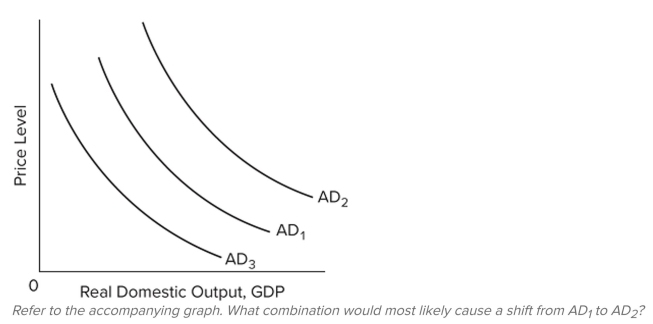
(82) 
The crowding-out effect of expansionary fiscal policy suggests that
(Multiple Choice)
5.0/5 (79)
(79) If the government wishes to increase the level of real GDP, it might reduce
(Multiple Choice)
4.8/5 (75)
(75) A public debt that is owed to foreigners can be burdensome because
(Multiple Choice)
4.9/5 (81)
(81)  Refer to the ?gure. Suppose that the economy is currently operating at the intersection of AS and AD and that the full-employment level of output is Y. If contractionary ?scal policy and accompanying
Multiplier effects move aggregate demand from AD
, what will be the effect on real GDP and the
Price level?
Refer to the ?gure. Suppose that the economy is currently operating at the intersection of AS and AD and that the full-employment level of output is Y. If contractionary ?scal policy and accompanying
Multiplier effects move aggregate demand from AD
, what will be the effect on real GDP and the
Price level? (Multiple Choice)
4.9/5 (87)
(87) In an aggregate demand-aggregate supply diagram, equal decreases in government spending and taxes will
(Multiple Choice)
4.8/5 (94)
(94) Government Spending Tax Revenues GDP Year 1 \ 800 \ 825 \ 4,000 Year 2 850 850 4,200 Year 3 900 875 4,350 Year 4 950 900 4,500 Year 5 1,000 925 4,600 The table contains budget information for a hypothetical economy. All data are in billions of dollars. In which year is there a budget surplus?
(Multiple Choice)
4.8/5 (85)
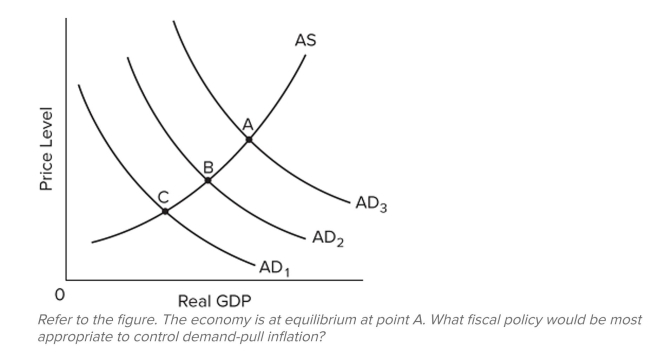
(85) 

Filters
- Essay(0)
- Multiple Choice(0)
- Short Answer(0)
- True False(0)
- Matching(0)