



 Chat with AI
Exam 13: Fiscal Policy, Deficits, and Debt

Exam 2: The Market System and the Circular Flow274 Questions
Exam 3: Demand, Supply, and Market Equilibrium357 Questions
Exam 4: Market Failures Caused by Externalities Asymmetric Information222 Questions
Exam 5: Public Goods, Public Choice, and Government Failure242 Questions
Exam 6: An Introduction to Macroeconomics243 Questions
Exam 7: Measuring Domestic Output and National Income238 Questions
Exam 8: Economic Growth274 Questions
Exam 9: Business Cycles, Unemployment, and Inflation298 Questions
Exam 10: Basic Macroeconomic Relationships233 Questions
Exam 11: The Aggregate Expenditures Model126 Questions
Exam 12: Aggregate Demand and Aggregate Supply320 Questions
Exam 13: Fiscal Policy, Deficits, and Debt401 Questions
Exam 14: Money, Banking, and Financial Institutions265 Questions
Exam 15: Money Creation285 Questions
Exam 16: Interest Rates and Monetary Policy405 Questions
Exam 17: Financial Economics356 Questions
Exam 18: Extending the Analysis of Aggregate Supply268 Questions
Exam 19: Current Issues in Macro Theory and Policy279 Questions
Exam 20: International Trade339 Questions
Exam 21: The Balance of Payments, Exchange Rates, and Trade Deficits315 Questions
Exam 22: The Economics of Developing Countries269 Questions
Select questions type


If the budget deficit becomes smaller, then it will cause the public debt to also become smaller.
(True/False)
4.8/5  (78)
(78) The impact of an expansionary fiscal policy may be strengthened if it crowds out some private
investment spending.
(True/False)
4.8/5 (81)
(81) Which of the following fiscal policy actions is most likely to increase aggregate supply?
(Multiple Choice)
4.8/5 (87)
(87) A contractionary fiscal policy shifts the aggregate demand curve leftward.
(True/False)
4.9/5 (82)
(82) The actual budget may be in deficit while the cyclically adjusted budget is in surplus.
(True/False)
4.9/5 (93)
(93) (Last Word) What is the long-run financial problem for Social Security?
(Essay)
4.7/5 (79)
(79) 
If the economy is to have significant built-in stability, then when real GDP increases, the tax revenues should
(Multiple Choice)
4.8/5 (78)
(78) In a certain year the aggregate amount demanded at the existing price level consists of $100 billion of consumption, $40 billion of investment, $10 billion of net exports, and $20 billion of government
Purchases. Full-employment GDP is $200 billion. To obtain full employment under these conditions, the
Government should
(Multiple Choice)
4.9/5 (72)
(72) The economy starts out with a balanced federal budget. If the government then implements expansionary fiscal policy, then there will be a
(Multiple Choice)
4.9/5 (78)
(78) A contractionary fiscal policy shifts the aggregate demand curve leftward.
(True/False)
4.9/5 (72)
(72) An increase in the public debt and its subsequent repayment will tend to
(Multiple Choice)
4.8/5 (79)
(79) Suppose the price level is fixed, the MPC is 0.5, and the GDP gap is a negative $80 billion. To achieve full-employment output (exactly), government should
(Multiple Choice)
4.7/5 (73)
(73) 
Since 2009, when actual budget deficits were nearly 10 percent of GDP,
(Multiple Choice)
4.8/5 (74)
(74) When current government expenditures equal current tax revenues and the economy is achieving full employment,
(Multiple Choice)
4.9/5 (84)
(84) 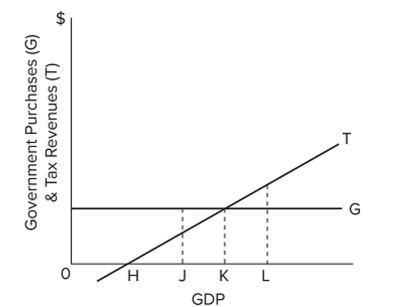 Refer to the graph. A budget surplus would be associated with GDP level
 (Multiple Choice)
4.7/5 (67)
(67) The portion of the public debt owed to foreigners does not represent any real economic burden to
Americans because we received money from foreigners when we incurred the debt.
(True/False)
4.7/5 (79)
(79) 
Filters
- Essay(0)
- Multiple Choice(0)
- Short Answer(0)
- True False(0)
- Matching(0)