



 Chat with AI
Exam 13: Fiscal Policy, Deficits, and Debt

Exam 2: The Market System and the Circular Flow274 Questions
Exam 3: Demand, Supply, and Market Equilibrium357 Questions
Exam 4: Market Failures Caused by Externalities Asymmetric Information222 Questions
Exam 5: Public Goods, Public Choice, and Government Failure242 Questions
Exam 6: An Introduction to Macroeconomics243 Questions
Exam 7: Measuring Domestic Output and National Income238 Questions
Exam 8: Economic Growth274 Questions
Exam 9: Business Cycles, Unemployment, and Inflation298 Questions
Exam 10: Basic Macroeconomic Relationships233 Questions
Exam 11: The Aggregate Expenditures Model126 Questions
Exam 12: Aggregate Demand and Aggregate Supply320 Questions
Exam 13: Fiscal Policy, Deficits, and Debt401 Questions
Exam 14: Money, Banking, and Financial Institutions265 Questions
Exam 15: Money Creation285 Questions
Exam 16: Interest Rates and Monetary Policy405 Questions
Exam 17: Financial Economics356 Questions
Exam 18: Extending the Analysis of Aggregate Supply268 Questions
Exam 19: Current Issues in Macro Theory and Policy279 Questions
Exam 20: International Trade339 Questions
Exam 21: The Balance of Payments, Exchange Rates, and Trade Deficits315 Questions
Exam 22: The Economics of Developing Countries269 Questions
Select questions type


The Great Recession of 2007-09 and the consequent policy response made the
(Multiple Choice)
4.8/5  (86)
(86) If the cyclically adjusted budget has a zero deficit but the actual budget has a $100 billion deficit, then
that means that the government is pursuing an expansionary fiscal policy.
(True/False)
4.9/5 (91)
(91) In a certain year, the aggregate amount demanded at the existing price level consists of $100 billion of consumption, $40 billion of investment, $10 billion of net exports, and $20 billion of government
Purchases. Full-employment GDP is $120 billion. To obtain price-level stability under these conditions,
The government should
(Multiple Choice)
4.9/5 (77)
(77) The crowding-out effect will be minimal when the economy is in a severe recession.
(True/False)
4.8/5 (81)
(81) 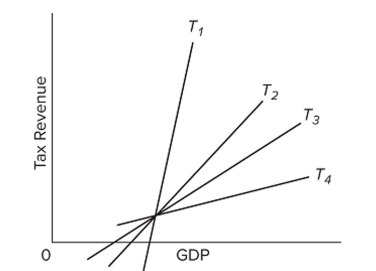 Refer to the diagram. Which tax system has the least built-in stability?
 (Multiple Choice)
5.0/5 (90)
(90) Which of the following did not contribute directly to the Great Recession?
(Multiple Choice)
4.9/5 (83)
(83) In 2018, the Federal Reserve and other U.S. (federal) government agencies held about what percentage of U.S. federal debt?
(Multiple Choice)
4.8/5 (77)
(77) Suppose the government purposely changes the economy's cyclically adjusted budget from a deficit of 0 percent of real GDP to a deficit of 3 percent of real GDP. The government is engaging in a(n)
(Multiple Choice)
5.0/5 (78)
(78) Explain what is meant by a built-in stabilizer and give two examples.
(Essay)
4.9/5 (64)
(64) The time that elapses between the beginning of a recession or an inflationary episode and the identification of the macroeconomic problem is referred to as a(n)
(Multiple Choice)
4.9/5 (69)
(69) Year Actual Budget, Percent of GDP (-deficits, +surpluses) Cyclically-Adjusted Budget, Percent of GDP (-deficits, +surpluses) 1 0 0 2 -3 0 3 -5 -2 4 -2 -2 5 +2 +1 Refer to the data for a ?ctional economy. The changes in the budget conditions between Year 2 and 3 best re?ect
(Multiple Choice)
4.9/5 (83)
(83) State and local governments are limited in their ability to respond to recessions because of
(Multiple Choice)
5.0/5 (83)
(83) An increase in the cyclical deficits will automatically increase the cyclically adjusted budget deficit.
(True/False)
4.8/5 (81)
(81) Differentiate between discretionary fiscal policy and nondiscretionary fiscal policy.
(Essay)
4.7/5 (95)
(95) When current government expenditures exceed current tax revenues and the economy is achieving full employment,
(Multiple Choice)
4.8/5 (91)
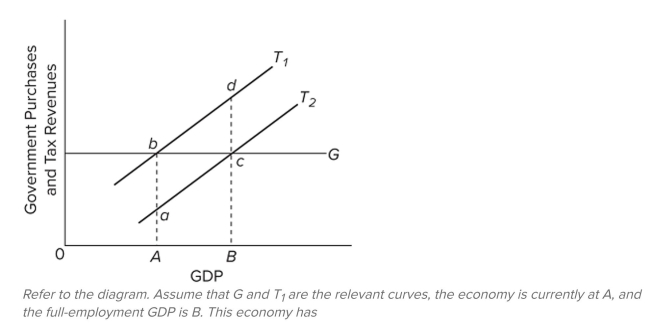
(91) 
Which of the following is the best example of public investment?
(Multiple Choice)
4.8/5 (80)
(80) The crowding-out effect from government borrowing to finance the public debt is reduced when
(Multiple Choice)
4.8/5 (74)
(74) 
Filters
- Essay(0)
- Multiple Choice(0)
- Short Answer(0)
- True False(0)
- Matching(0)