



 Chat with AI
Exam 21: Income Inequity and Poverty

Exam 1: Ten Lessons From Economics146 Questions
Exam 2: Thinking Like an Economist133 Questions
Exam 3: Interdependence and the Gains From Trade139 Questions
Exam 4: The Market Forces of Supply and Demand215 Questions
Exam 5: Elasticity and Its Application178 Questions
Exam 6: Supply, Demand and Government Policies145 Questions
Exam 7: Consumers, Producers and the Efficiency of Markets171 Questions
Exam 8: Application: the Costs of Taxation135 Questions
Exam 9: Application: International Trade151 Questions
Exam 10: Externalities199 Questions
Exam 11: Public Goods and Common Resources178 Questions
Exam 12: The Design of the Tax System154 Questions
Exam 13: The Costs of Production191 Questions
Exam 14: Firms in Competitive Markets198 Questions
Exam 15: Monopoly212 Questions
Exam 16: Monopolistic Competition212 Questions
Exam 17: Business Strategy and Oligopoly179 Questions
Exam 18: Competition Policy103 Questions
Exam 19: The Markets for the Factors of Production214 Questions
Exam 20: Earnings, Unions and Discrimination201 Questions
Exam 21: Income Inequity and Poverty111 Questions
Exam 22: The Theory of Consumer Choice158 Questions
Exam 23: Frontiers of Microeconomics111 Questions
Exam 24: Measuring a Nations Income51 Questions
Exam 25: Measuring the Cost of Living55 Questions
Exam 26: Production and Growth62 Questions
Exam 27: Saving, Investment and the Financial System62 Questions
Exam 28: The Natural Rate of Unemployment58 Questions
Exam 29: The Monetary System66 Questions
Exam 30: Inflation: Its Causes and Costs74 Questions
Exam 31: Open-Economy Macroeconomics: Basic Concepts68 Questions
Exam 32: A Macroeconomic Theory of the Open Economy61 Questions
Exam 33: Aggregate Demand and Aggregate Supply81 Questions
Exam 34: The Influence of Monetary and Fiscal Policy on Aggregate Demand73 Questions
Exam 35: The Short-Run Trade-Off Between Inflation and Unemployment57 Questions
Exam 36: Global Financial Crisis of 2008 and Beyond37 Questions
Exam 37: Five Debates Over Macroeconomic Policy38 Questions
Select questions type


Permanent income is distributed between income groups ________:
(Multiple Choice)
4.8/5  (69)
(69) What would be the qualification(s) to receive government assistance under a negative income tax?
(i) being enrolled in job training
(ii) having preschool children
(iii) having a low income
(Multiple Choice)
4.8/5 (74)
(74) Which of the following statements about a negative income tax system are true?
(i) it would eliminate tax progressivity
(ii) it would collect more tax from high-income households
(iii) it would give transfers to low-income households
(Multiple Choice)
4.9/5 (81)
(81) Some economists argue that because expenditure must be equal to income, the expenditure-based measure of income inequality is no better than the income-based measure of income inequality.
(True/False)
4.9/5 (80)
(80) According to the maximin criterion, income can be transferred from the rich to the poor as long as it:
(i) enhances the welfare of workers
(ii) promotes an egalitarian distribution of income
(iii) raises the wellbeing of the least fortunate
(Multiple Choice)
4.8/5 (67)
(67) Using demand-supply analysis, show how the elasticity of demand of labour determines the magnitude of unemployment when an effective minimum wage is imposed.
(Essay)
4.8/5 (80)
(80) Explain what is meant by 'in-kind transfer' programs.Briefly outline the pros and cons associated with an in-kind transfer program.
(Essay)
4.9/5 (72)
(72) In Australia, the share of pre-tax income going to the bottom fifth of families in the income distribution has been:
(Multiple Choice)
4.8/5 (80)
(80) One way to measure the poverty rate is by calculating the percentage of the population whose family income is below the poverty line.
(True/False)
5.0/5 (69)
(69) If cash is transferred to the poor, this is known as an in-kind transfer.
(True/False)
4.9/5 (90)
(90) Explain the concept of diminishing marginal utility and describe the role that it plays in the utilitarian argument for redistribution of income.
(Essay)
4.9/5 (70)
(70) Using the graph drawn above, what could occur if:
i) a government that advocates a flat tax rate to the income distribution.
ii) a government advocates a proportional tax where there are more tax brackets. 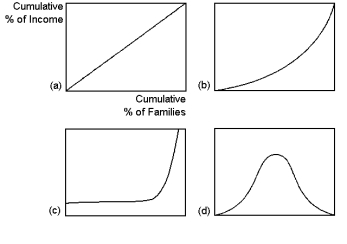
(Short Answer)
4.8/5 (85)
(85) Which of the following are common criticisms of government programs designed to assist the poor?
(i) they create incentives for people to become 'needy'
(ii) those who receive assistance rarely meet the criterion for eligibility
(iii) they typically account for a majority of annual government expenditures
(Multiple Choice)
4.9/5 (64)
(64) 
Filters
- Essay(0)
- Multiple Choice(0)
- Short Answer(0)
- True False(0)
- Matching(0)