



 Chat with AI
Exam 21: Income Inequity and Poverty

Exam 1: Ten Lessons From Economics146 Questions
Exam 2: Thinking Like an Economist133 Questions
Exam 3: Interdependence and the Gains From Trade139 Questions
Exam 4: The Market Forces of Supply and Demand215 Questions
Exam 5: Elasticity and Its Application178 Questions
Exam 6: Supply, Demand and Government Policies145 Questions
Exam 7: Consumers, Producers and the Efficiency of Markets171 Questions
Exam 8: Application: the Costs of Taxation135 Questions
Exam 9: Application: International Trade151 Questions
Exam 10: Externalities199 Questions
Exam 11: Public Goods and Common Resources178 Questions
Exam 12: The Design of the Tax System154 Questions
Exam 13: The Costs of Production191 Questions
Exam 14: Firms in Competitive Markets198 Questions
Exam 15: Monopoly212 Questions
Exam 16: Monopolistic Competition212 Questions
Exam 17: Business Strategy and Oligopoly179 Questions
Exam 18: Competition Policy103 Questions
Exam 19: The Markets for the Factors of Production214 Questions
Exam 20: Earnings, Unions and Discrimination201 Questions
Exam 21: Income Inequity and Poverty111 Questions
Exam 22: The Theory of Consumer Choice158 Questions
Exam 23: Frontiers of Microeconomics111 Questions
Exam 24: Measuring a Nations Income51 Questions
Exam 25: Measuring the Cost of Living55 Questions
Exam 26: Production and Growth62 Questions
Exam 27: Saving, Investment and the Financial System62 Questions
Exam 28: The Natural Rate of Unemployment58 Questions
Exam 29: The Monetary System66 Questions
Exam 30: Inflation: Its Causes and Costs74 Questions
Exam 31: Open-Economy Macroeconomics: Basic Concepts68 Questions
Exam 32: A Macroeconomic Theory of the Open Economy61 Questions
Exam 33: Aggregate Demand and Aggregate Supply81 Questions
Exam 34: The Influence of Monetary and Fiscal Policy on Aggregate Demand73 Questions
Exam 35: The Short-Run Trade-Off Between Inflation and Unemployment57 Questions
Exam 36: Global Financial Crisis of 2008 and Beyond37 Questions
Exam 37: Five Debates Over Macroeconomic Policy38 Questions
Select questions type


What is meant by a perfectly equal distribution of income? Use a graph to depict such a situation.
(Essay)
4.9/5  (80)
(80) A tax system that collects revenue from high-income households and gives transfers and tax concessions to low-income households is known as:
(Multiple Choice)
4.8/5 (80)
(80) What is the political philosophy called in which government should choose policies deemed to be just, as evaluate by an impartial observer behind a 'veil of ignorance':
(Multiple Choice)
4.8/5 (80)
(80) According to the Henderson Commission, the poverty line in Australia was set at:
(Multiple Choice)
4.9/5 (80)
(80) Because people can borrow when they are young, the life cycle theory would suggest that a standard of living depends on:
(Multiple Choice)
4.8/5 (89)
(89) The life cycle effect characterises a lifetime income profile in which income:
(Multiple Choice)
4.8/5 (77)
(77) A school voucher system introduced in the United States has lead to:
(Multiple Choice)
4.9/5 (82)
(82) The concept of utility is fundamental to utilitarianism and describes the:
(Multiple Choice)
4.8/5 (74)
(74) Which of the following household units are more likely than average to be living in poverty?
(i) couples without children
(ii) single people
(iii) sole one-parents with children
(Multiple Choice)
4.8/5 (75)
(75) Under a negative income tax, it is likely for a person who does not earn income to receive assistance from the government.
(True/False)
5.0/5 (96)
(96) Assume that the government proposes a negative income tax that calculates taxes owed by the formula TAXES OWED = (1/3 * INCOME) - $20 000.Compute the tax that would be owed given each of the following levels of income.
a.$180 000
b.$120 000
c.$60 000
d.$30 000
e.zero
(Short Answer)
4.9/5 (80)
(80) Which of the following reasons suggests that income-based measures of poverty are not ideal when considering the poverty rates of young people:
(Multiple Choice)
4.9/5 (79)
(79) The political philosophy according to which the government should choose policies that maximise the total utility of everyone in society is called:
(Multiple Choice)
4.9/5 (79)
(79) The most commonly used approach to define the poverty line in Australia is to follow the definition of the Henderson Commission, conducted in 1975.This sets the poverty line at:
(Multiple Choice)
4.7/5 (73)
(73) For each figure below, describe whether it could reflect a possible distribution of income and if so, what is implied about the equality of income depicted. 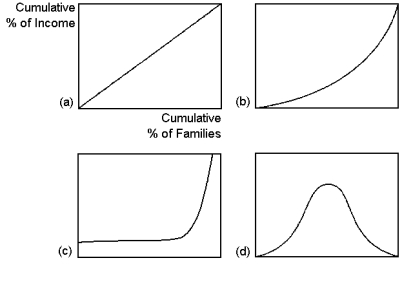
(Essay)
4.9/5 (74)
(74) Measures of poverty that fail to account for the value of in-kind transfers:
(Multiple Choice)
4.9/5 (77)
(77) 
Filters
- Essay(0)
- Multiple Choice(0)
- Short Answer(0)
- True False(0)
- Matching(0)