



 Chat with AI
Exam 13: Structure Determination

Exam 1: Structure and Bonding:acids and Bases41 Questions
Exam 2: Alkanes: the Nature of Organic Compounds44 Questions
Exam 3: Alkenes and Alkynes: the Nature of Organic Reactions40 Questions
Exam 4: Reactions of Alkenes and Alkynes44 Questions
Exam 5: Aromatic Compounds52 Questions
Exam 6: Sterechemistry at Tetrahedral Centers39 Questions
Exam 7: Organohalides: Nucleophilic Substitutions and Eliminations40 Questions
Exam 8: Alcohols, Phenols, Ethers, and Their Sulfur Analogs36 Questions
Exam 9: Aldehydes and Ketones: Nucleophilic Addition Reactions32 Questions
Exam 10: Carboxylic Acids and Derivatives: Nucleophilic Acyl Substitution Reactions63 Questions
Exam 11: Carbonyl Alpha-Substitution Reactions and Condensation Reactions38 Questions
Exam 12: Amines32 Questions
Exam 13: Structure Determination65 Questions
Exam 14: Biomolecules: Carbohydrates48 Questions
Exam 15: Biomolecules: Amino Acids, Peptides, and Proteins50 Questions
Exam 16: Biomolecules: Lipids and Nucleic Acids50 Questions
Exam 17: The Organic Chemistry of Metabolic Pathways40 Questions
Select questions type


Which of the following does not involve the interaction of molecules with electromagnetic energy?
(Multiple Choice)
4.9/5  (82)
(82) Instructions: For each of the compounds below tell how many signals you would expect the molecule to have in its normal, broadband decoupled 13C NMR spectra.
-Number of signals: 
(Essay)
4.9/5 (70)
(70) Treatment of tert-butyl alcohol with hydrogen chloride yields a mixture of tert-butyl chloride and 2-methylpropene.  a)After chromatographic separation, how would you use 1H NMR to help you decide which was which?
b)How would the 13C NMR for the two compounds differ?
a)After chromatographic separation, how would you use 1H NMR to help you decide which was which?
b)How would the 13C NMR for the two compounds differ? (Essay)
4.9/5 (67)
(67) Which structure of molecular formula C4H8Cl2 fits the 1H NMR and 13C NMR spectra shown below? 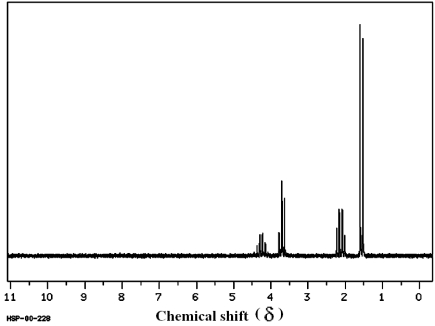
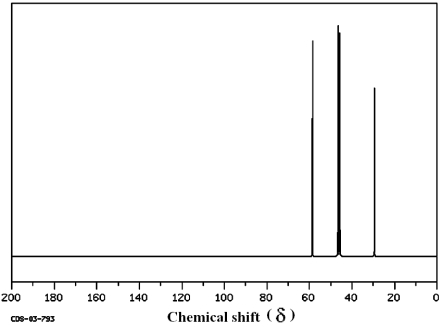 (Spectrum obtained from: SDBSWeb: http://www.aist.go.jp/RIODB/SDBS/)
 (Multiple Choice)
4.8/5 (84)
(84) Which feature in the 1H NMR spectrum provides information about the relative numbers of hydrogen atoms of each type found in a compound?
(Multiple Choice)
4.8/5 (83)
(83) Instructions: Match each of the following groups of bond-types to the region of the infrared spectrum in which their absorptions occur.
-C-C, C-O, C-N, and C-X single-bond vibrations.
(Multiple Choice)
4.8/5 (81)
(81) Instructions: Answer the following question(s) for the compound whose 1H NMR spectra is shown below.
C4H8O 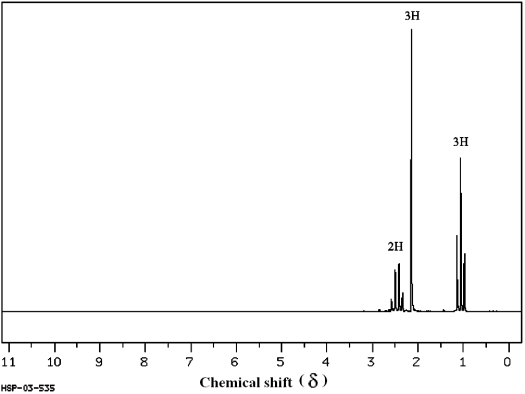 (Spectrum obtained from: SDBSWeb: http://www.aist.go.jp/RIODB/SDBS/)
-Refer to instructions. Propose a structure for this compound.
(Spectrum obtained from: SDBSWeb: http://www.aist.go.jp/RIODB/SDBS/)
-Refer to instructions. Propose a structure for this compound. (Essay)
4.7/5 (80)
(80) Which of the following combinations of peaks appears in the 1H NMR spectrum of 2-methylpropane?
(Multiple Choice)
4.7/5 (92)
(92) Instructions: Refer to the structure of 3-methylbutan-2-one below to answer the following question(s). 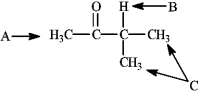 -Refer to instructions. What is the splitting pattern for the hydrogens in 3-methylbutan-2-one labeled A, B, and C, respectively?
 (Multiple Choice)
4.8/5 (79)
(79) Which of the following regions in the electromagnetic spectrum corresponds to the radiation with the highest energy?
(Multiple Choice)
4.9/5 (65)
(65) Which of the following compounds gives an infrared spectrum with a peak at strong 1730 cm-1?
(Multiple Choice)
4.8/5 (79)
(79) When 2-bromopropane reacts with ethoxide ion, two products are formed; one is the product of SN2 substitution and the other is the product of E2 elimination. Write the structures of both products, and tell how they could be distinguished using IR spectroscopy.
(Essay)
4.9/5 (86)
(86) Which of the following compounds gives an infrared spectrum with peaks at 3000-3500 cm-1 and ~1750 cm-1?
(Multiple Choice)
4.9/5 (66)
(66) Instructions: For each of the compounds below tell how many signals you would expect the molecule to have in its normal, broadband decoupled 13C NMR spectra.
-Number of signals: 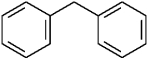
(Essay)
4.9/5 (70)
(70) Which of the following combinations of peaks appears in the 1H NMR spectrum of diethyl ether, CH3CH2OCH2CH3?
(Multiple Choice)
4.7/5 (72)
(72) When an organic molecule is irradiated with ultraviolet radiation, the energy absorbed by the molecule corresponds to:
(Multiple Choice)
4.8/5 (86)
(86) Which of the following compounds would produce the most downfield signal in a 13C NMR spectrum? 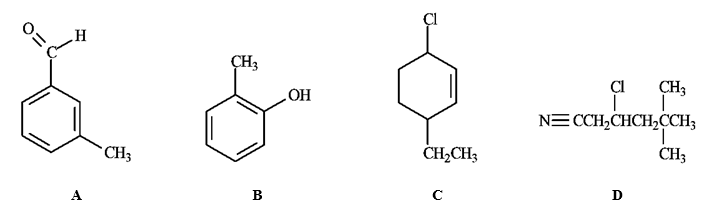
(Multiple Choice)
4.9/5 (80)
(80) Examining the infrared spectrum of a compound allows us to:
(Multiple Choice)
4.8/5 (74)
(74) Circle any of the following compounds that would be a candidate to produce a UV absorption spectrum. 
(Essay)
4.8/5 (70)
(70) Which of the following compounds would show the longest wavelength max in its UV spectrum?
(Multiple Choice)
4.8/5 (73)
(73) 
Filters
- Essay(0)
- Multiple Choice(0)
- Short Answer(0)
- True False(0)
- Matching(0)