



 Chat with AI
Exam 13: Structure Determination

Exam 1: Structure and Bonding:acids and Bases41 Questions
Exam 2: Alkanes: the Nature of Organic Compounds44 Questions
Exam 3: Alkenes and Alkynes: the Nature of Organic Reactions40 Questions
Exam 4: Reactions of Alkenes and Alkynes44 Questions
Exam 5: Aromatic Compounds52 Questions
Exam 6: Sterechemistry at Tetrahedral Centers39 Questions
Exam 7: Organohalides: Nucleophilic Substitutions and Eliminations40 Questions
Exam 8: Alcohols, Phenols, Ethers, and Their Sulfur Analogs36 Questions
Exam 9: Aldehydes and Ketones: Nucleophilic Addition Reactions32 Questions
Exam 10: Carboxylic Acids and Derivatives: Nucleophilic Acyl Substitution Reactions63 Questions
Exam 11: Carbonyl Alpha-Substitution Reactions and Condensation Reactions38 Questions
Exam 12: Amines32 Questions
Exam 13: Structure Determination65 Questions
Exam 14: Biomolecules: Carbohydrates48 Questions
Exam 15: Biomolecules: Amino Acids, Peptides, and Proteins50 Questions
Exam 16: Biomolecules: Lipids and Nucleic Acids50 Questions
Exam 17: The Organic Chemistry of Metabolic Pathways40 Questions
Select questions type


Instructions: Refer to the structure of 3-methylbutan-2-one below to answer the following question(s). 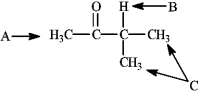 -Refer to instructions. What is the ratio of peak areas upon integration of the spectrum for A, B, and C respectively?
Free
(Multiple Choice)
4.8/5  (77)
(77) Correct Answer: Verified
D
At what approximate positions might the compound below show IR absorptions? 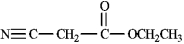
Free
(Essay)
5.0/5 (76)
(76) Correct Answer:Verified
VerifiedThis compound should show a medium absorption at 2210-2260 cm-1 for the nitrile, and a strong absorption at about 1735 cm-1 for the ester carbonyl.
Which of the following would produce only singlets in an 1H NMR spectrum? 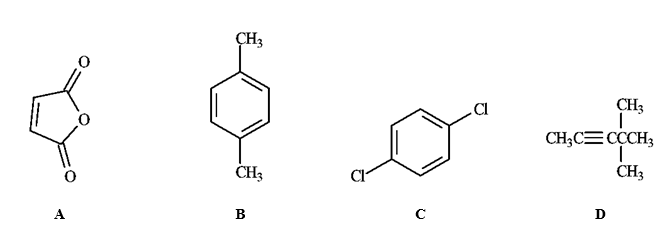
Free
(Multiple Choice)
4.8/5 (73)
(73) Correct Answer:Verified
VerifiedE
Which of the following compounds would have the longest max in the UV region of the electromagnetic spectrum? 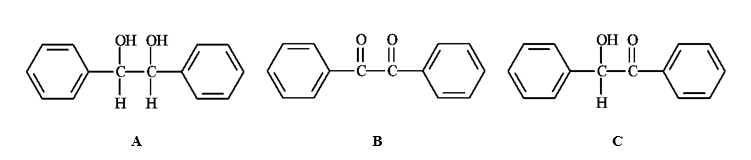
(Multiple Choice)
4.8/5 (83)
(83) Instructions: Match each of the following groups of bond-types to the region of the infrared spectrum in which their absorptions occur.
-triple bond stretching vibrations.
(Multiple Choice)
4.8/5 (77)
(77) Below is the mass spectrum of an unknown hydrocarbon. In addition, this hydrocarbon shows characteristic absorption at 2100 cm - 1 in its IR spectrum. Give the structure of this unknown. 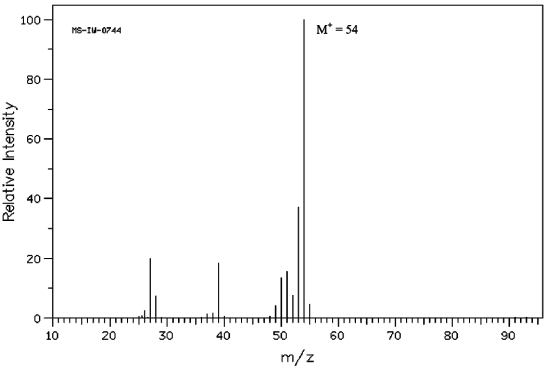 (Spectrum obtained from: SDBSWeb: http://www.aist.go.jp/RIODB/SDBS/)
 (Essay)
4.7/5 (70)
(70) Instructions: The following questions pertain to the charting of NMR spectra. MATCH a term to each description below. Place the letter of the term in the blank to the left of the description.
-Refer to instructions. __________ The calibration standard for 1H and 13C NMR is:
(Multiple Choice)
4.8/5 (77)
(77) Instructions: The following questions pertain to the charting of NMR spectra. MATCH a term to each description below. Place the letter of the term in the blank to the left of the description.
-Refer to instructions. __________ The NMR charts are calibrated using an arbitrary scale that is divided into __________ units.
(Multiple Choice)
4.8/5 (78)
(78) Which of the following compounds gives an infrared spectrum with peaks at 3300 cm-1 (sharp peak) and 2150 cm-1 (sharp peak)?
(Multiple Choice)
4.8/5 (68)
(68) Which feature in the 1H NMR spectrum provides information about the number of neighboring protons of each proton in the compound?
(Multiple Choice)
4.8/5 (77)
(77) Instructions: Match each of the following groups of bond-types to the region of the infrared spectrum in which their absorptions occur.
-C=O, C=N, and C=C bond absorptions.
(Multiple Choice)
4.8/5 (77)
(77) The amount of energy in electromagnetic radiation is related to the frequency and wavelength of the radiation. High energy radiation, like gamma rays, is of:
(Multiple Choice)
4.8/5 (80)
(80) Which of the following bonds undergoes stretching at the highest frequency?
(Multiple Choice)
4.8/5 (72)
(72) Instructions: For each of the compounds below tell how many signals you would expect the molecule to have in its normal, broadband decoupled 13C NMR spectra.
-Number of signals: 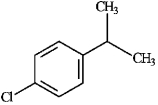
(Essay)
4.9/5 (79)
(79) Which of the following compounds gives an infrared spectrum with peaks at 3300 cm=-=1 (strong, broad peak) and 1640 cm=-=1 (sharp, weak peak)?
(Multiple Choice)
4.8/5 (73)
(73) Cyclohexene and hex-2-yne both have the molecular formula, C6H10.
a)How would you use infrared spectroscopy to distinguish between the two compounds?
b)How could the mass spectrum be used to distinguish between the two compounds?
(Essay)
4.9/5 (82)
(82) Instructions: The following questions pertain to the charting of NMR spectra. MATCH a term to each description below. Place the letter of the term in the blank to the left of the description.
-Refer to instructions. __________ When looking at an NMR chart the right-hand part of the chart is the __________.
(Multiple Choice)
4.9/5 (89)
(89) Which type of spectroscopy (IR, UV, or MS) will best distinguish between the pair of compounds below? Give a brief reason. 
(Essay)
4.7/5 (75)
(75) 
Filters
- Essay(0)
- Multiple Choice(0)
- Short Answer(0)
- True False(0)
- Matching(0)