



 Chat with AI
Exam 4: Reactions of Alkenes and Alkynes

Exam 1: Structure and Bonding:acids and Bases41 Questions
Exam 2: Alkanes: the Nature of Organic Compounds44 Questions
Exam 3: Alkenes and Alkynes: the Nature of Organic Reactions40 Questions
Exam 4: Reactions of Alkenes and Alkynes44 Questions
Exam 5: Aromatic Compounds52 Questions
Exam 6: Sterechemistry at Tetrahedral Centers39 Questions
Exam 7: Organohalides: Nucleophilic Substitutions and Eliminations40 Questions
Exam 8: Alcohols, Phenols, Ethers, and Their Sulfur Analogs36 Questions
Exam 9: Aldehydes and Ketones: Nucleophilic Addition Reactions32 Questions
Exam 10: Carboxylic Acids and Derivatives: Nucleophilic Acyl Substitution Reactions63 Questions
Exam 11: Carbonyl Alpha-Substitution Reactions and Condensation Reactions38 Questions
Exam 12: Amines32 Questions
Exam 13: Structure Determination65 Questions
Exam 14: Biomolecules: Carbohydrates48 Questions
Exam 15: Biomolecules: Amino Acids, Peptides, and Proteins50 Questions
Exam 16: Biomolecules: Lipids and Nucleic Acids50 Questions
Exam 17: The Organic Chemistry of Metabolic Pathways40 Questions
Select questions type


What type of reactive intermediate is formed in the reaction of an alkene with aqueous acid to give an alcohol?

Free
(Multiple Choice)
5.0/5  (95)
(95) Correct Answer: Verified
A
The following reaction is carried out in cyclohexane with the application of heat. Write the complete equation for the reaction below. If more than one major organic product is expected, draw each one. 
Free
(Essay)
4.8/5 (65)
(65) Correct Answer:Verified
Verified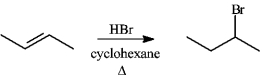
Povidone is produced commercially as a series of products having mean molecular weights ranging from about 10,000 to 700,000. Complexed with iodine, povidone yields an iodophor, marketed under the tradename Betadine, which is used as a topical anti-infective. 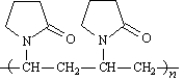 Identify the monomer unit(s) in povidone.
Free
(Essay)
4.9/5 (79)
(79) Correct Answer:Verified
Verified
Instructions: Predict the structure of the alkene you would use to prepare the folloiwng compounds. There may be more than one answer in some cases.
-Predict. 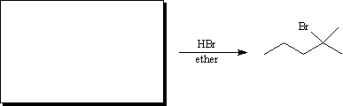
(Essay)
4.8/5 (77)
(77) Draw the structure of the polymer formed from the monomer given below, showing four repeating units. 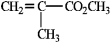
(Essay)
4.8/5 (94)
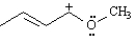
(94) 
Instructions: Predict the products of each reaction below. Indicate regiochemistry and stereochemistry when relevant.
-Predict and indicate. 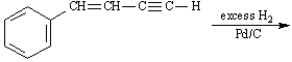
(Essay)
4.8/5 (76)
(76) MATCH each definition to the term it describes. Place the letter of the term in the blank to the left of the definition.
-Refer to Instructions. _____Predicts that in electrophilic additions to alkenes the more stable carbocation intermediate is formed.
(Multiple Choice)
4.8/5 (83)
(83) MATCH each definition to the term it describes. Place the letter of the term in the blank to the left of the definition.
-Refer to Instructions. _____Assigns priorities to substituent groups on a carbon.
(Multiple Choice)
4.9/5 (93)
(93) To answer the questions below, consider the following information:
In an abandoned laboratory has been found a flammable liquid, A, in a bottle bearing only the label "Compound A: C7H12. Government agents have offered you a considerable sum to determine the structure of this compound. After verifying the molecular formula by elemental analysis, you find that Compound A reacts with 1 mol equiv of hydrogen and, after treatment with acidic KMnO4, gives the dicarboxylic acid C (see below). Another bottle from the same laboratory is labeled "Compound B (isomer of A)." Compound B also reacts with 1 mol equiv of hydrogen, but yields cyclohexanone after treatment with acidic KMnO4. 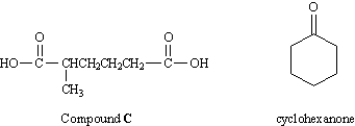 -Refer to Instructions. Suggest structures for A and B.
 (Essay)
4.7/5 (71)
(71) Rank the carbocations below in order of increasing stability (least stable = 1; most stable = 3). Place the number corresponding to the carbocation's relative stability in the blank below the structure. 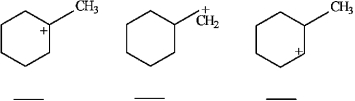
(Essay)
4.7/5 (81)
(81) Instructions: Predict the products of each reaction below. Indicate regiochemistry and stereochemistry when relevant.
-Predict and indicate. 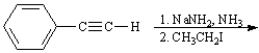
(Essay)
4.9/5 (80)
(80) On the structures provided, draw arrows showing the electron flow in the reaction mechanism for the electrophilic addition of hydrogen bromide to hex-1-yne. 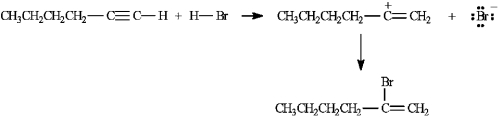
(Essay)
4.8/5 (68)
(68) Instructions: Predict the structure of the alkene you would use to prepare the folloiwng compounds. There may be more than one answer in some cases.
-Predict. 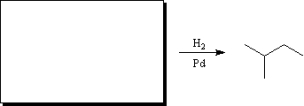
(Essay)
4.7/5 (86)
(86) Instructions: Predict the structure of the alkene you would use to prepare the folloiwng compounds. There may be more than one answer in some cases.
-Predict. 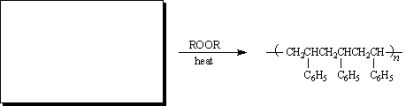
(Essay)
4.8/5 (70)
(70) Instructions: The reaction of 2-methylpropene with HBr in ether gives one of the two products below. Answer the following question(s) about this reaction. 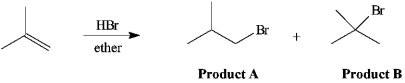 -Refer to instructions. The reaction mixture would contain a majority of which isomeric product?
 (Short Answer)
4.8/5 (75)
(75) Instructions: Predict the products of each reaction below. Indicate regiochemistry and stereochemistry when relevant.
-Predict and indicate. 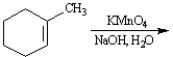
(Essay)
4.8/5 (87)
(87) Draw all the isomeric products formed from the addition of HCl to the following compound. 
(Essay)
4.9/5 (75)
(75) Instructions: Predict the products of each reaction below. Indicate regiochemistry and stereochemistry when relevant.
-Predict and indicate: 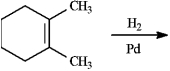
(Essay)
4.9/5 (79)
(79) 
Filters
- Essay(0)
- Multiple Choice(0)
- Short Answer(0)
- True False(0)
- Matching(0)