



 Chat with AI
Exam 4: Reactions of Alkenes and Alkynes

Exam 1: Structure and Bonding:acids and Bases41 Questions
Exam 2: Alkanes: the Nature of Organic Compounds44 Questions
Exam 3: Alkenes and Alkynes: the Nature of Organic Reactions40 Questions
Exam 4: Reactions of Alkenes and Alkynes44 Questions
Exam 5: Aromatic Compounds52 Questions
Exam 6: Sterechemistry at Tetrahedral Centers39 Questions
Exam 7: Organohalides: Nucleophilic Substitutions and Eliminations40 Questions
Exam 8: Alcohols, Phenols, Ethers, and Their Sulfur Analogs36 Questions
Exam 9: Aldehydes and Ketones: Nucleophilic Addition Reactions32 Questions
Exam 10: Carboxylic Acids and Derivatives: Nucleophilic Acyl Substitution Reactions63 Questions
Exam 11: Carbonyl Alpha-Substitution Reactions and Condensation Reactions38 Questions
Exam 12: Amines32 Questions
Exam 13: Structure Determination65 Questions
Exam 14: Biomolecules: Carbohydrates48 Questions
Exam 15: Biomolecules: Amino Acids, Peptides, and Proteins50 Questions
Exam 16: Biomolecules: Lipids and Nucleic Acids50 Questions
Exam 17: The Organic Chemistry of Metabolic Pathways40 Questions
Select questions type


Instructions: Predict the structure of the alkene you would use to prepare the folloiwng compounds. There may be more than one answer in some cases.
-Predict: 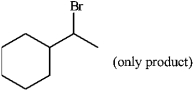
(Essay)
4.9/5  (95)
(95) Instructions: To answer the question(s) below, consider the following reaction:
When cyclohexene reacts with chlorine in tetrachloromethane, the following dihalide is formed. 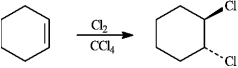 -Refer to instructions. Since the two chlorine atoms add to opposite faces of the cyclohexene double bond, we say that the reaction occurs with:
 (Multiple Choice)
5.0/5 (82)
(82) Circle whichever of the following would be classified as a conjugated diene. 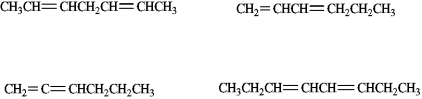
(Essay)
4.9/5 (87)
(87) Predict the major organic product(s) in the reaction below. If more than one major organic product is expected, draw each one. 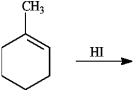
(Essay)
4.9/5 (69)
(69) Instructions: Predict the products of each reaction below. Indicate regiochemistry and stereochemistry when relevant.
-Predict and indicate. 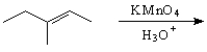
(Essay)
4.9/5 (77)
(77) Instructions: To answer the question(s) below, consider the following reaction:
When cyclohexene reacts with chlorine in tetrachloromethane, the following dihalide is formed.
-Refer to instructions. Provide the IUPAC name for the product of this reaction.
-Refer to instructions. Provide the IUPAC name for the product of this reaction. (Short Answer)
4.9/5 (84)
(84) Predict the major organic product(s) in the reaction below. If more than one major organic product is expected, draw each one. Explain the significance of "35 C" and "ether" shown in the reaction. 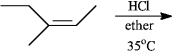
(Essay)
4.9/5 (80)
(80) Instructions: The reaction of 2-methylpropene with HBr in ether gives one of the two products below. Answer the following question(s) about this reaction. 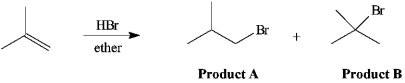 -Refer to instructions. Which product is the Markovnikov product?
 (Short Answer)
4.8/5 (74)
(74) Draw the structure of the monomer used to prepare the polymer shown below. 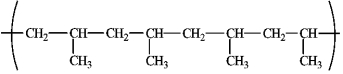
(Short Answer)
4.8/5 (75)
(75) What type of reactive intermediate is involved in both of the following general reaction types?
1)reaction of an alkene with Br2 in the presence of water to give a bromohydrin
2)two-step hydroxylation of an alkene
(Multiple Choice)
5.0/5 (73)
(73) MATCH each definition to the term it describes. Place the letter of the term in the blank to the left of the definition.
-Refer to Instructions. _____Predicts that in addition of HX to alkenes, the H adds to the less substituted alkene carbon and the X adds to the more substituted alkene carbon.
(Multiple Choice)
4.8/5 (87)
(87) 
What type of reactive intermediate is formed in the reaction of an alkene with HBr to give a bromoalkane?
(Multiple Choice)
4.8/5 (77)
(77) The product(s) of the reaction when carried out in an organic solvent 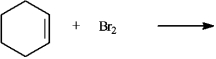 would be:
 (Multiple Choice)
4.9/5 (81)
(81) What type of reaction mechanism accounts for the reaction of an alkyne with HBr to give an alkyl bromide?
(Multiple Choice)
4.9/5 (83)
(83) Lyapolate Sodium, whose structure is shown below, is used as an anticoagulant. Identify the monomer unit(s) in lyapolate sodium. 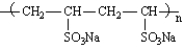
(Essay)
4.9/5 (78)
(78) Instructions: Predict the products of each reaction below. Indicate regiochemistry and stereochemistry when relevant.
-Predict and indicate. 
(Essay)
4.8/5 (71)
(71) Instructions: Predict the products of each reaction below. Indicate regiochemistry and stereochemistry when relevant.
-Predict and indicate. 
(Essay)
4.9/5 (61)
(61) What type of reaction mechanism accounts for the reaction of an alkene with HBr to give an alkyl bromide?
(Multiple Choice)
4.9/5 (77)
(77) 
Filters
- Essay(0)
- Multiple Choice(0)
- Short Answer(0)
- True False(0)
- Matching(0)