



 Chat with AI
Exam 17: The Organic Chemistry of Metabolic Pathways

Exam 1: Structure and Bonding:acids and Bases41 Questions
Exam 2: Alkanes: the Nature of Organic Compounds44 Questions
Exam 3: Alkenes and Alkynes: the Nature of Organic Reactions40 Questions
Exam 4: Reactions of Alkenes and Alkynes44 Questions
Exam 5: Aromatic Compounds52 Questions
Exam 6: Sterechemistry at Tetrahedral Centers39 Questions
Exam 7: Organohalides: Nucleophilic Substitutions and Eliminations40 Questions
Exam 8: Alcohols, Phenols, Ethers, and Their Sulfur Analogs36 Questions
Exam 9: Aldehydes and Ketones: Nucleophilic Addition Reactions32 Questions
Exam 10: Carboxylic Acids and Derivatives: Nucleophilic Acyl Substitution Reactions63 Questions
Exam 11: Carbonyl Alpha-Substitution Reactions and Condensation Reactions38 Questions
Exam 12: Amines32 Questions
Exam 13: Structure Determination65 Questions
Exam 14: Biomolecules: Carbohydrates48 Questions
Exam 15: Biomolecules: Amino Acids, Peptides, and Proteins50 Questions
Exam 16: Biomolecules: Lipids and Nucleic Acids50 Questions
Exam 17: The Organic Chemistry of Metabolic Pathways40 Questions
Select questions type


The reaction of fructose 1,6-bisphosphate to give glyceraldehyde-3-phosphate and dihydroxyacetone phosphate is an example of

Free
(Multiple Choice)
4.9/5  (79)
(79) Correct Answer: Verified
A
Which group of small molecules best fit the boxes associated with the reaction shown? 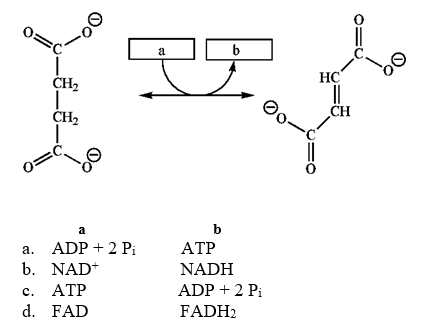
Free
(Short Answer)
4.8/5 (81)
(81) Correct Answer:Verified
VerifiedD
Consider the following reaction. 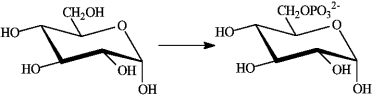 Which of the following describes this reaction?
Free
(Multiple Choice)
4.9/5 (71)
(71) Correct Answer:Verified
VerifiedC
Which group of small molecules best fit the boxes associated with the reaction shown? 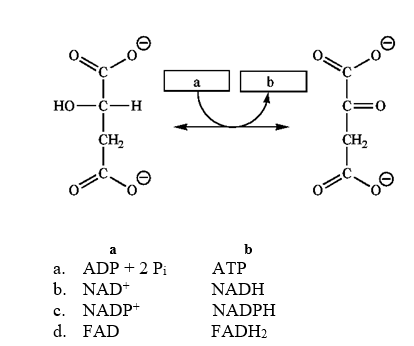
(Short Answer)
4.9/5 (70)
(70) Which group of small molecules best fit the boxes associated with the reaction shown? 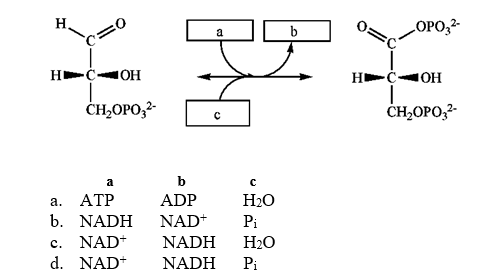
(Short Answer)
4.9/5 (79)
(79) Instructions: Consider the reaction below to answer the following questions:
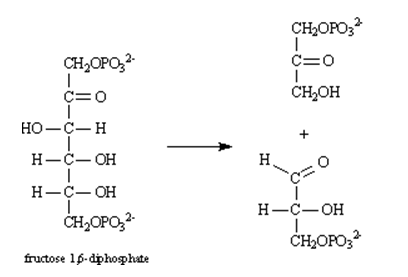 -Refer to instructions. This reaction is an example of:
 (Multiple Choice)
5.0/5 (91)
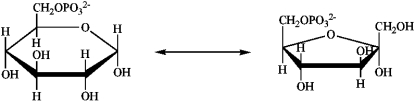
(91) 
What product would be obtained from enzymatic transamination of 3-hydroxy-2-ketopropanoic acid? 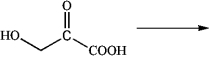
(Essay)
4.8/5 (73)
(73) Instructions: Match a term or structure from the list below to each of the following definitions or names.
-Acetyl groups are oxidized to yield carbon dioxide and water.
(Multiple Choice)
4.8/5 (86)
(86) Many biological reactions are endergonic. Explain how it is possible that these reactions occur spontaneously.
(Essay)
4.8/5 (92)
(92) How many passages through the -oxidation pathway are required to completely degrade the following fatty acid?
CH3(CH2)12CO2H
(Short Answer)
4.7/5 (84)
(84) Instructions: Match a term or structure from the list below to each of the following definitions or names.
-The "energy currency" of the cell.
(Multiple Choice)
4.8/5 (73)
(73) Instructions: Consider the reaction below to answer the following question(s). 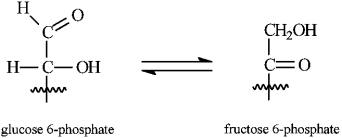 -Refer to instructions. Write the mechanism for this isomerization.
 (Essay)
5.0/5 (88)
(88) Instructions: Match a term or structure from the list below to each of the following definitions or names.
-Coenzyme NAD+ required in the -oxidation of fatty acids, glycolysis, and the citric acid cycle.
(Multiple Choice)
4.8/5 (77)
(77) Instructions: Consider the reaction below to answer the following question(s).
-Refer to instructions. This reaction proceeds through a common enol structure. Draw the structure of the glucose/fructose enol.
-Refer to instructions. This reaction proceeds through a common enol structure. Draw the structure of the glucose/fructose enol. (Essay)
4.7/5 (71)
(71) Draw the structure of the ultimate organic glycolysis product of -glucose. 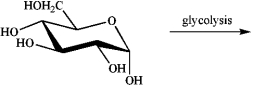
(Essay)
4.9/5 (76)
(76) Instructions: Consider the reaction below to answer the following question(s).
-Refer to instructions. The isomerization of glucose 6-phosphate to fructose 6-phosphate is an example of:
-Refer to instructions. The isomerization of glucose 6-phosphate to fructose 6-phosphate is an example of: (Multiple Choice)
4.9/5 (68)
(68) 
Filters
- Essay(0)
- Multiple Choice(0)
- Short Answer(0)
- True False(0)
- Matching(0)