



 Chat with AI
Exam 15: Biomolecules: Amino Acids, Peptides, and Proteins

Exam 1: Structure and Bonding:acids and Bases41 Questions
Exam 2: Alkanes: the Nature of Organic Compounds44 Questions
Exam 3: Alkenes and Alkynes: the Nature of Organic Reactions40 Questions
Exam 4: Reactions of Alkenes and Alkynes44 Questions
Exam 5: Aromatic Compounds52 Questions
Exam 6: Sterechemistry at Tetrahedral Centers39 Questions
Exam 7: Organohalides: Nucleophilic Substitutions and Eliminations40 Questions
Exam 8: Alcohols, Phenols, Ethers, and Their Sulfur Analogs36 Questions
Exam 9: Aldehydes and Ketones: Nucleophilic Addition Reactions32 Questions
Exam 10: Carboxylic Acids and Derivatives: Nucleophilic Acyl Substitution Reactions63 Questions
Exam 11: Carbonyl Alpha-Substitution Reactions and Condensation Reactions38 Questions
Exam 12: Amines32 Questions
Exam 13: Structure Determination65 Questions
Exam 14: Biomolecules: Carbohydrates48 Questions
Exam 15: Biomolecules: Amino Acids, Peptides, and Proteins50 Questions
Exam 16: Biomolecules: Lipids and Nucleic Acids50 Questions
Exam 17: The Organic Chemistry of Metabolic Pathways40 Questions
Select questions type


Which of the following tripeptides is not hydrolysed by chymotrypsin?

Free
(Multiple Choice)
4.8/5  (87)
(87) Correct Answer: Verified
C
Instructions: Refer to the data below to answer the following question(s).
Leucine is an essential amino acid with the systematic name 2-amino-3-methylpentanoic acid. It has pKa1 = 2.36 and pKa2 = 9.60.
-Refer to instructions. What is the pI of leucine?
Free
(Essay)
4.9/5 (94)
(94) Correct Answer:Verified
VerifiedThe pI is the isoelectric point and is the average of pKa1 and pKa2. For leucine: 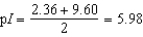
Which of the following amino acids migrates to the positive electrode on paper electrophoresis at a pH of 7.0?
Free
(Multiple Choice)
4.9/5 (72)
(72) Correct Answer:Verified
VerifiedA
Instructions: Match a structure from the list below to each of the following terms.
-A peptide coupling reagent.
(Multiple Choice)
4.8/5 (89)
(89) Instructions: Match a structure from the list below to each of the following terms.
-A polypeptide which gives four fragments on treatment with chymotrypsin.
(Multiple Choice)
4.8/5 (78)
(78) Instructions: Refer to the data below to answer the following question(s).
Porcine dynorphin is a neuropeptide having 17 amino acid residues. Its structure is shown below.
Tyr-Gly-Gly-Phe-Leu-Arg-Arg-Ile-Arg-Pro-Lys-Leu-Lys-Trp-Asp-Asn-Gln
-Refer to instructions. What fragments would result if dynorphin were cleaved by trypsin?
(Essay)
4.9/5 (77)
(77) Instructions: Match a structure from the list below to each of the following terms.
-An amino acid with a protected carboxyl group.
(Multiple Choice)
4.9/5 (87)
(87) BOC protecting groups are generally removed by treatment with trifluoroacetic acid.  On the structures provided below, draw arrows consistent with electron flow in the mechanism of this reaction.
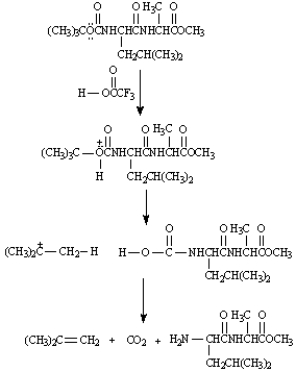
On the structures provided below, draw arrows consistent with electron flow in the mechanism of this reaction. (Essay)
4.7/5 (79)
(79) Which of the following amino acids has an aromatic side chain?
(Multiple Choice)
4.9/5 (61)
(61) Which of the following amino acids would contain the highest concentration of zwitterions at pH 5.90?
(Multiple Choice)
5.0/5 (77)
(77) Instructions: Consider the following structure. Based on this structure answer the following question(s). 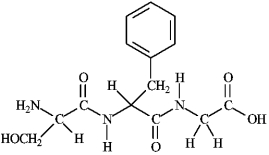 -Refer to instructions. Identify the C-terminal amino acid and the N-terminal amino acid.
 (Essay)
4.8/5 (72)
(72) Match a term from the list below to each definition.
-Enzymes which catalyze the transfer of a phosphate group.
(Multiple Choice)
4.9/5 (88)
(88) Instructions: Refer to the data below to answer the following question(s).
Leucine is an essential amino acid with the systematic name 2-amino-3-methylpentanoic acid. It has pKa1 = 2.36 and pKa2 = 9.60.
-Refer to instructions. Draw the condensed structure for leucine, and label all chirality centers with an asterisk and identify the amine as primary, secondary or tertiary.
(Essay)
4.7/5 (65)
(65) Instructions: Match a structure from the list below to each of the following terms.
-A peptide containing eight amino acid residues with a C-terminal valine.
(Multiple Choice)
4.8/5 (75)
(75) Instructions: Refer to the data below to answer the following question(s).
Leucine is an essential amino acid with the systematic name 2-amino-3-methylpentanoic acid. It has pKa1 = 2.36 and pKa2 = 9.60.
-Refer to instructions. Draw the structure of the predominant form of leucine at pH = 1.50.
(Essay)
4.9/5 (91)
(91) Instructions: Refer to the data below to answer the following question.
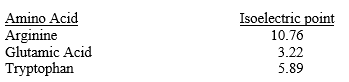 -Refer to instructions. At what pH would you carry out an electrophoresis experiment if you wanted to separate a mixture of lysine, aspartic acid and phenylalanine? Explain.
 (Essay)
4.8/5 (73)
(73) Which of the following amino acids has a sulfur-containing side chain?
(Multiple Choice)
4.8/5 (84)
(84) To what structural feature does the term "secondary structure" refer?
(Multiple Choice)
4.9/5 (82)
(82) Instructions: Refer to the data below to answer the following question(s).
Leucine is an essential amino acid with the systematic name 2-amino-3-methylpentanoic acid. It has pKa1 = 2.36 and pKa2 = 9.60.
-Refer to instructions. Leucine is described as an essential amino acid. What does this mean?
(Essay)
4.8/5 (63)
(63) 
Filters
- Essay(0)
- Multiple Choice(0)
- Short Answer(0)
- True False(0)
- Matching(0)