



 Chat with AI
Exam 6: Microbial Nutrition and Growth

Exam 1: A Brief History of Microbiology73 Questions
Exam 2: The Chemistry of Microbiology76 Questions
Exam 3: Cell Structure and Function80 Questions
Exam 4: Microscopy, Staining, and Classification80 Questions
Exam 5: Microbial Metabolism77 Questions
Exam 6: Microbial Nutrition and Growth75 Questions
Exam 7: Microbial Genetics75 Questions
Exam 8: Recombinant DNA Technology75 Questions
Exam 9: Controlling Microbial Growth in the Environment75 Questions
Exam 10:Controlling Microbial Growth in the Body: Antimicrobial Drugs75 Questions
Exam 11: Characterizing and Classifying Prokaryotes75 Questions
Exam 12: Characterizing and Classifying Eukaryotes75 Questions
Exam 13: Characterizing and Classifying Viruses, Viroids, and Prions75 Questions
Exam 14: Infection, Infectious Diseases, and Epidemiology76 Questions
Exam 15: Innate Immunity75 Questions
Exam 16: Adaptive Immunity75 Questions
Exam 17: Immunization and Immune Testing75 Questions
Exam 18: Immune Disorders75 Questions
Exam 19: Microbial Diseases of the Skin and Wounds72 Questions
Exam 20: Microbial Diseases of the Nervous System and Eyes71 Questions
Exam 21: Microbial Cardiovascular and Systemic Diseases71 Questions
Exam 22: Microbial Diseases of the Respiratory System70 Questions
Exam 23: Microbial Diseases of the Digestive System70 Questions
Exam 24: Microbial Diseases of the Urinary and Reproductive Systems65 Questions
Exam 25: Applied and Industrial Microbiology73 Questions
Exam 26: Microbial Ecology and Microbiomes73 Questions
Select questions type


Serial dilution can be used in combination with pour plates as a method for isolating pure cultures.
(True/False)
4.8/5  (81)
(81) A laboratory recipe lists sucrose, an ammonia compound, calcium salts and a buffer as the ingredients for a microbiologic medium. These are added to water and autoclaved. What type of medium does this protocol produce?
(Multiple Choice)
4.8/5 (65)
(65) A microorganism found living under conditions of high ________ is a barophile.
(Multiple Choice)
4.7/5 (78)
(78) The carotenoid pigments of some phototrophs interact with ________ to reduce its toxicity.
(Multiple Choice)
4.7/5 (83)
(83) A clinical sample from a mucus membrane is usually collected as a (biopsy/needle/swab) specimen.
(Short Answer)
4.8/5 (74)
(74) Explain the similarities and differences between direct and indirect methods of measuring microbial growth, and give examples of each.
(Essay)
4.8/5 (80)
(80) Culturing of intracellular parasites generally requires (enrichment/cell culture/low oxygen) conditions.
(Short Answer)
4.8/5 (79)
(79) A new prokaryote is recovered from a remote saline hot spring. Design a set of experiments to determine whether the organism is thermophilic or thermoduric, halophilic or halotolerant.
(Essay)
4.7/5 (85)
(85) 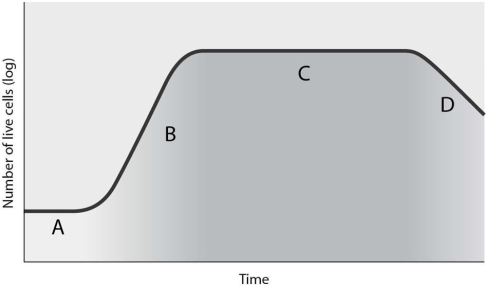 Which of the following statements is CORRECT regarding Figure 6.1?
 (Multiple Choice)
4.8/5 (77)
(77) Rates of cell production and cell death are approximately equal during the ________ phase of growth.
(Multiple Choice)
4.9/5 (70)
(70) Explain how temperature and pH levels can influence microbial infections in the human body.
(Essay)
4.7/5 (89)
(89) Photoheterotrophs use carbon dioxide as their sole carbon source.
(True/False)
5.0/5 (83)
(83) The preferred method for long term storage of bacteria is (freezing/refrigeration/lyophilization).
(Short Answer)
5.0/5 (92)
(92) In the process of ________, microbes detect the presence and density of other microbes and modify their metabolic activity in response.
(Multiple Choice)
4.9/5 (77)
(77) Joan wants to discover a microbe capable of degrading an environmental contaminant. Which of the following culturing methods would be most effective for isolation of such an organism?
(Multiple Choice)
4.7/5 (82)
(82) Thermoduric mesophiles are often responsible for spoilage of improperly canned foods.
(True/False)
4.9/5 (80)
(80) 
Filters
- Essay(0)
- Multiple Choice(0)
- Short Answer(0)
- True False(0)
- Matching(0)