



 Chat with AI
Exam 10: Externalities

Exam 1: Ten Principles of Economics220 Questions
Exam 2: Thinking Like an Economist284 Questions
Exam 3: Interdependence and the Gains From Trade192 Questions
Exam 4: The Market Forces of Supply and Demand277 Questions
Exam 5: Elasticity and Its Application222 Questions
Exam 6: Supply, Demand, and Government Policies321 Questions
Exam 7: Consumers, Producers, and the Efficiency of Markets218 Questions
Exam 8: Applications: The Costs of Taxation203 Questions
Exam 9: Application: International Trade214 Questions
Exam 10: Externalities204 Questions
Exam 11: Public Goods and Common Resources182 Questions
Exam 12: The Design of the Tax System225 Questions
Exam 13: The Costs of Production261 Questions
Exam 14: Firms in Competitive Markets243 Questions
Exam 15: Monopoly231 Questions
Exam 16: Monopolistic Competition246 Questions
Exam 17: Oligopoly204 Questions
Exam 18: The Markets for the Factors of Production232 Questions
Exam 19: Earnings and Discrimination230 Questions
Exam 20: Income Inequality and Poverty194 Questions
Exam 21: The Theory of Consumer Choice209 Questions
Exam 22: Frontiers in Microeconomics185 Questions
Exam 23: Measuring a Nations Income231 Questions
Exam 24: Measuring the Cost of Living214 Questions
Exam 25: Production and Growth187 Questions
Exam 26: Saving, Investment, and the Financial System225 Questions
Exam 27: Tools of Finance198 Questions
Exam 28: Unemployment and Its Natural Rate361 Questions
Exam 29: The Monetary System210 Questions
Exam 30: Money Growth and Inflation201 Questions
Exam 31: Open-Economy Macroeconomics: Basic Concepts194 Questions
Exam 32: A Macroeconomic Theory of the Open Economy188 Questions
Exam 33: Aggregate Demand and Aggregate Supply189 Questions
Exam 34: The Influence of Monetary and Fiscal Policy on Aggregate Demand207 Questions
Exam 35: The Short-Run Tradeoff Between Inflation and Unemployment223 Questions
Exam 36: Six Debates Over Macroeconomic Policy154 Questions
Select questions type


Which of the following statements is not true of both pollution permits and corrective taxes?
(Multiple Choice)
4.9/5  (82)
(82) The patent system gives firms greater incentive to engage in research and other activities that advance technology.
(True/False)
4.9/5 (72)
(72) Research into new technologies conveys neither negative externalities nor positive externalities.
(True/False)
4.9/5 (77)
(77) The concept of external cost is associated with a negative externality, but not with a positive externality.
(True/False)
4.8/5 (84)
(84) Which of the following is not a characteristic of pollution permits?
(Multiple Choice)
4.9/5 (87)
(87) Private parties may choose not to solve an externality problem if the transaction costs are large enough.
(True/False)
4.9/5 (77)
(77) Scenario 10-4
The demand curve for fire extinguishers slopes downward and the supply curve for fire extinguishers slopes upward. The production of the 500th fire extinguisher entails the following:
• a private cost of $10;
• an external cost of $0;
• a private value of $9;
• an external benefit of $3.
-Refer to Scenario 10-4. Is the socially-optimal quantity of fire extinguishers less than, equal to, or greater than 500? Explain.
(Essay)
4.8/5 (91)
(91) Most economists prefer corrective taxes to regulation as a way to correct the problem of pollution because the market-based solution
(Multiple Choice)
4.8/5 (83)
(83) Which of the following is not an advantage of corrective taxes?
(Multiple Choice)
4.8/5 (78)
(78) Which of the following illustrates the concept of a negative externality?
(Multiple Choice)
4.8/5 (77)
(77) When market activity generates a negative externality, the level of output in the market equilibrium is lower than the socially optimal level.
(True/False)
4.8/5 (66)
(66) Figure 10-8 
-Refer to Figure 10-8. This market is characterized by a negative externality.
-Refer to Figure 10-8. This market is characterized by a negative externality. (True/False)
4.9/5 (75)
(75) Figure 10-5 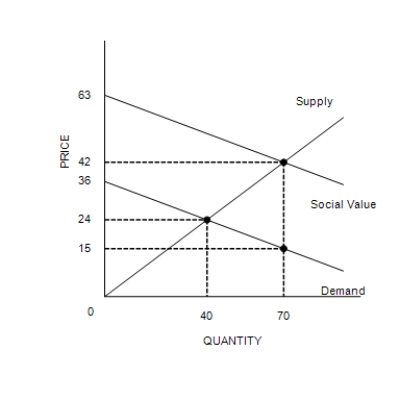 -Refer to Figure 10-5. The socially optimal quantity of output is
 (Multiple Choice)
4.9/5 (92)
(92) Scenario 10-4
The demand curve for fire extinguishers slopes downward and the supply curve for fire extinguishers slopes upward. The production of the 500th fire extinguisher entails the following:
• a private cost of $10;
• an external cost of $0;
• a private value of $9;
• an external benefit of $3.
-Refer to Scenario 10-4. What is the social value of the 500th fire extinguisher?
(Essay)
4.9/5 (86)
(86) Suppose the market-equilibrium quantity of good x is larger than the socially-optimal quantity of good x. Does the production of good x convey a positive externality or does it convey a negative externality?
(Essay)
4.8/5 (81)
(81) Figure 10-7 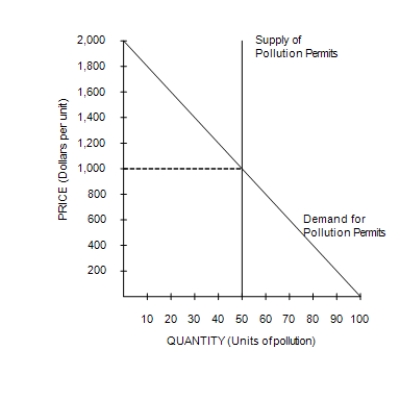 -Refer to Figure 10-7. This graph shows the market for pollution when permits are issued to firms and traded in the marketplace. In the absence of a pollution permit system, the quantity of pollution would be
 (Multiple Choice)
4.9/5 (74)
(74) Suppose a Pigovian tax is imposed on a market that is characterized by one or more externalities. Is this a command-and-control policy or is it a market-based policy?
(Short Answer)
4.8/5 (94)
(94) Table 10-2
Quantity (Units) Private Value (Dollars) Private Cost (Dollars) Social Value (Dollars) 1 51 45 57 2 48 48 54 3 45 51 51 4 42 54 48 5 39 57 45 6 36 60 42
-Refer to Table 10-2. What is the socially optimal level of output in this market?
(Multiple Choice)
4.9/5 (76)
(76) Figure 10-6
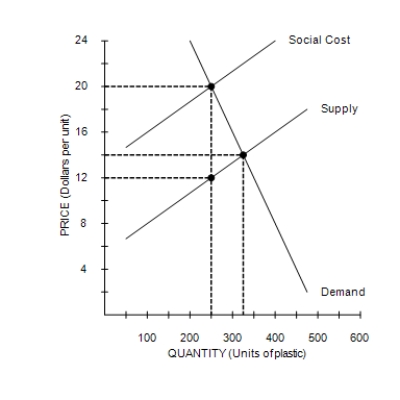 -Refer to Figure 10-6. If 250 units of plastics are produced and consumed, then the
 (Multiple Choice)
4.9/5 (75)
(75) 
Filters
- Essay(0)
- Multiple Choice(0)
- Short Answer(0)
- True False(0)
- Matching(0)