



 Chat with AI
Exam 10: Externalities

Exam 1: Ten Principles of Economics220 Questions
Exam 2: Thinking Like an Economist284 Questions
Exam 3: Interdependence and the Gains From Trade192 Questions
Exam 4: The Market Forces of Supply and Demand277 Questions
Exam 5: Elasticity and Its Application222 Questions
Exam 6: Supply, Demand, and Government Policies321 Questions
Exam 7: Consumers, Producers, and the Efficiency of Markets218 Questions
Exam 8: Applications: The Costs of Taxation203 Questions
Exam 9: Application: International Trade214 Questions
Exam 10: Externalities204 Questions
Exam 11: Public Goods and Common Resources182 Questions
Exam 12: The Design of the Tax System225 Questions
Exam 13: The Costs of Production261 Questions
Exam 14: Firms in Competitive Markets243 Questions
Exam 15: Monopoly231 Questions
Exam 16: Monopolistic Competition246 Questions
Exam 17: Oligopoly204 Questions
Exam 18: The Markets for the Factors of Production232 Questions
Exam 19: Earnings and Discrimination230 Questions
Exam 20: Income Inequality and Poverty194 Questions
Exam 21: The Theory of Consumer Choice209 Questions
Exam 22: Frontiers in Microeconomics185 Questions
Exam 23: Measuring a Nations Income231 Questions
Exam 24: Measuring the Cost of Living214 Questions
Exam 25: Production and Growth187 Questions
Exam 26: Saving, Investment, and the Financial System225 Questions
Exam 27: Tools of Finance198 Questions
Exam 28: Unemployment and Its Natural Rate361 Questions
Exam 29: The Monetary System210 Questions
Exam 30: Money Growth and Inflation201 Questions
Exam 31: Open-Economy Macroeconomics: Basic Concepts194 Questions
Exam 32: A Macroeconomic Theory of the Open Economy188 Questions
Exam 33: Aggregate Demand and Aggregate Supply189 Questions
Exam 34: The Influence of Monetary and Fiscal Policy on Aggregate Demand207 Questions
Exam 35: The Short-Run Tradeoff Between Inflation and Unemployment223 Questions
Exam 36: Six Debates Over Macroeconomic Policy154 Questions
Select questions type


Does research into new technologies create a positive externality or does it create a negative externality?
(Essay)
4.8/5  (77)
(77) Although regulation and corrective taxes are both capable of reducing pollution, regulation accomplishes this goal more efficiently.
(True/False)
4.9/5 (82)
(82) Figure 10-7 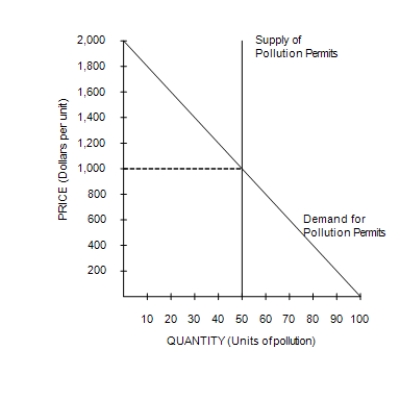 -Refer to Figure 10-7. This graph shows the market for pollution when permits are issued to firms and traded in the marketplace. The equilibrium number of permits is
 (Multiple Choice)
4.7/5 (82)
(82) Figure 10-2  -Refer to Figure 10-2. The socially optimal quantity would be
 (Multiple Choice)
4.9/5 (80)
(80) Table 10-2
Quantity (Units) Private Value (Dollars) Private Cost (Dollars) Social Value (Dollars) 1 51 45 57 2 48 48 54 3 45 51 51 4 42 54 48 5 39 57 45 6 36 60 42
-Refer to Table 10-2. How large would a subsidy need to be in this market to move the market from the equilibrium level of output to the socially optimal level of output?
(Multiple Choice)
4.9/5 (86)
(86) Sophia sits behind Gabriel on an airplane. Gabriel owns the right to recline his seat and values this right at $10. Sophia values a non-reclined seat in front of her at $20. Assuming no transaction costs, an efficient solution would be for Sophia to pay Gabriel $15 to not recline his seat.
(True/False)
4.8/5 (77)
(77) According to recent research, the gas tax in the United States is lower than the optimal level.
(True/False)
4.8/5 (87)
(87) Figure 10-4
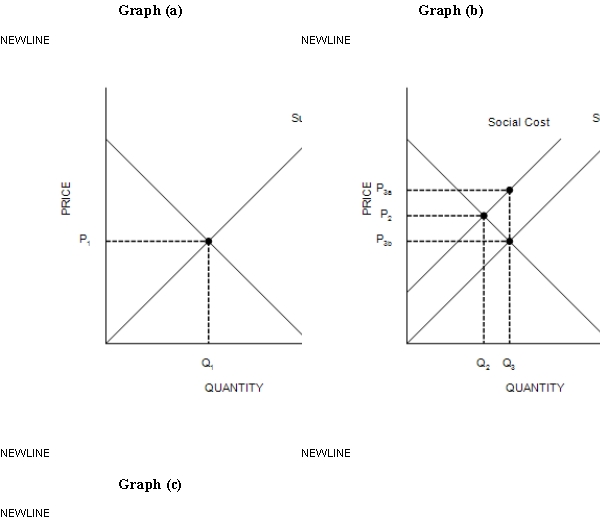 -Refer to Figure 10-4, Graph (b) and Graph (c). The installation of a scrubber in a smokestack reduces the emission of harmful chemicals from the smokestack. Therefore, the external benefit of smokestack scrubber installation is represented by
 (Multiple Choice)
4.8/5 (64)
(64) Figure 10-3 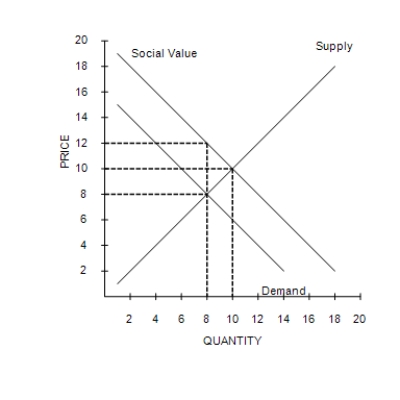 -Refer to Figure 10-3. If the government wanted to tax or subsidize this good to achieve the socially optimal level of output, it would
 (Multiple Choice)
4.9/5 (72)
(72) Figure 10-6
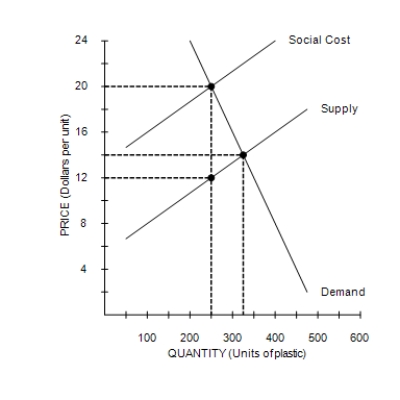 -Refer to Figure 10-6. If the government imposed a corrective tax that successfully moved the market from the market equilibrium to the social optimum, then tax revenue for the government would amount to
 (Multiple Choice)
4.9/5 (88)
(88) Scenario 10-1
The demand curve for gasoline slopes downward and the supply curve for gasoline slopes upward. The production of the 400th gallon of gasoline entails the following:
a private cost of $2.83;
a social cost of $3.12;
a value to consumers of $3.23.
-Refer to Scenario 10-1. Suppose the equilibrium quantity of gasoline is 440 gallons; that is, QMARKET = 440. Then the equilibrium price of a gallon could be
(Multiple Choice)
4.9/5 (79)
(79) Describe the circumstances under which it would be better for the government to sell pollution permits than to levy a corrective tax.
(Essay)
4.8/5 (87)
(87) Suppose that coal producers create a negative externality equal to $5 per ton of coal. What is the relationship between the equilibrium quantity of coal and the socially optimal quantity of coal?
(Multiple Choice)
4.9/5 (76)
(76) Figure 10-2
-Refer to Figure 10-2. Without government intervention, the equilibrium quantity would be
-Refer to Figure 10-2. Without government intervention, the equilibrium quantity would be (Multiple Choice)
4.9/5 (71)
(71) If the social value of producing robots is greater than the private value of producing robots, the private market produces too few robots.
(True/False)
4.8/5 (70)
(70) In some circumstances, selling pollution permits may be better than levying a corrective tax.
(True/False)
4.9/5 (84)
(84) Government can be used to solve externality problems that are too costly for private parties to solve.
(True/False)
4.9/5 (93)
(93) Table 10-3
Quantity (Units) Private Value (Dollars) Private Cost (Dollars) External Benefit (Dollars) 1 22 12 10 2 20 15 10 3 18 18 10 4 16 21 10 5 14 24 10 6 12 27 10
-Refer to Table 10-3. What amount of subsidy per unit of output would move the market from the equilibrium level of output to the socially optimal level of output?
(Multiple Choice)
4.7/5 (89)
(89) Negative externalities lead markets to produce a smaller quantity of a good than is socially desirable, while positive externalities lead markets to produce a larger quantity of a good than is socially desirable.
(True/False)
4.7/5 (93)
(93) 
Filters
- Essay(0)
- Multiple Choice(0)
- Short Answer(0)
- True False(0)
- Matching(0)