



 Chat with AI
Exam 10: Externalities

Exam 1: Ten Principles of Economics220 Questions
Exam 2: Thinking Like an Economist284 Questions
Exam 3: Interdependence and the Gains From Trade192 Questions
Exam 4: The Market Forces of Supply and Demand277 Questions
Exam 5: Elasticity and Its Application222 Questions
Exam 6: Supply, Demand, and Government Policies321 Questions
Exam 7: Consumers, Producers, and the Efficiency of Markets218 Questions
Exam 8: Applications: The Costs of Taxation203 Questions
Exam 9: Application: International Trade214 Questions
Exam 10: Externalities204 Questions
Exam 11: Public Goods and Common Resources182 Questions
Exam 12: The Design of the Tax System225 Questions
Exam 13: The Costs of Production261 Questions
Exam 14: Firms in Competitive Markets243 Questions
Exam 15: Monopoly231 Questions
Exam 16: Monopolistic Competition246 Questions
Exam 17: Oligopoly204 Questions
Exam 18: The Markets for the Factors of Production232 Questions
Exam 19: Earnings and Discrimination230 Questions
Exam 20: Income Inequality and Poverty194 Questions
Exam 21: The Theory of Consumer Choice209 Questions
Exam 22: Frontiers in Microeconomics185 Questions
Exam 23: Measuring a Nations Income231 Questions
Exam 24: Measuring the Cost of Living214 Questions
Exam 25: Production and Growth187 Questions
Exam 26: Saving, Investment, and the Financial System225 Questions
Exam 27: Tools of Finance198 Questions
Exam 28: Unemployment and Its Natural Rate361 Questions
Exam 29: The Monetary System210 Questions
Exam 30: Money Growth and Inflation201 Questions
Exam 31: Open-Economy Macroeconomics: Basic Concepts194 Questions
Exam 32: A Macroeconomic Theory of the Open Economy188 Questions
Exam 33: Aggregate Demand and Aggregate Supply189 Questions
Exam 34: The Influence of Monetary and Fiscal Policy on Aggregate Demand207 Questions
Exam 35: The Short-Run Tradeoff Between Inflation and Unemployment223 Questions
Exam 36: Six Debates Over Macroeconomic Policy154 Questions
Select questions type


Scenario 10-3
Suppose the equation for the demand curve in a market is P = 120 - (1/5) QD , where QD is the quantity demanded and is the price. Also, suppose the equation for the supply curve in the same market is P = (1/10) QS , where QS is the quantity supplied.
-Refer to Scenario 10-3. Suppose there is an external cost of $12 associated with the production of each unit of the good. What is the equation of the social-cost curve?
(Essay)
4.9/5  (73)
(73) The likelihood of successful private solutions to problems caused by externalities depends, in part, upon the number of interested parties. Briefly explain.
(Essay)
4.8/5 (80)
(80) Figure 10-4
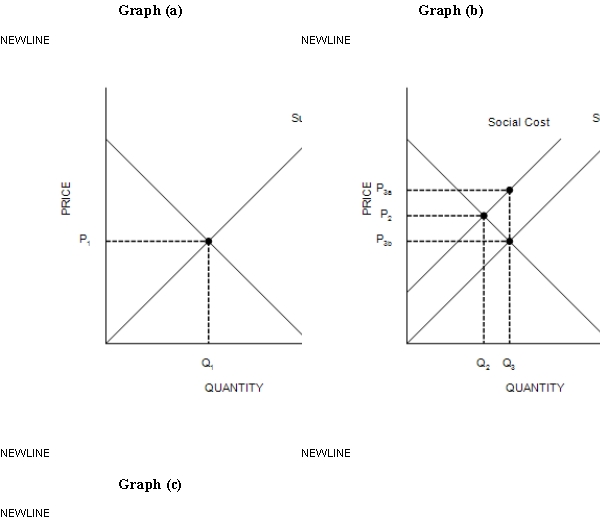 -Refer to Figure 10-4, Graph (b) and Graph (c). The overuse of antibiotics leads to the development of antibiotic-resistant diseases. Therefore, the external cost of antibiotic overuse is represented by
 (Multiple Choice)
4.9/5 (76)
(76) When firms internalize a negative externality, the market supply curve shifts to the left.
(True/False)
4.8/5 (90)
(90) Scenario 10-4
The demand curve for fire extinguishers slopes downward and the supply curve for fire extinguishers slopes upward. The production of the 500th fire extinguisher entails the following:
• a private cost of $10;
• an external cost of $0;
• a private value of $9;
• an external benefit of $3.
-Refer to Scenario 10-4. In order to reach the social optimum, should fire extinguishers be taxed or subsidized? What is the appropriate amount of the tax or subsidy on each fire extinguisher?
(Essay)
5.0/5 (67)
(67) At any given quantity, the cost of the marginal seller is the height of the __________.
(Essay)
4.7/5 (84)
(84) When Monique drives to work every morning, she drives on a congested highway. What Monique does not realize is that when she enters the highway each morning she increases the travel time of all other drivers on the highway. In this case, the external cost of Monique's highway trip
(Multiple Choice)
4.9/5 (91)
(91) Scenario 10-3
Suppose the equation for the demand curve in a market is P = 120 - (1/5) QD , where QD is the quantity demanded and is the price. Also, suppose the equation for the supply curve in the same market is P = (1/10) QS , where QS is the quantity supplied.
-Refer to Scenario 10-3. Suppose there is an external cost of $12 associated with the production of each unit of the good. What particular tax or subsidy would move the market to the social optimum?
(Essay)
5.0/5 (72)
(72) Figure 10-4
-Refer to Figure 10-4, Graph (b) and Graph (c). The overuse of antibiotics leads to the development of antibiotic-resistant diseases. Therefore, a government policy that internalized the externality would move the quantity of antibiotics used from point
-Refer to Figure 10-4, Graph (b) and Graph (c). The overuse of antibiotics leads to the development of antibiotic-resistant diseases. Therefore, a government policy that internalized the externality would move the quantity of antibiotics used from point (Multiple Choice)
4.9/5 (79)
(79) Scenario 10-1
The demand curve for gasoline slopes downward and the supply curve for gasoline slopes upward. The production of the 400th gallon of gasoline entails the following:
a private cost of $2.83;
a social cost of $3.12;
a value to consumers of $3.23.
-Education yields positive externalities. For example,
(Multiple Choice)
4.9/5 (73)
(73) According to the Coase Theorem, individuals can always work out a mutually beneficial agreement to solve the problems of externalities even when high transaction costs are involved.
(True/False)
4.8/5 (73)
(73) As a means of dealing with pollution, do economists generally prefer corrective taxes or do they prefer regulations?
(Essay)
4.8/5 (69)
(69) Zaria and Hannah are roommates. Zaria assigns a $30 value to smoking cigarettes. Hannah values smoke-free air at $15. Which of the following scenarios is a successful example of the Coase theorem?
(Multiple Choice)
4.8/5 (72)
(72) Table 10-3
Quantity (Units) Private Value (Dollars) Private Cost (Dollars) External Benefit (Dollars) 1 22 12 10 2 20 15 10 3 18 18 10 4 16 21 10 5 14 24 10 6 12 27 10
-Refer to Table 10-3. The table represents a market in which
(Multiple Choice)
4.7/5 (81)
(81) Figure 10-1  -Refer to Figure 10-1. This graph represents the tobacco industry. The industry creates
 (Multiple Choice)
4.9/5 (89)
(89) Figure 10-7 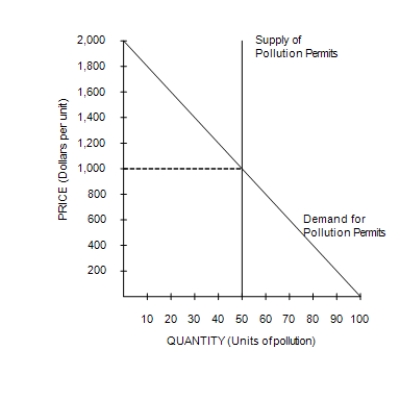 -Two firms, A and B, each currently emit 100 tons of chemicals into the air. The government has decided to reduce the pollution and from now on will require a pollution permit for each ton of pollution emitted into the air. The government gives each firm 40 pollution permits, which it can either use or sell to the other firm. It costs Firm A $200 for each ton of pollution that it eliminates before it is emitted into the air, and it costs Firm B $100 for each ton of pollution that it eliminates before it is emitted into the air. After the two firms buy or sell pollution permits from each other, we would expect that Firm A will emit
 (Multiple Choice)
4.9/5 (65)
(65) Laws that are passed that either require or forbid certain behaviors are examples of command-and-control policies.
(True/False)
4.9/5 (77)
(77) The tax on gasoline causes deadweight losses, as is the case with all taxes.
(True/False)
4.8/5 (64)
(64) Government intervention is necessary to correct all externalities.
(True/False)
4.8/5 (78)
(78) Social welfare can be enhanced by allowing firms to trade their rights to pollute.
(True/False)
4.9/5 (66)
(66) 
Filters
- Essay(0)
- Multiple Choice(0)
- Short Answer(0)
- True False(0)
- Matching(0)