



 Chat with AI
Exam 10: Externalities

Exam 1: Ten Principles of Economics220 Questions
Exam 2: Thinking Like an Economist284 Questions
Exam 3: Interdependence and the Gains From Trade192 Questions
Exam 4: The Market Forces of Supply and Demand277 Questions
Exam 5: Elasticity and Its Application222 Questions
Exam 6: Supply, Demand, and Government Policies321 Questions
Exam 7: Consumers, Producers, and the Efficiency of Markets218 Questions
Exam 8: Applications: The Costs of Taxation203 Questions
Exam 9: Application: International Trade214 Questions
Exam 10: Externalities204 Questions
Exam 11: Public Goods and Common Resources182 Questions
Exam 12: The Design of the Tax System225 Questions
Exam 13: The Costs of Production261 Questions
Exam 14: Firms in Competitive Markets243 Questions
Exam 15: Monopoly231 Questions
Exam 16: Monopolistic Competition246 Questions
Exam 17: Oligopoly204 Questions
Exam 18: The Markets for the Factors of Production232 Questions
Exam 19: Earnings and Discrimination230 Questions
Exam 20: Income Inequality and Poverty194 Questions
Exam 21: The Theory of Consumer Choice209 Questions
Exam 22: Frontiers in Microeconomics185 Questions
Exam 23: Measuring a Nations Income231 Questions
Exam 24: Measuring the Cost of Living214 Questions
Exam 25: Production and Growth187 Questions
Exam 26: Saving, Investment, and the Financial System225 Questions
Exam 27: Tools of Finance198 Questions
Exam 28: Unemployment and Its Natural Rate361 Questions
Exam 29: The Monetary System210 Questions
Exam 30: Money Growth and Inflation201 Questions
Exam 31: Open-Economy Macroeconomics: Basic Concepts194 Questions
Exam 32: A Macroeconomic Theory of the Open Economy188 Questions
Exam 33: Aggregate Demand and Aggregate Supply189 Questions
Exam 34: The Influence of Monetary and Fiscal Policy on Aggregate Demand207 Questions
Exam 35: The Short-Run Tradeoff Between Inflation and Unemployment223 Questions
Exam 36: Six Debates Over Macroeconomic Policy154 Questions
Select questions type


Which of the following is an example of a positive externality?
(Multiple Choice)
4.8/5  (83)
(83) Figure 10-4
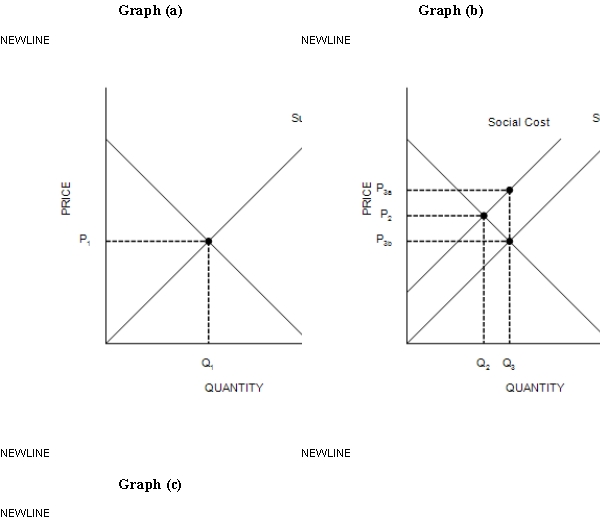 -Refer to Figure 10-4. Which graph represents a market with no externality?
 (Multiple Choice)
4.8/5 (71)
(71) Table 10-2
Quantity (Units) Private Value (Dollars) Private Cost (Dollars) Social Value (Dollars) 1 51 45 57 2 48 48 54 3 45 51 51 4 42 54 48 5 39 57 45 6 36 60 42
-Refer to Table 10-2. What is the equilibrium quantity of output in this market?
(Multiple Choice)
4.7/5 (77)
(77) Scenario 10-1
The demand curve for gasoline slopes downward and the supply curve for gasoline slopes upward. The production of the 400th gallon of gasoline entails the following:
a private cost of $2.83;
a social cost of $3.12;
a value to consumers of $3.23.
-Refer to Scenario 10-1. Suppose the dollar amount of the externality, per gallon of gasoline, is constant, regardless of how much gasoline is produced. Then the externality could be internalized if producers of gasoline were
(Multiple Choice)
4.8/5 (85)
(85) Suppose a new market for tradable pollution permits is created. As long as there is a free market for the pollution rights, the final allocation will be __________ , regardless of the initial allocation of permits.
(Short Answer)
4.8/5 (90)
(90) In a market characterized by externalities, the market equilibrium fails to maximize the total benefit to society as a whole.
(True/False)
4.8/5 (77)
(77) Some policies toward externalities provide incentives so that private decision makers will choose to solve the problem on their own. What name do we use for these types of policies?
(Essay)
4.8/5 (76)
(76) Two types of private solutions to the problem of externalities are
(Multiple Choice)
4.8/5 (77)
(77) Even if possible, it would be inefficient to prohibit all polluting activity.
(True/False)
4.9/5 (80)
(80) The Coase theorem asserts that private economic actors can solve the problem of externalities among themselves, without government intervention, regardless of whether those actors incur significant costs in reaching and enforcing an agreement.
(True/False)
4.8/5 (80)
(80) Despite the appealing logic of the Coase theorem, private actors often fail to resolve on their own the problems caused by externalities.
(True/False)
4.8/5 (72)
(72) Figure 10-5 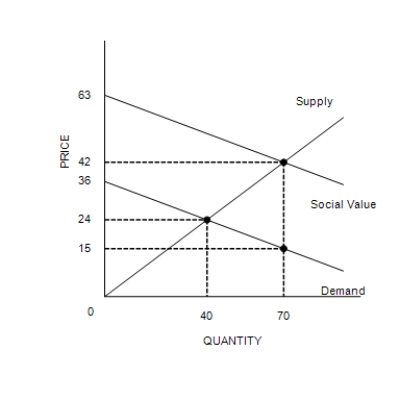 -Refer to Figure 10-5. Taking only private value and private cost into account, total surplus at the market equilibrium amounts to
 (Multiple Choice)
4.8/5 (98)
(98) Suppose a subsidy is offered to consumers of education as a means of internalizing the externalities associated with education. If the subsidy accurately reflects the external benefits of education, then the new demand curve for education coincides with which other curve?
(Essay)
4.7/5 (94)
(94) Most economists prefer regulation to taxation because regulation corrects market inefficiencies at a lower cost than taxation does.
(True/False)
4.8/5 (100)
(100) Briefly explain how research into new technologies gives rise to a positive externality.
(Essay)
5.0/5 (66)
(66) Suppose the Environmental Protection Agency issues pollution permits in order to limit the quantity of pollution. Under this policy, is the supply of pollution rights perfectly elastic or is it perfectly inelastic?
(Short Answer)
4.8/5 (92)
(92) The concept of external benefit is associated with a negative externality, but not with a positive externality.
(True/False)
4.8/5 (72)
(72) Scenario 10-1
The demand curve for gasoline slopes downward and the supply curve for gasoline slopes upward. The production of the 400th gallon of gasoline entails the following:
a private cost of $2.83;
a social cost of $3.12;
a value to consumers of $3.23.
-Refer to Scenario 10-1. The production of the 400th gallon of gasoline entails an
(Multiple Choice)
4.7/5 (75)
(75) Scenario 10-4
The demand curve for fire extinguishers slopes downward and the supply curve for fire extinguishers slopes upward. The production of the 500th fire extinguisher entails the following:
• a private cost of $10;
• an external cost of $0;
• a private value of $9;
• an external benefit of $3.
-Refer to Scenario 10-4. Does the production of fire extinguishers convey a positive externality, a negative externality, or neither?
(Essay)
4.7/5 (76)
(76) 
Filters
- Essay(0)
- Multiple Choice(0)
- Short Answer(0)
- True False(0)
- Matching(0)