



 Chat with AI
Exam 10: Externalities

Exam 1: Ten Principles of Economics220 Questions
Exam 2: Thinking Like an Economist284 Questions
Exam 3: Interdependence and the Gains From Trade192 Questions
Exam 4: The Market Forces of Supply and Demand277 Questions
Exam 5: Elasticity and Its Application222 Questions
Exam 6: Supply, Demand, and Government Policies321 Questions
Exam 7: Consumers, Producers, and the Efficiency of Markets218 Questions
Exam 8: Applications: The Costs of Taxation203 Questions
Exam 9: Application: International Trade214 Questions
Exam 10: Externalities204 Questions
Exam 11: Public Goods and Common Resources182 Questions
Exam 12: The Design of the Tax System225 Questions
Exam 13: The Costs of Production261 Questions
Exam 14: Firms in Competitive Markets243 Questions
Exam 15: Monopoly231 Questions
Exam 16: Monopolistic Competition246 Questions
Exam 17: Oligopoly204 Questions
Exam 18: The Markets for the Factors of Production232 Questions
Exam 19: Earnings and Discrimination230 Questions
Exam 20: Income Inequality and Poverty194 Questions
Exam 21: The Theory of Consumer Choice209 Questions
Exam 22: Frontiers in Microeconomics185 Questions
Exam 23: Measuring a Nations Income231 Questions
Exam 24: Measuring the Cost of Living214 Questions
Exam 25: Production and Growth187 Questions
Exam 26: Saving, Investment, and the Financial System225 Questions
Exam 27: Tools of Finance198 Questions
Exam 28: Unemployment and Its Natural Rate361 Questions
Exam 29: The Monetary System210 Questions
Exam 30: Money Growth and Inflation201 Questions
Exam 31: Open-Economy Macroeconomics: Basic Concepts194 Questions
Exam 32: A Macroeconomic Theory of the Open Economy188 Questions
Exam 33: Aggregate Demand and Aggregate Supply189 Questions
Exam 34: The Influence of Monetary and Fiscal Policy on Aggregate Demand207 Questions
Exam 35: The Short-Run Tradeoff Between Inflation and Unemployment223 Questions
Exam 36: Six Debates Over Macroeconomic Policy154 Questions
Select questions type


Figure 10-3 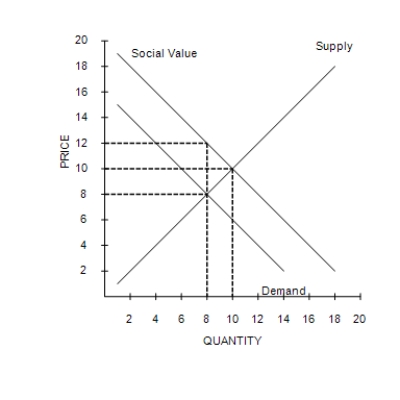 -Refer to Figure 10-3. What is the socially optimal quantity of output in this market?
 (Multiple Choice)
4.7/5  (87)
(87) Suppose a tax is imposed on producers of aluminum as a means of internalizing the externality associated with aluminum production. If the tax accurately reflects the external costs of pollutants released into the atmosphere, then the new supply curve for aluminum coincides with which other curve?
(Essay)
4.8/5 (70)
(70) According to the Coase theorem, private parties can solve the problem of externalities if
(Multiple Choice)
4.9/5 (80)
(80) To determine the optimal level of output in a market with negative externalities, a benevolent social planner would look for the level of output at which private cost equals private value.
(True/False)
4.8/5 (81)
(81) Figure 10-1  -Refer to Figure 10-1. This graph represents the tobacco industry. Without any government intervention, the equilibrium price and quantity are
 (Multiple Choice)
4.8/5 (81)
(81) Using a supply and demand diagram, demonstrate how a positive externality leads to market inefficiency. How might the government help to eliminate this inefficiency?
(Short Answer)
4.8/5 (62)
(62) Figure 10-4
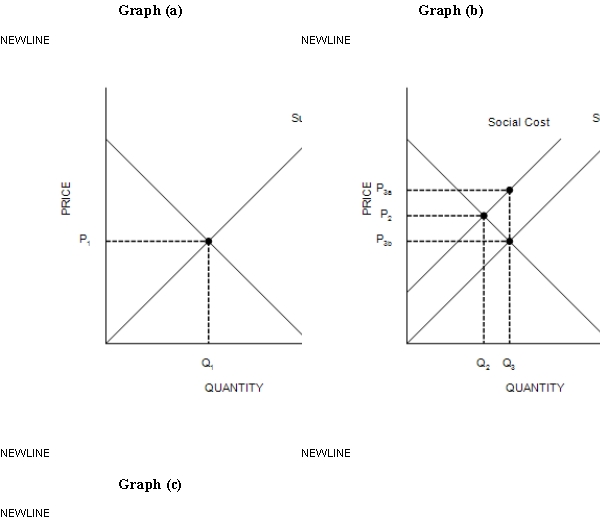 -Refer to Figure 10-4. The overuse of antibiotics leads to the development of antibiotic-resistant diseases. Therefore, the market for antibiotics is shown in
 (Multiple Choice)
4.9/5 (90)
(90) If the government were to limit the release of air pollution produced by a glue factory to 75 parts per million, the policy would be considered a
(Multiple Choice)
4.8/5 (82)
(82) Flu shots provide a positive externality. Suppose that the market for vaccinations is perfectly competitive. Without government intervention in the vaccination market, which of the following statements is correct?
(Multiple Choice)
4.7/5 (83)
(83) When we identify public policies toward externalities, we contrast command-and-control policies with what other type of policies?
(Essay)
4.8/5 (82)
(82) The Environmental Protection Agency (EPA) requires that firms in a certain industry adopt a particular technology to reduce the emission of pollutants. Is this requirement a command- and-control policy or is it a market-based policy?
(Essay)
4.8/5 (83)
(83) Scenario 10-3
Suppose the equation for the demand curve in a market is P = 120 - (1/5) QD , where QD is the quantity demanded and is the price. Also, suppose the equation for the supply curve in the same market is P = (1/10) QS , where QS is the quantity supplied.
-Refer to Scenario 10-3. Suppose there is an external cost of $12 associated with the production of each unit of the good. What are the socially optimal quantity and price?
(Essay)
4.9/5 (67)
(67) Suppose the government levies a corrective tax on firms that pollute in order to limit the quantity of pollution. Under this policy, does the demand curve for pollution rights determine the quantity of pollution, or does it determine the price of pollution?
(Essay)
4.9/5 (85)
(85) Sabrina installed a wooden sculpture in her front yard. A negative externality arises if the sculpture
(Multiple Choice)
4.8/5 (80)
(80) In which of the following cases is the Coase theorem most likely to solve the externality?
(Multiple Choice)
4.7/5 (80)
(80) When externalities are present, reaching an efficient outcome is especially difficult when the number of interested parties is large.
(True/False)
4.9/5 (82)
(82) Corrective taxes are more efficient than regulations for keeping the environment clean.
(True/False)
4.7/5 (86)
(86) Dioxin emission that results from the production of paper is a good example of a negative externality because
(Multiple Choice)
4.9/5 (78)
(78) A congestion toll imposed on a highway driver to force the driver to take into account the increase in travel time she imposes on all other drivers is an example of internalizing the externality.
(True/False)
5.0/5 (85)
(85) 
Filters
- Essay(0)
- Multiple Choice(0)
- Short Answer(0)
- True False(0)
- Matching(0)