



 Chat with AI
Exam 10: Externalities

Exam 1: Ten Principles of Economics220 Questions
Exam 2: Thinking Like an Economist284 Questions
Exam 3: Interdependence and the Gains From Trade192 Questions
Exam 4: The Market Forces of Supply and Demand277 Questions
Exam 5: Elasticity and Its Application222 Questions
Exam 6: Supply, Demand, and Government Policies321 Questions
Exam 7: Consumers, Producers, and the Efficiency of Markets218 Questions
Exam 8: Applications: The Costs of Taxation203 Questions
Exam 9: Application: International Trade214 Questions
Exam 10: Externalities204 Questions
Exam 11: Public Goods and Common Resources182 Questions
Exam 12: The Design of the Tax System225 Questions
Exam 13: The Costs of Production261 Questions
Exam 14: Firms in Competitive Markets243 Questions
Exam 15: Monopoly231 Questions
Exam 16: Monopolistic Competition246 Questions
Exam 17: Oligopoly204 Questions
Exam 18: The Markets for the Factors of Production232 Questions
Exam 19: Earnings and Discrimination230 Questions
Exam 20: Income Inequality and Poverty194 Questions
Exam 21: The Theory of Consumer Choice209 Questions
Exam 22: Frontiers in Microeconomics185 Questions
Exam 23: Measuring a Nations Income231 Questions
Exam 24: Measuring the Cost of Living214 Questions
Exam 25: Production and Growth187 Questions
Exam 26: Saving, Investment, and the Financial System225 Questions
Exam 27: Tools of Finance198 Questions
Exam 28: Unemployment and Its Natural Rate361 Questions
Exam 29: The Monetary System210 Questions
Exam 30: Money Growth and Inflation201 Questions
Exam 31: Open-Economy Macroeconomics: Basic Concepts194 Questions
Exam 32: A Macroeconomic Theory of the Open Economy188 Questions
Exam 33: Aggregate Demand and Aggregate Supply189 Questions
Exam 34: The Influence of Monetary and Fiscal Policy on Aggregate Demand207 Questions
Exam 35: The Short-Run Tradeoff Between Inflation and Unemployment223 Questions
Exam 36: Six Debates Over Macroeconomic Policy154 Questions
Select questions type


To produce honey, beekeepers place hives of bees in the fields of farmers. As bees gather nectar, they pollinate the crops in the fields, which increases the yields of these fields at no additional cost to the farmer. What might be a reasonable private solution to this externality, and how might the solution be reached?
(Essay)
5.0/5  (71)
(71) Scenario 10-1
The demand curve for gasoline slopes downward and the supply curve for gasoline slopes upward. The production of the 400th gallon of gasoline entails the following:
a private cost of $2.83;
a social cost of $3.12;
a value to consumers of $3.23.
-Refer to Scenario 10-1. Let Q represent the number of gallons of gasoline and let P represent the price of a gallon of gasoline. Which of the following statements is correct?
(Multiple Choice)
5.0/5 (79)
(79) In a market with positive externalities, the market equilibrium quantity maximizes the welfare of society as a whole.
(True/False)
4.9/5 (79)
(79) Use a graph to illustrate the quantity of pollution that would be emitted (a) after a corrective tax has been imposed and (b) after tradable pollution permits have been imposed. Could these two quantities ever be equivalent?
(Short Answer)
4.8/5 (74)
(74) Suppose that Company A's railroad cars pass through Farmer B's corn fields. The railroad causes an externality to the farmer because the railroad cars emit sparks that cause $1,500 in damage to the farmer's crops. There is a special soy-based grease that the railroad could purchase that would eliminate the damaging sparks. The grease costs $1,200. Suppose that the farmer has the right to compensation for any damage that his crops suffer. Assume that there are no transaction costs. Which of the following characterizes the efficient outcome?
(Multiple Choice)
5.0/5 (96)
(96) Assume each college degree that is granted conveys an external benefit of $3,500. The granting of the 500th college degree entails a private cost of $15,000 and a private value of $25,000. What is the social value of the 500th college degree?
(Essay)
4.9/5 (85)
(85) Figure 10-3 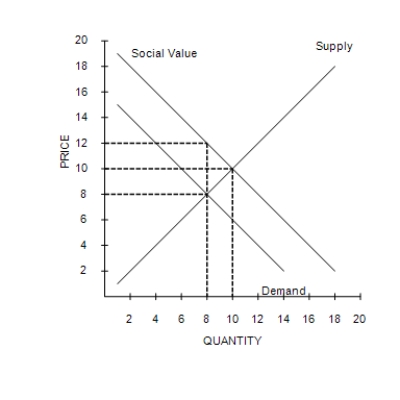 -Refer to Figure 10-3. What is the equilibrium price in this market?
 (Multiple Choice)
4.8/5 (78)
(78) Barking dogs cannot be considered an externality because externalities must be associated with some form of market exchange.
(True/False)
5.0/5 (60)
(60) Figure 10-4
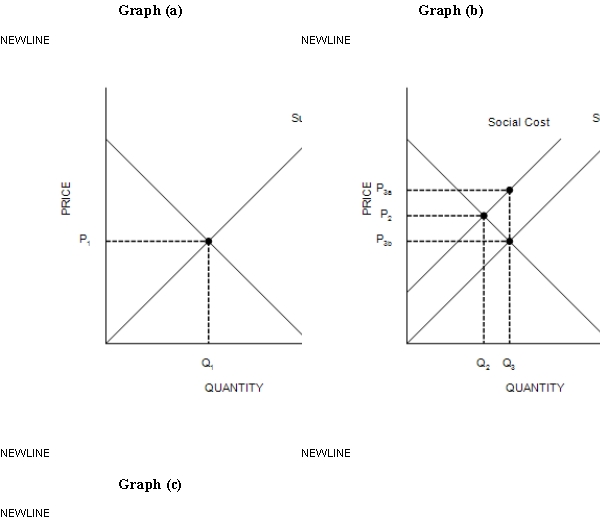 -Refer to Figure 10-4, Graph (b) and Graph (c). The installation of a scrubber in a smokestack reduces the emission of harmful chemicals from the smokestack. Therefore, the socially optimal quantity of smokestack scrubbers is represented by point
 (Multiple Choice)
4.8/5 (80)
(80) The government can internalize externalities by taxing goods that have negative externalities and subsidizing goods that have positive externalities.
(True/False)
4.9/5 (70)
(70) Table 10-3
Quantity (Units) Private Value (Dollars) Private Cost (Dollars) External Benefit (Dollars) 1 22 12 10 2 20 15 10 3 18 18 10 4 16 21 10 5 14 24 10 6 12 27 10
-Refer to Table 10-3. The socially optimal quantity of output is
(Multiple Choice)
4.8/5 (75)
(75) Sheryl sits on her patio and plays her guitar while her neighbors are outside. Sheryl neither pays nor receives any compensation for playing her guitar. Under what condition does her guitar-playing give rise to a positive externality?
(Essay)
4.8/5 (85)
(85) Firms that can reduce pollution easily would be willing to sell their pollution permits.
(True/False)
4.9/5 (74)
(74) According to the Coase theorem, the private market will need government intervention in order to reach an efficient outcome.
(True/False)
4.9/5 (71)
(71) According to the Coase theorem, if private parties can bargain without cost, then the private market will solve the problem of externalities.
(True/False)
4.9/5 (83)
(83) Figure 10-5 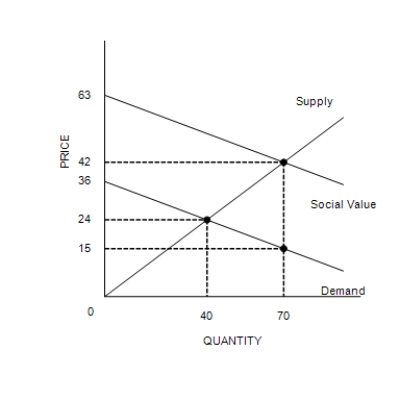 -Refer to Figure 10-5. A benevolent social planner would prefer
 (Multiple Choice)
4.8/5 (87)
(87) Suppose a certain good provides an external benefit. If the private cost of the last unit of the good that was produced is equal to the social value of that unit, then the sum of producer and consumer surplus is maximized.
(True/False)
4.9/5 (79)
(79) Organizers of an outdoor concert in a park surrounded by residential neighborhoods are likely to consider the noise and traffic cost to residential neighborhoods when they assess the financial viability of the concert venture.
(True/False)
4.8/5 (74)
(74) If the production of computer chips yields greater technology spillovers than the production of potato chips, the government should
(Multiple Choice)
4.9/5 (82)
(82) 
Filters
- Essay(0)
- Multiple Choice(0)
- Short Answer(0)
- True False(0)
- Matching(0)