



 Chat with AI
Exam 3: Interdependence and the Gains From Trade

Exam 1: Ten Principles of Economics220 Questions
Exam 2: Thinking Like an Economist284 Questions
Exam 3: Interdependence and the Gains From Trade192 Questions
Exam 4: The Market Forces of Supply and Demand277 Questions
Exam 5: Elasticity and Its Application222 Questions
Exam 6: Supply, Demand, and Government Policies321 Questions
Exam 7: Consumers, Producers, and the Efficiency of Markets218 Questions
Exam 8: Applications: The Costs of Taxation203 Questions
Exam 9: Application: International Trade214 Questions
Exam 10: Externalities204 Questions
Exam 11: Public Goods and Common Resources182 Questions
Exam 12: The Design of the Tax System225 Questions
Exam 13: The Costs of Production261 Questions
Exam 14: Firms in Competitive Markets243 Questions
Exam 15: Monopoly231 Questions
Exam 16: Monopolistic Competition246 Questions
Exam 17: Oligopoly204 Questions
Exam 18: The Markets for the Factors of Production232 Questions
Exam 19: Earnings and Discrimination230 Questions
Exam 20: Income Inequality and Poverty194 Questions
Exam 21: The Theory of Consumer Choice209 Questions
Exam 22: Frontiers in Microeconomics185 Questions
Exam 23: Measuring a Nations Income231 Questions
Exam 24: Measuring the Cost of Living214 Questions
Exam 25: Production and Growth187 Questions
Exam 26: Saving, Investment, and the Financial System225 Questions
Exam 27: Tools of Finance198 Questions
Exam 28: Unemployment and Its Natural Rate361 Questions
Exam 29: The Monetary System210 Questions
Exam 30: Money Growth and Inflation201 Questions
Exam 31: Open-Economy Macroeconomics: Basic Concepts194 Questions
Exam 32: A Macroeconomic Theory of the Open Economy188 Questions
Exam 33: Aggregate Demand and Aggregate Supply189 Questions
Exam 34: The Influence of Monetary and Fiscal Policy on Aggregate Demand207 Questions
Exam 35: The Short-Run Tradeoff Between Inflation and Unemployment223 Questions
Exam 36: Six Debates Over Macroeconomic Policy154 Questions
Select questions type


Consider two individuals, Jarek and Danuta each of whom knits sweaters and makes hamburgers, respectively. The gains from trade between Jarek and Danuta are most obvious in which of the following cases?

Free
(Multiple Choice)
4.8/5  (95)
(95) Correct Answer: Verified
D
Table 3-13
 -Refer to Table 3-13. What is England's opportunity cost of one radio?
Free
(Short Answer)
4.8/5 (91)
(91) Correct Answer:Verified
Verified0.25 compass.
Table 3-5
Assume that France and Portugal can switch between producing cheese and producing bread at a constant rate.
 -Refer to Table 3-5. Which of the following combinations of cheese and bread could Portugal produce in 24 hours?
Free
(Multiple Choice)
4.7/5 (79)
(79) Correct Answer:Verified
VerifiedA
Table 3-13
-Refer to Table 3-13. Which country has an absolute advantage in producing compasses?
-Refer to Table 3-13. Which country has an absolute advantage in producing compasses? (Short Answer)
4.8/5 (81)
(81) The production possibilities frontier (PPF) depicts the combinations of goods that provides society with the maximum possible benefit.
(True/False)
4.7/5 (91)
(91) A popular celebrity that is paid highly for her time should probably not mow her own lawn because
(Multiple Choice)
4.9/5 (92)
(92) A country can have a comparative advantage in the production of a good, even if it does not have an absolute advantage in the production of that good.
(True/False)
4.8/5 (62)
(62) A gardener has the ability to grow either apples or pears or some combination of the two. Given no other information, it follows that the gardener's opportunity cost of a pound of apples multiplied by his opportunity cost of a pound of pears
(Multiple Choice)
4.9/5 (89)
(89) Ellie and Brendan both produce apple pies and vanilla ice cream. If Ellie's opportunity cost of one apple pie is 1/2 gallon of ice cream and Brendan's opportunity cost of one apple pie is 1/4 gallon of ice cream, Ellie has a comparative advantage in the production of ice cream.
(True/False)
4.8/5 (76)
(76) Table 3-13
-Refer to Table 3-13. Which country has a comparative advantage in producing compasses?
-Refer to Table 3-13. Which country has a comparative advantage in producing compasses? (Short Answer)
4.7/5 (78)
(78) In an economy consisting of two people producing two goods, it is possible for one person to have the absolute advantage and the comparative advantage in both goods.
(True/False)
4.8/5 (78)
(78) If a country has a lower opportunity cost than its potential trading partner, the country should decide to be self-sufficient.
(True/False)
4.9/5 (74)
(74) When each person specializes in producing the good in which he or she has a comparative advantage, each person can gain from trade but total production in the economy is unchanged.
(True/False)
5.0/5 (85)
(85) Whenever a nation is producing on its PPF, that nation will be using all of its available resources.
(True/False)
4.8/5 (64)
(64) If Wrex can produce more math problems per hour and more book reports per hour than Maxine can, then Wrex cannot gain from trading math problems and book reports with Maxine.
(True/False)
4.9/5 (76)
(76) Opportunity cost measures the trade-off between two goods that each producer faces.
(True/False)
4.8/5 (84)
(84) Table 3-7
Barb and Ren run a business that sets up and tests computers. Assume that Barb and Ren can switch between setting up and testing computers at a constant rate. The following table applies.
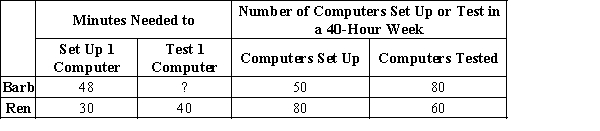 -Refer to Table 3-7. Which of the following points would not be on Barb's production possibilities frontier, based on a 40-hour week?
 (Multiple Choice)
4.9/5 (89)
(89) Trade can only benefit a nation if that nation has an absolute advantage in the production of that good.
(True/False)
4.8/5 (92)
(92) Ellie and Brendan both produce apple pies and vanilla ice cream. If Ellie's opportunity cost of one apple pie is 1/2 gallon of ice cream and Brendan's opportunity cost of one apple pie is 1/4 gallon of ice cream, a mutually advantageous trade can be struck at a price of one apple pie for 1/3 gallon of ice cream.
(True/False)
4.8/5 (85)
(85) 
Filters
- Essay(0)
- Multiple Choice(0)
- Short Answer(0)
- True False(0)
- Matching(0)